
Spellbook vs Callidus: Which Is The Top Pick in 2026?
.jpeg)


Deciding between Spellbook vs Callidus (StrongSuit) is a common challenge for legal teams looking to adopt AI for their contract workflows.
Spellbook is a complete AI suite built for commercial law that operates directly in Microsoft Word, focusing on helping lawyers draft and review contracts with greater speed and precision. Callidus also offers a Word-native assistant but positions itself as a generalist co-pilot with a unique multi-model approach.
To help you make an informed choice, this review breaks down the key differences in their product features, AI architecture, security, and pricing.
Key Takeaways
- Spellbook is an AI suite built specifically for commercial law, while Callidus is a generalist AI co-pilot for broader legal workflows. Both tools operate as Microsoft Word add-ins to help with contract review and drafting.
- Their primary difference is their approach to grounding AI outputs. Spellbook offers data-driven negotiation support with its unique Compare to Market feature, while Callidus provides citation-backed legal research through a partnership with CourtListener.
- Spellbook is the leading choice for commercial law, trusted by over 4,000 legal teams to draft and review contracts with greater speed and precision, apply review standards consistently, and negotiate with confidence using real-time market data.
1. Callidus
Callidus is a generalist AI co-pilot designed for a wide range of legal workflows, operating as a Microsoft Word add-in. It supports various tasks including contract review, clause drafting, and legal Q&A for both transactional and litigation needs.
The platform uses a multi-model system, routing queries to different AI models, and provides citation-backed legal research through a partnership with CourtListener. While this approach offers broad functionality, it positions Callidus as a flexible but less specialized tool. This is a key consideration in the Spellbook vs Callidus comparison, especially for teams focused purely on commercial contracts.
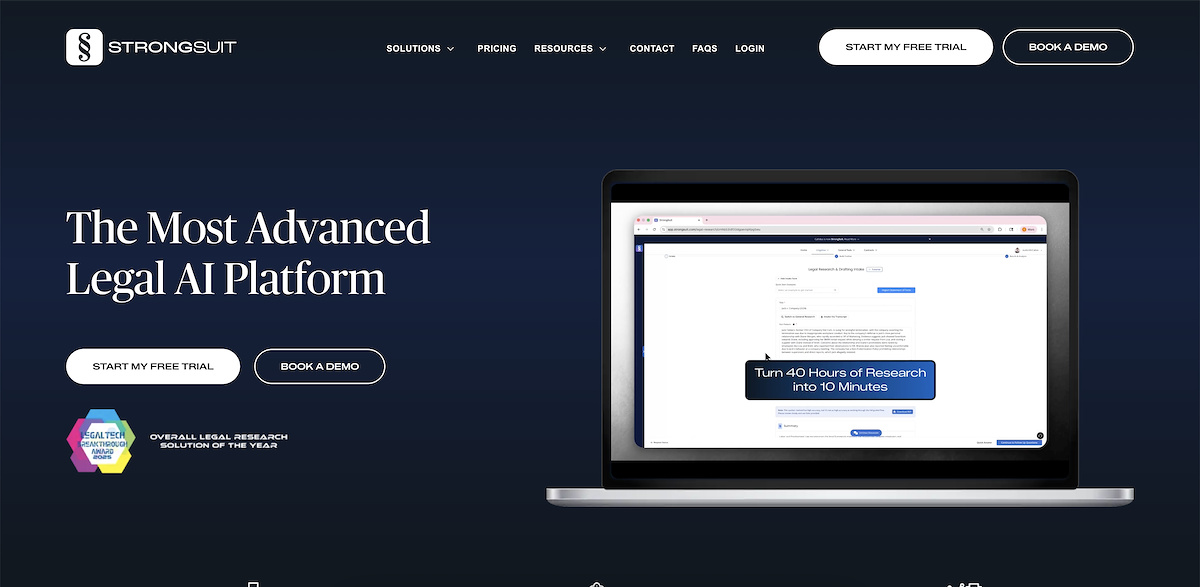
Callidus Features
Callidus provides a suite of tools within its Microsoft Word add-in, organized across several functional tabs.
- Negotiate: Analyzes contracts against user-uploaded playbooks and suggests redlines, categorizing issues by severity.
- Draft: Generates new clauses with an awareness of the existing document's context.
- Chat & Research: Answers legal questions with supporting citations through an exclusive partnership with CourtListener.
- Compare Contracts: Aligns third-party agreements with a firm’s internal templates.
Callidus Pricing
Callidus uses a straightforward, flat-rate pricing model with no hidden fees.
- $3,000 per user, per year.
- Includes unlimited usage, playbook uploads, and support.
- Discounts are available for larger teams.
- The company has indicated that prices are likely to increase following a planned rebrand.
Key Considerations about Callidus
While Callidus offers a broad feature set, there are several key points for legal teams to consider. The platform is positioned as a generalist AI co-pilot for a wide range of legal workflows, not a specialized tool built specifically for commercial law.
Its playbook functionality is also less developed than some alternatives, as it currently lacks the automatic fallback logic needed for strict enforcement of negotiation standards. This approach offers flexibility but may not suit teams that require rigid consistency.
The platform's partnership with CourtListener provides a unique research angle, but it does not offer data-driven negotiation support like Spellbook's Compare to Market feature. For teams weighing Spellbook vs Callidus, this distinction between a generalist research tool and a specialized, data-grounded contract suite is a critical factor.
2. Spellbook, The Smarter Alternative
Spellbook is an AI suite built specifically for commercial law that integrates directly into Microsoft Word. It helps legal teams draft and review contracts 10x faster and with greater precision, making it ideal for commercial lawyers focused on drafting, reviewing, and redlining agreements.
What sets Spellbook apart is that it is the only contract AI grounded in real-time market data. Its Review feature analyzes agreements against thousands of similar contracts, providing data-driven answers to "What's market?" This offers a distinct advantage for teams weighing Spellbook vs Callidus, grounding negotiations in objective evidence rather than subjective claims.
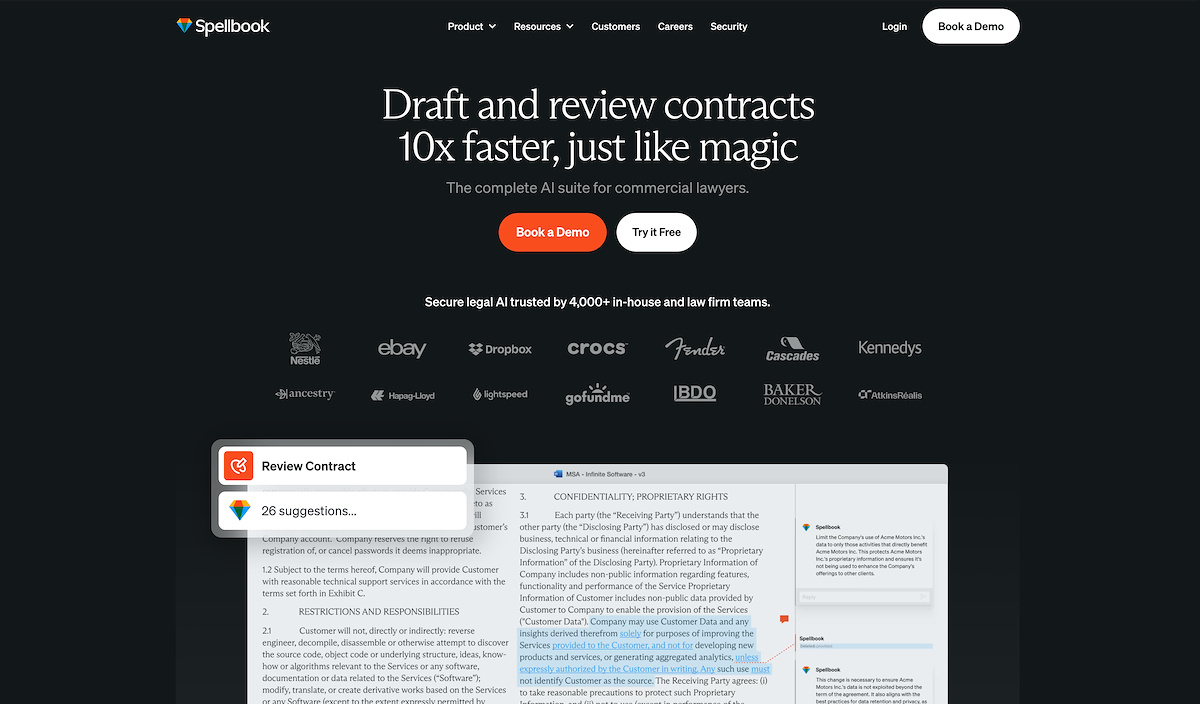
Spellbook Features
Spellbook’s features are organized around the core tasks of a commercial lawyer, operating directly within Microsoft Word to maintain familiar workflows. The platform is designed to improve both the speed and precision of contract work.
- Review: This feature provides an instant, document-wide analysis of any contract. It automatically generates redlines as track changes, identifies risks, and flags ambiguous language. It also integrates with customizable playbooks to ensure all agreements adhere to firm or client standards.
- Draft: Spellbook can generate new clauses or entire agreements from a simple instruction. It can also draw from a firm’s own precedent documents using Spellbook Library, automatically adapting the language to match the context and defined terms of the current agreement, such as an indemnification clause.
- Ask: This functions as a contract-specific Q&A tool. Lawyers can ask questions about the document they are working on and receive answers with direct citations to the relevant contract language, supporting quick validation.
- Compare to Market: A key differentiator in the Spellbook vs Callidus debate, this feature allows lawyers to benchmark contract terms against real-time data from thousands of similar agreements. It provides objective, data-driven answers to "What's market?" in a negotiation, a distinct advantage over tools that focus on general legal research.
- Associate: This is an AI agent that can execute complex, multi-document projects from a single prompt. It can cross-reference entire data rooms, prepare document packages from a term sheet, and manage other multi-step workflows that would typically be assigned to a junior associate.
Spellbook Pricing
Spellbook uses a custom per-seat pricing model determined by team size and feature requirements. All plans are structured as an annual subscription.
- Volume discounts are available for larger teams.
- All core features, onboarding, and support are included.
You can test the full platform and its features with a free 7-day trial.
Why Commercial Lawyers Love Spellbook
Unlike generalist AI co-pilots, Spellbook is built exclusively for the nuances of commercial law. While it operates entirely within Microsoft Word to keep lawyers in their existing workflows, its specialization is its greatest strength.
This focus allows for features that provide data-driven negotiation support, a critical factor in the Spellbook vs Callidus decision. It helps teams apply review standards with precision and negotiate from a position of strength, using objective market data instead of general legal research.
[cta-1]
Spellbook vs Callidus: Key Differences
1. Core Focus: Specialized Suite vs. Generalist Co-Pilot
The primary difference in the Spellbook vs Callidus comparison is their core focus. Spellbook is a complete AI suite built specifically for the nuances of commercial law, designed to help lawyers draft, review, and negotiate contracts with greater speed and precision.
Callidus, in contrast, is positioned as a generalist AI co-pilot for a broader range of legal workflows, supporting both transactional tasks and litigation research. This makes it a more flexible but less specialized tool.
2. Grounding AI: Market Data vs. Legal Research
How each platform grounds its AI outputs is a critical distinction. Spellbook is the only contract AI grounded in real-time market data. Its unique Compare to Market feature analyzes contract terms against thousands of similar agreements, providing data-driven answers to "What's market?" for stronger negotiation positions.
Callidus takes a different approach, grounding its AI in legal research through an exclusive partnership with CourtListener. This provides citation-backed answers to legal questions but does not offer the same objective, data-driven negotiation support found in Spellbook.
3. AI Architecture and Maturity
Spellbook uses leading AI models with deep legal-specific tuning and a proprietary "Market Grounding" system. The platform continuously improves through Preference Learning, adapting to user edits to deliver more personalized suggestions over time. Its maturity is reflected in its adoption by over 4,000 legal teams and its enterprise-grade security, including HIPAA compliance.
Callidus uses a multi-model orchestration layer to route tasks to different AI models. While this offers flexibility, the platform is a newer entrant and is still undergoing a rebrand to establish its market position. This difference in maturity is a key factor when evaluating Spellbook vs Callidus for long-term use.
Which Option Is Right For Your Business?
Choosing the right AI assistant depends on your team’s primary focus and daily workflows. Here’s how to decide in the Spellbook vs Callidus debate based on your specific needs.
For the Dedicated Commercial Law Team
Spellbook is the superior choice. Its exclusive focus on commercial law means its features are finely tuned for the specific demands of contract drafting, review, and negotiation.
This specialization leads to more accurate and contextually relevant support within your existing Word-based workflow, improving both speed and precision.
For the In-House Team with Diverse Needs
Callidus may be a better fit if your team handles a wide range of legal work beyond contracts, including litigation research. Its generalist design provides flexibility across different legal domains.
The platform's straightforward pricing and ability to assist with legal Q&A make it a versatile option for teams that require a multi-purpose tool.
For the High-Volume Transactional Practice
Spellbook is the recommended tool. It is built to handle a high volume of agreements, helping teams work faster while maintaining strict quality and consistency.
Its ability to ground negotiations in objective data gives lawyers a distinct advantage, and its enterprise-grade security is built for firm-wide adoption.
The Bottom Line: Your decision on Spellbook vs Callidus comes down to specialization. For legal teams focused squarely on commercial contracts, Spellbook offers a more powerful, precise, and data-driven tool. For teams needing a generalist assistant for varied legal tasks, Callidus provides broader functionality.
Try Spellbook Free
For legal teams focused on commercial contracts, Spellbook provides a more precise, data-driven tool than generalist alternatives. See how its market data and specialized features can support your negotiations by starting a free 7-day trial today.
Frequently Asked Questions
How do Spellbook and Callidus handle data security and client confidentiality?
Data security is a critical factor for any legal technology. Spellbook is built with enterprise-grade security, including SOC 2 Type II compliance and options for private cloud hosting. This ensures that all client data remains confidential and is never used to train public AI models.
Spellbook's security measures are designed to meet the strict requirements of large legal teams and corporations. While Callidus also takes security seriously, Spellbook’s established enterprise-readiness provides a clear framework for firms wondering is ChatGPT private and handling other sensitive information.
What AI models do Spellbook and Callidus use?
Both platforms use advanced large language models, but their strategies differ. Spellbook uses leading models that are heavily fine-tuned for the specific language and structure of commercial contracts. This specialized training improves the relevance and precision of its outputs for legal work.
Callidus employs a multi-model system, which routes prompts to different generalist AI models, such as Gemini for lawyers, based on the task. This approach offers flexibility for a wide range of legal queries but may not provide the same level of specialized performance for contract negotiation as Spellbook's fine-tuned system.
How does Spellbook ensure its AI suggestions are reliable for commercial law?
Spellbook ensures reliability through a combination of specialized AI, data-driven grounding, and user-in-the-loop verification. The AI is not a generalist; it is specifically trained on legal datasets, which allows it to understand the nuances of commercial agreements and generate contextually appropriate language for clauses like limitation of liability.
Furthermore, its suggestions are grounded in objective data through the Compare to Market feature, which benchmarks terms against thousands of real contracts. This provides a layer of validation that goes beyond a standard AI model. Features like Ask also cite the exact source of information within the document, allowing lawyers to quickly verify answers and maintain full control over the final work product.
[cta-2]
Our Research Methodology
This comparison is based on comprehensive research of publicly available information, including product websites, feature documentation, press releases, customer reviews, legal technology publications, and third-party analyses from sources like LawSites, Artificial Lawyer, and industry analysts.
Where pricing information is not publicly disclosed, we've included estimates based on available industry data and user reports. Information is current as of 2026 and may change as products evolve. We encourage readers to verify details directly with vendors and request demos to evaluate fit for their specific needs.
Lawyer-built prompts to help you draft, review, and negotiate contracts faster—with any LLM.
Get the latest news, trends, and tactics in legal Al—straight to your inbox.


Thank you for your interest! Our team will reach out to further understand your use case.
Spellbook is the most complete AI suite for commercial legal work, trusted by more than 4,000 in-house teams and law firms worldwide.

SOC 2 Type II

HIPAA

GDPR

EU AI Act

HIPAA Compliant
