
Spellbook vs GC AI: Which Is The Top Pick in 2026?
.jpeg)


Choosing between Spellbook vs GC AI is a critical decision for legal teams looking to integrate AI into their contract workflows. Spellbook is an AI suite built directly into Microsoft Word, designed to help lawyers draft and review contracts with greater speed and precision. To help you make an informed choice, this review breaks down how each platform performs on key metrics, including detailed product analysis, pricing, and AI architecture.
Key Takeaways
- Both Spellbook and GC AI are legal AI platforms designed to assist with contract workflows. Spellbook operates as an AI suite directly within Microsoft Word, while GC AI offers a dual interface with a web application for research and a Word add-in for review.
- The main difference in the Spellbook vs GC AI comparison lies in their core focus. GC AI provides a unified workspace for research and contract review, while Spellbook specializes in accelerating contract drafting and negotiation directly in Word, supported by unique features like real-time market data for benchmarking.
- Spellbook is the preferred choice for over 4,000 legal teams. They trust its specialized tools to draft, review, and negotiate contracts faster and with greater precision, using data-driven insights to confidently handle everything from standard agreements to complex negotiations.
1. GC AI
GC AI is a legal AI platform designed as a workspace for in-house legal teams. It provides a dual interface: a web application for research and analysis, and a separate Microsoft Word add-in for contract review and redlining. This approach attempts to combine research workflows with practical document editing. While it offers broad functionality, this split focus differs from Spellbook's singular integration within Microsoft Word, which is built for uninterrupted contract drafting and negotiation.
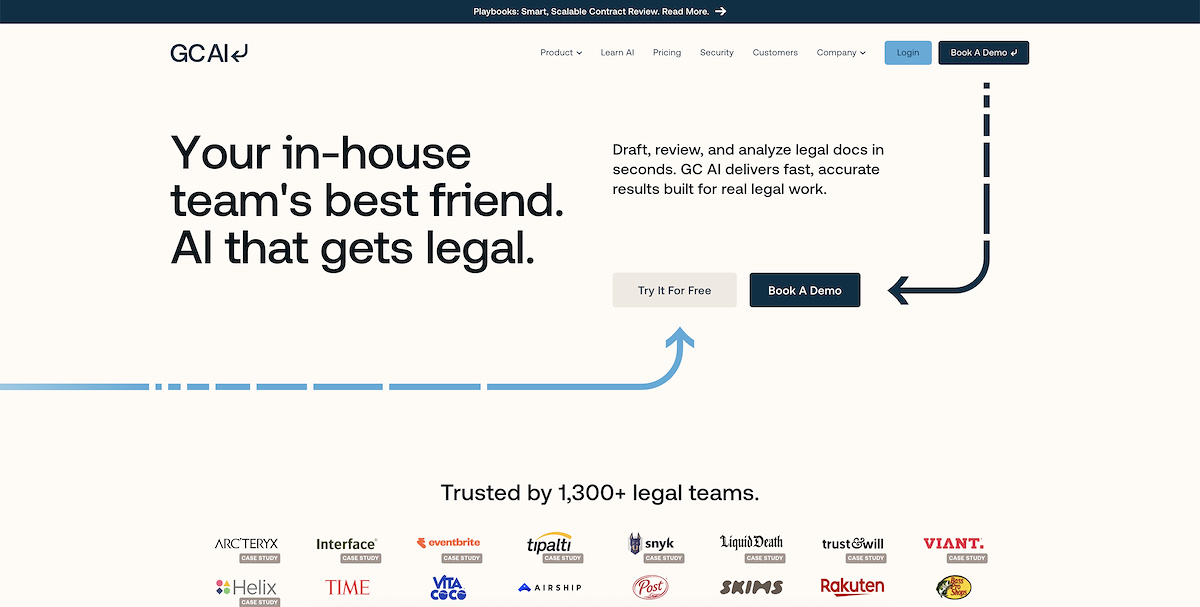
GC AI Features
GC AI offers a platform split between two main interfaces. Its features are designed to create a central workspace for legal teams.
- A web application for legal research and analysis with citation support.
- A Microsoft Word add-in for in-document contract review and redlining.
- Customizable playbooks to standardize review against internal policies.
- Shared prompts and knowledge bases to support team collaboration.
- Analysis tools for reviewing multiple documents at once.
GC AI Pricing
GC AI’s pricing is structured in two main tiers, with costs calculated on an annual, per-user basis.
- Solo Plan: $5,000 per user, per year.
- Team Plan: $7,000 per user, per year, which adds SSO and collaboration tools.
- Volume discounts are available for teams with 10 or more users.
Key Considerations about GC AI
When evaluating Spellbook vs GC AI, teams should note GC AI's dual-interface model. Splitting work between a web app and a Word add-in can interrupt a lawyer's workflow, forcing context switches that a fully integrated tool avoids.
While GC AI aims to be a unified workspace, its broad focus on both research and contract review may not provide the specialized depth needed for complex drafting and negotiation. This is a critical factor for teams deciding between Spellbook vs GC AI, as a dedicated tool often delivers more refined performance.
Finally, the platform's pricing places it at the higher end of the market, which could be a significant consideration for legal departments managing tight budgets.
2. Spellbook, The Smarter Alternative
Spellbook is an AI suite for commercial law that operates entirely within Microsoft Word. This integration helps legal teams draft and review contracts 10x faster and with greater precision, eliminating the context switching required by tools with separate web and document interfaces.
A key differentiator in the Spellbook vs GC AI comparison is its use of real-time market data. Spellbook's Review feature analyzes agreements against thousands of live benchmarks, providing data-driven answers to "What's market?" during negotiations. This focus on data-backed contract execution is trusted by over 4,000 legal teams.
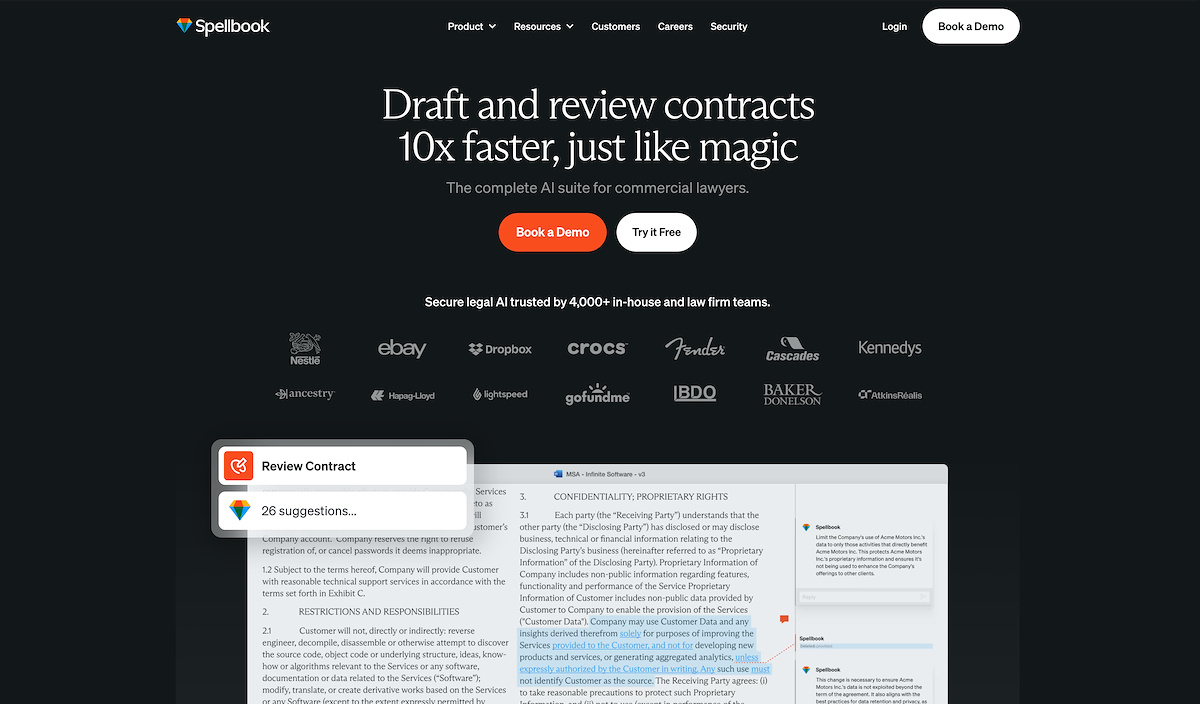
Spellbook Features
Spellbook's features are all built to operate directly within Microsoft Word. This integrated approach is a significant point of difference in the Spellbook vs GC AI comparison, as it keeps lawyers focused within a single application rather than switching between different interfaces.
- Review: This feature provides an instant, document-wide analysis of contracts. It automatically generates redlines to flag risks, suggest improvements, and identify missing clauses, with all edits appearing as standard track changes.
- Draft: Lawyers can generate new clauses or entire agreements from a simple instruction. The tool can pull from a built-in library of standard provisions or a firm’s own precedent documents, automatically adapting language to match the context of the current agreement.
- Ask: This functions as a contract-specific Q&A tool. It allows lawyers to ask questions about the open document and receive answers with direct citations to the relevant contract language for quick verification.
- Compare to Market: A unique feature that allows users to benchmark any contract against real-time market data from thousands of similar agreements. It provides data-driven answers on whether a term is standard, helping lawyers verify positions and negotiate with statistical evidence.
- Associate: An AI agent that can execute multi-document, multi-step projects from a single prompt. It can handle tasks like cross-referencing document sets, preparing full document packages from a term sheet, or reviewing a data room for due diligence.
Spellbook Pricing
Spellbook offers custom per-seat pricing based on team size, with plans billed annually. All features, training, and support are included in every plan.
- Pricing is provided via a custom quote after a demo.
- Volume discounts are available for teams of 10 or more.
You can see how Spellbook works for your team by starting a free trial.
Why Commercial Lawyers Love Spellbook
Unlike legal AI workspaces that divide attention between a web app and a document add-in, Spellbook is built to live entirely within Microsoft Word. While its functionality is centered in Word, this dedicated approach is intentional, keeping lawyers focused in their primary drafting environment without disruptive context switching.
This singular focus allows for more refined tools that improve both the speed and precision of contract work. For instance, the ability to benchmark specific terms, like a limitation of liability clause, against real-time market data gives lawyers a data-backed advantage in negotiations. It’s a practical tool designed for the specific realities of commercial law.
[cta-1]
Spellbook vs GC AI: Key Differences
The primary differences in the Spellbook vs GC AI comparison come down to workflow integration, core functionality, and data intelligence.
1. Workflow and Integration
Spellbook operates entirely within Microsoft Word, where lawyers already work. This integrated design eliminates the context switching required by tools with separate web and document interfaces, allowing for uninterrupted focus on drafting and review.
GC AI, on the other hand, uses a dual-interface model. It splits workflows between a web application for research and a separate Word add-in for contract review, which can force lawyers to move between different environments to complete a single task.
2. Core Focus and Data Intelligence
Spellbook is a specialized AI suite built specifically for contracts and commercial law. Its features are designed to accelerate contract drafting and negotiation with greater precision.
A key differentiator is that Spellbook is the only contract AI grounded in real-time market data. Its Review feature analyzes contracts against thousands of live benchmarks, giving lawyers data-driven answers for negotiations.
GC AI has a broader focus, aiming to be a unified workspace for both research and contract review. While its research function provides citations, it lacks the specialized, data-backed negotiation intelligence that defines the Spellbook experience. This makes the Spellbook vs GC AI decision critical for teams that prioritize data-driven negotiation.
Which Option Is Right For Your Business?
For Teams Focused on Contract Velocity
Spellbook is the better choice. Its complete integration within Microsoft Word means lawyers can work without interruption.
This focused environment is built to accelerate drafting and review, making it ideal for teams that handle a high volume of agreements and prioritize efficiency.
For Lawyers Who Need a Negotiating Edge
Spellbook has the advantage. Its specialization in commercial law provides more refined analysis for complex agreements, like those with detailed indemnification clauses.
The platform's data intelligence offers a factual basis for negotiation, moving discussions beyond opinion to market-backed positions.
For Teams Needing a Broad Research and Review Tool
GC AI may be a suitable fit. Its dual-interface model is designed for teams that frequently switch between deep legal research and document review.
If your workflow involves extensive analysis in a web environment before moving to Word, GC AI’s structure supports that separation of tasks.
The Bottom Line
Your decision in the Spellbook vs GC AI debate depends on your primary need. GC AI offers a generalist workspace for research and review, while Spellbook provides a specialized, fully integrated tool for lawyers who live in their contracts.
For most commercial legal teams, Spellbook’s focused approach delivers superior speed and precision directly where it matters most: in Microsoft Word.
Try Spellbook Free
Spellbook stands apart from generalist platforms by delivering specialized AI tools directly within Microsoft Word, helping you work with greater speed and precision. Its unique ability to benchmark contracts against real-time market data gives you a factual edge in any negotiation. See how this focused approach can benefit your team by starting a free trial.
Frequently Asked Questions
What AI models do Spellbook and GC AI use?
Both platforms are built on large language models (LLMs), but their approach to using this technology differs. The specific models used by GC AI are proprietary to their platform.
Spellbook, in contrast, uses a combination of top-performing models, including those from OpenAI and Anthropic. This multi-model approach allows Spellbook to select the best AI for a specific legal task. Furthermore, these models are fine-tuned on a massive, curated dataset of legal documents, which improves their ability to generate precise and contextually appropriate contract language for lawyers using AI.
How do Spellbook and GC AI handle data security and confidentiality?
Data security is a critical consideration for any legal AI tool. Legal teams must ensure that confidential client information remains protected.
Spellbook addresses this with a zero-retention policy, meaning your contract data is never stored by its LLM providers or used to train their public models. The platform is also SOC 2 Type II compliant, confirming its commitment to high security standards. This is an important factor for teams concerned about whether AI is private.
GC AI also has security protocols in place, but teams should review their specific data handling and retention policies to ensure they align with firm and client requirements.
What is the implementation process like for each platform?
The implementation process reflects the core design of each tool. For Spellbook, adoption is typically quick because it functions as a simple add-in within Microsoft Word.
Since lawyers do not have to leave their primary drafting environment, the learning curve is minimal. Spellbook also includes training and support in all plans to facilitate a smooth transition for the entire team.
GC AI's implementation involves two components: the Word add-in and the separate web application. This may require more training as teams need to learn how to navigate and integrate both interfaces into their existing contract and research workflows.
How does Spellbook ensure its AI-generated suggestions are accurate and reliable for legal work?
Spellbook’s reliability is rooted in its specialized focus on commercial law. The platform’s AI models are not general-purpose; they are fine-tuned on a vast corpus of legal agreements, which helps them understand the nuances of contract language with high precision.
Beyond text generation, Spellbook provides data-backed validation. Features like Compare to Market analyze clauses against thousands of real-world examples to determine what is standard. This gives lawyers a factual basis for their decisions, whether they are drafting a confidentiality clause or negotiating payment terms.
[cta-2]
Our Research Methodology
This comparison is based on comprehensive research of publicly available information, including product websites, feature documentation, press releases, customer reviews, legal technology publications, and third-party analyses from sources like LawSites, Artificial Lawyer, and industry analysts.
Where pricing information is not publicly disclosed, we've included estimates based on available industry data and user reports. Information is current as of 2026 and may change as products evolve. We encourage readers to verify details directly with vendors and request demos to evaluate fit for their specific needs.
Lawyer-built prompts to help you draft, review, and negotiate contracts faster—with any LLM.
Get the latest news, trends, and tactics in legal Al—straight to your inbox.


Thank you for your interest! Our team will reach out to further understand your use case.
Spellbook is the most complete AI suite for commercial legal work, trusted by more than 4,000 in-house teams and law firms worldwide.

SOC 2 Type II

HIPAA

GDPR

EU AI Act

HIPAA Compliant
