
CoCounsel vs Harvey: Which Is The Top Pick in 2026?
.jpeg)


Choosing between CoCounsel vs Harvey for your legal AI needs often comes down to a choice between a research-backed ecosystem and a platform for large-scale collaborative analysis. To help you decide, this review breaks down their core features, pricing models, and underlying technology. We'll explore how each tool fits into daily legal work, helping you find the right fit for your team's specific contract drafting and review workflows.
Key Takeaways
- CoCounsel and Harvey are legal AI platforms for enterprise teams. CoCounsel is built for research-backed workflows using Thomson Reuters content, while Harvey is designed for large-scale collaborative analysis and diligence projects.
- The primary difference in the CoCounsel vs Harvey matchup is their approach. CoCounsel grounds its outputs in proprietary legal content for research-heavy tasks, while Harvey provides a configurable environment for team-based diligence and managing complex legal processes.
- Alternatively, Spellbook is a legal AI suite trusted by over 4,000 legal teams to draft and review contracts with greater speed and precision. It operates directly in Microsoft Word and is the only tool that provides real-time market benchmarks to support data-driven negotiations.
1. CoCounsel
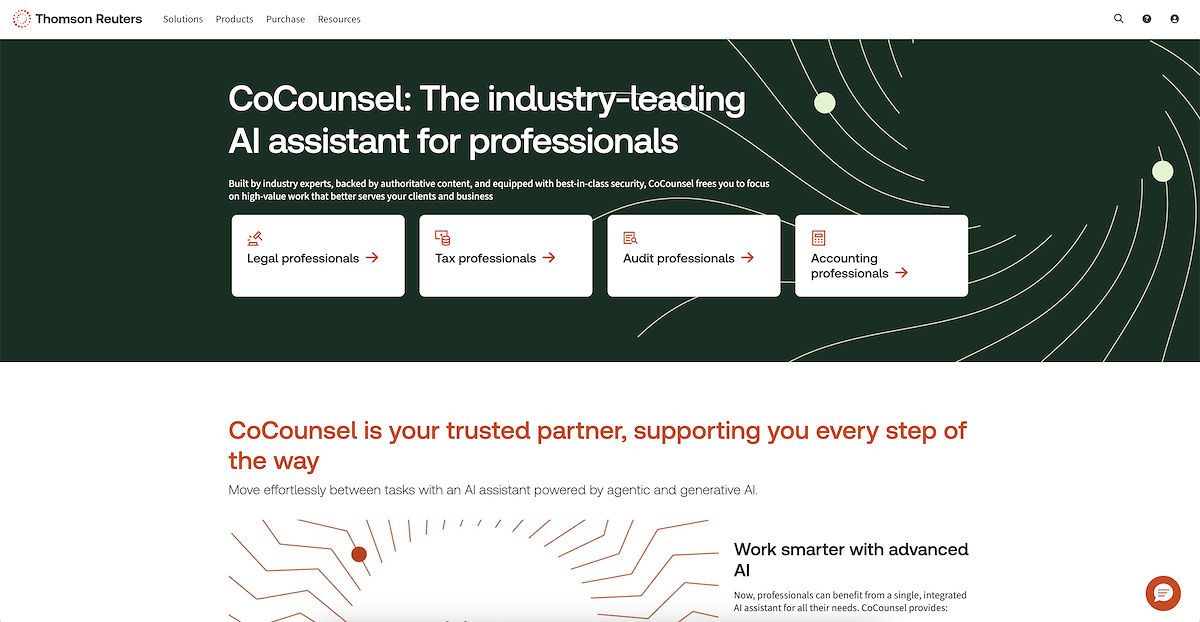
CoCounsel is an AI legal workflow platform from Thomson Reuters that combines AI tools for document work with an optional research layer powered by Westlaw and Practical Law. It supports tasks like drafting, redlining, and analysis through both a Microsoft Word add-in and a separate web portal. Unlike Harvey's focus on collaborative analysis, CoCounsel's main value is its connection to proprietary legal content. However, its most powerful features depend on access to these separate, costly subscriptions, which can fragment the user workflow between different interfaces.
CoCounsel Features
- Word Add-in: For in-document drafting, redlining, and applying playbooks.
- Standalone Portal: A separate web interface for document storage and multi-document analysis.
- Playbooks: Allows teams to check agreements against their own internal standards.
- Multi-Document Analysis: Supports running structured queries across large volumes of agreements.
- Optional Research Layer: Integrates with Westlaw and Practical Law for citation-backed answers.
CoCounsel Pricing
CoCounsel uses a tiered, per-user pricing model billed annually. Costs increase significantly based on the level of access to Thomson Reuters' proprietary content, such as Practical Law and Westlaw. This structure places it at the higher end of the market, especially when compared to tools that do not bundle extensive legal research databases. A 30-day trial is available, but all uploaded documents are deleted at the end of the period.
Key Considerations about CoCounsel
A key drawback of CoCounsel is its fragmented workflow. Users must switch between the Word add-in for drafting and a separate web portal for multi-document analysis. The platform's most valuable features, which ground answers in authoritative content to avoid issues like AI-generated fake citations, depend on expensive, separate subscriptions to Westlaw and Practical Law. Without these add-ons, CoCounsel functions primarily as a playbook and document analysis tool, which may not justify its premium price for all teams. This makes the CoCounsel vs Harvey decision more complex for those prioritizing a unified workflow.
2. Harvey
Harvey is a legal AI platform built for large-scale analysis and collaborative projects, targeting enterprise legal teams and large law firms. It provides a shared environment for managing complex diligence and transactional workflows across large document sets. Unlike CoCounsel's focus on integrating with proprietary research content, Harvey is designed as a configurable workspace for team-based analysis. This makes it more of a system for legal operations rather than a simple drafting assistant, which can introduce additional setup and management overhead.

Harvey Features
- Vault: A repository for analyzing up to 100,000 documents at once.
- Workflows: Configurable, multi-step processes to standardize legal tasks.
- AI Assistant: A prompt-based interface for legal questions and drafting.
- Collaboration Tools: Shared workspaces with permission controls for team projects.
- Word Add-in: Supports in-document editing and analysis.
Harvey Pricing
Harvey uses an enterprise subscription model with pricing negotiated based on team size. A two-week pilot is part of its standard evaluation process.
- Annual Subscriptions: Pricing is quoted per year.
- Indicative Cost: Approximately $40,000 annually for 10 users.
Key Considerations about Harvey
While Harvey is built for large-scale analysis, its flexibility can introduce significant overhead. The platform requires considerable setup to configure its workspaces and workflows, making it less ideal for teams looking for a tool that works for rapid review right away.
Harvey is positioned as a system for legal operations, which may be excessive for teams focused on accelerating contract drafting and redlining. Its architecture is geared toward complex, collaborative diligence projects rather than the high-velocity transactional work common in many commercial practices. This makes the CoCounsel vs Harvey choice difficult for teams prioritizing speed in their existing Word-based workflows.
3. Spellbook, The Smarter Alternative
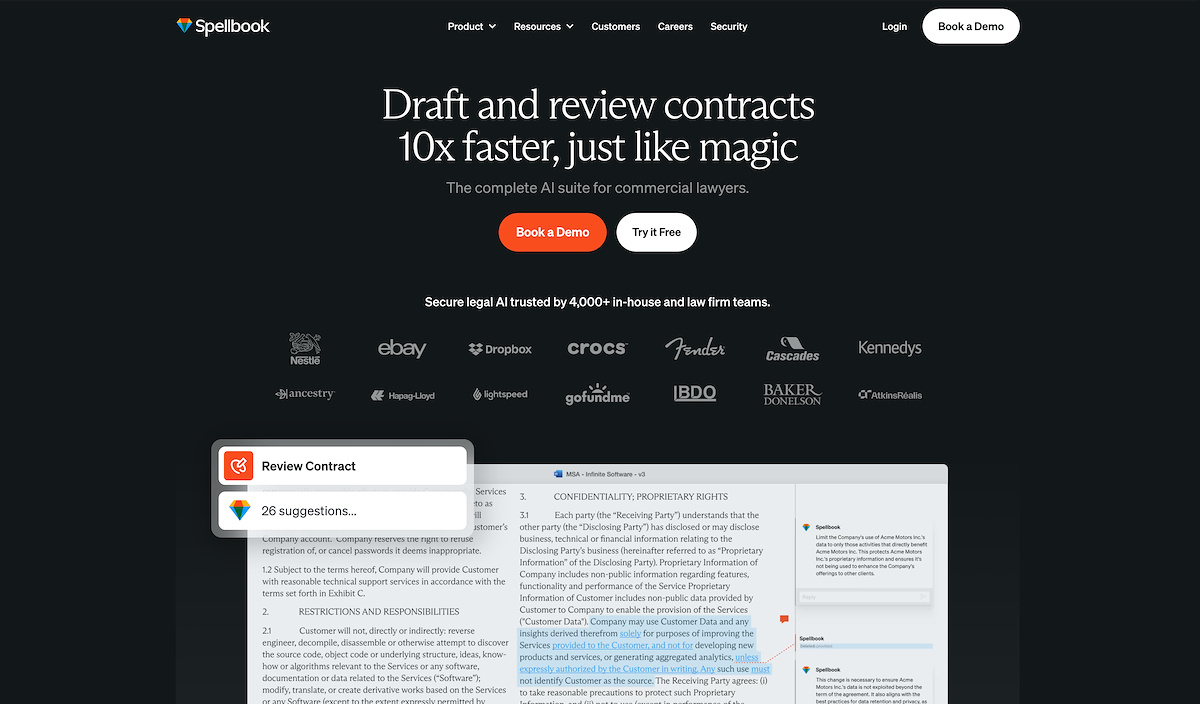
For teams looking for an alternative to CoCounsel and Harvey, Spellbook is a complete AI suite built specifically for contracts and commercial law. It integrates directly into Microsoft Word, where lawyers already work, helping legal teams draft and review contracts with greater speed and precision.
Spellbook is also the only contract AI grounded in real-time market data. Its Review feature analyzes contracts against live benchmarks from thousands of similar agreements, giving lawyers data-driven answers to "What's market?" in every negotiation. Today, more than 4,000 legal teams—including those at Dropbox, Fender, and Crocs—trust Spellbook for their contract workflows.
Spellbook Features
- Review: Instantly analyzes entire documents, suggesting redlines that appear as track changes. This allows lawyers to maintain full control over the final work product while quickly identifying risks and applying playbook standards.
- Draft: Generates new clauses or entire agreements from simple instructions. It can also search a firm’s historical contracts to find and adapt precedent language to the current document’s context and style.
- Ask: A contract-specific Q&A tool that lets lawyers ask questions about a document directly in Word. It provides answers with citations to the relevant contract language for quick verification.
- Compare to Market: Analyzes contract terms against real-time market data from thousands of similar agreements. This feature gives lawyers data-driven benchmarks to support their negotiation positions.
- Associate: An AI agent that manages multi-document projects from a single prompt. It can handle tasks like due diligence review, updating terms across multiple files, and preparing document packages.
Spellbook Pricing
Spellbook uses a custom per-seat pricing model, with costs determined by team size and feature requirements. All pricing is provided through a custom quote process, and a 7-day free trial is available for teams to test all features and workflows.
- Annual Subscriptions: Billed per user, with volume discounts available.
- Free Trial: A 7-day trial is available for individuals and small teams.
You can get started with a free trial today.
Why Commercial Lawyers Love Spellbook
Unlike enterprise legal operations platforms, Spellbook is built for the high-velocity work of commercial lawyers. While it operates exclusively within Microsoft Word, this focus allows for a deep integration that accelerates contract review and drafting without requiring users to switch applications.
This makes it a practical choice for teams who need to improve workflows immediately. It also provides the benefits of AI in a secure, contract-specific tool, helping teams avoid the pitfalls seen with general models, like the case of the lawyer who used ChatGPT. This focus on practical, safe application is a key differentiator in the CoCounsel vs Harvey discussion.
[cta-1]
Harvey vs CoCounsel vs Spellbook: Key Differences
When comparing CoCounsel vs Harvey, the choice often comes down to how your team works. Each platform is designed with a different philosophy, which affects its workflow, features, and ideal user.
1. CoCounsel: The Research-Backed Assistant
CoCounsel’s primary strength is its integration with Thomson Reuters' proprietary content like Westlaw and Practical Law. This makes it a strong choice for research-heavy tasks that require citation-backed answers. However, its workflow is fragmented between a Word add-in and a separate web portal, and its most powerful features depend on expensive, separate subscriptions.
2. Harvey: The Collaborative Analysis Hub
Harvey is designed for large-scale, collaborative projects. It provides a shared workspace for analyzing large document sets, making it suitable for complex diligence and transactional workflows. This focus on being a configurable system for legal operations means it often requires significant setup, which may be excessive for teams focused on accelerating daily contract drafting and review.
3. Spellbook: The Word-Native Contract Specialist
Spellbook is a complete AI suite built specifically for contracts, operating entirely within Microsoft Word. This eliminates context switching and helps teams draft and review contracts with greater speed and precision. Unlike the others, Spellbook is grounded in real-time market data, offering data-driven benchmarks for negotiations. With features like an AI agent for multi-document projects and a focus on high-velocity commercial work, it offers a practical alternative for teams who need to improve their existing workflows immediately. This distinct approach sets it apart in the CoCounsel vs Harvey discussion.
Which Option Is Right For Your Business?
For Research-Intensive Teams
CoCounsel is the logical choice if your work depends on constant access to proprietary legal databases. Its main advantage is its connection to established research content, making it suitable for teams whose primary need is citation-backed legal analysis.
For Large-Scale Diligence Projects
Harvey is built for enterprise legal teams managing complex, multi-document workflows. It is a good fit for large-scale diligence or transactional projects where collaboration and process management across many files are the main priorities.
For High-Velocity Commercial Teams
Spellbook is the ideal option for legal teams focused on accelerating day-to-day contract drafting and review. Because it works entirely within Microsoft Word, it fits directly into existing workflows. Its specialization in contracts provides practical tools for faster, more precise negotiations.
For Lean Teams Needing Immediate Impact
For smaller departments or firms that need a tool that works right away, Spellbook is the most practical choice. It avoids the significant setup required by larger systems and offers a clear path to improving efficiency on core contract work with its straightforward Word integration and available free trial.
The Bottom Line: The CoCounsel vs Harvey debate is secondary for most commercial lawyers. While CoCounsel serves research-heavy needs and Harvey handles large-scale project management, Spellbook is built for the core task of drafting and reviewing contracts efficiently within Word.
Try Spellbook Free
While CoCounsel and Harvey are built for legal research and complex project management, Spellbook is designed for the core work of commercial lawyers: drafting and reviewing contracts with speed and precision. It works directly in Microsoft Word, fitting into your existing process without extensive setup. You can experience the difference with a free trial today.
Frequently Asked Questions
Which tool is better for teams that work primarily in Microsoft Word?
Both CoCounsel and Harvey offer Microsoft Word add-ins, but their core platforms operate differently. CoCounsel's workflow is split between its Word add-in for drafting and a separate web portal for more complex analysis, which can interrupt a user's focus.
The Harvey vs CoCounsel discussion for Word integration shows a similar pattern. While Harvey provides an add-in, its main strength is its separate collaborative platform designed for large-scale projects, not necessarily for optimizing the workflow of an individual lawyer working within a single document.
How do CoCounsel and Harvey handle data security and client confidentiality?
Both platforms are designed for enterprise use and emphasize their security measures. As a Thomson Reuters product, CoCounsel is governed by the company's extensive data security and privacy policies, processing data within a private environment to maintain confidentiality.
Similarly, Harvey was developed with a focus on enterprise-grade security, ensuring that all client data is handled in a secure, isolated manner. When considering any AI tool, it's important to understand the specifics of data handling, such as whether your data is used for training models. For example, understanding if ChatGPT is private is a key concern for many legal professionals.
How does Spellbook fit into the Harvey AI vs CoCounsel comparison?
Spellbook presents a focused alternative. While CoCounsel is built for research and Harvey is designed for large-scale project management, Spellbook is made specifically for the core work of commercial lawyers: drafting and reviewing contracts with speed and precision.
It operates exclusively within Microsoft Word, which means it integrates into existing workflows without requiring users to switch applications. Unlike the other two, Spellbook also grounds its analysis in real-time market data, giving lawyers objective benchmarks to use in negotiations. This makes it a practical choice for teams who need to improve efficiency on daily contract work immediately.
[cta-2]
Our Research Methodology
This comparison is based on comprehensive research of publicly available information, including product websites, feature documentation, press releases, customer reviews, legal technology publications, and third-party analyses from sources like LawSites, Artificial Lawyer, and industry analysts.
Where pricing information is not publicly disclosed, we've included estimates based on available industry data and user reports. Information is current as of 2026 and may change as products evolve. We encourage readers to verify details directly with vendors and request demos to evaluate fit for their specific needs.
.png)
%20(1).png)


Thank you for your interest! Our team will reach out to further understand your use case.
Spellbook is the most complete AI suite for commercial legal work, trusted by more than 4,000 in-house teams and law firms worldwide.

SOC 2 Type II

HIPAA

GDPR

EU AI Act

HIPAA Compliant
