
Harvey vs. LexisNexis: Which Is the Right Choice in 2026?
.jpeg)


Choosing the right legal AI platform is a critical decision, and the Harvey vs LexisNexis comparison is a common one for many legal teams. Harvey is known for its broad legal reasoning and collaborative workflows, while LexisNexis integrates AI with its vast proprietary legal research database. To help you decide, we will break down their product features, pricing, and AI architecture to see which is the best fit for your practice.
Key Takeaways
- Harvey is a legal AI platform focused on collaborative analysis and complex workflows, while LexisNexis is an AI assistant integrated into its proprietary legal research database.
- The primary difference in the Harvey vs LexisNexis comparison is their foundation. Harvey emphasizes flexible legal reasoning on user documents, while LexisNexis grounds its AI in its own authoritative content library to provide citation-backed answers.
- For teams focused on transactional work, Spellbook is a leading alternative trusted by over 4,000 legal teams. It helps lawyers draft and review contracts faster and with greater precision, negotiate with data-driven confidence using real-time market benchmarks, and automate complex tasks directly within Microsoft Word.
1. Harvey
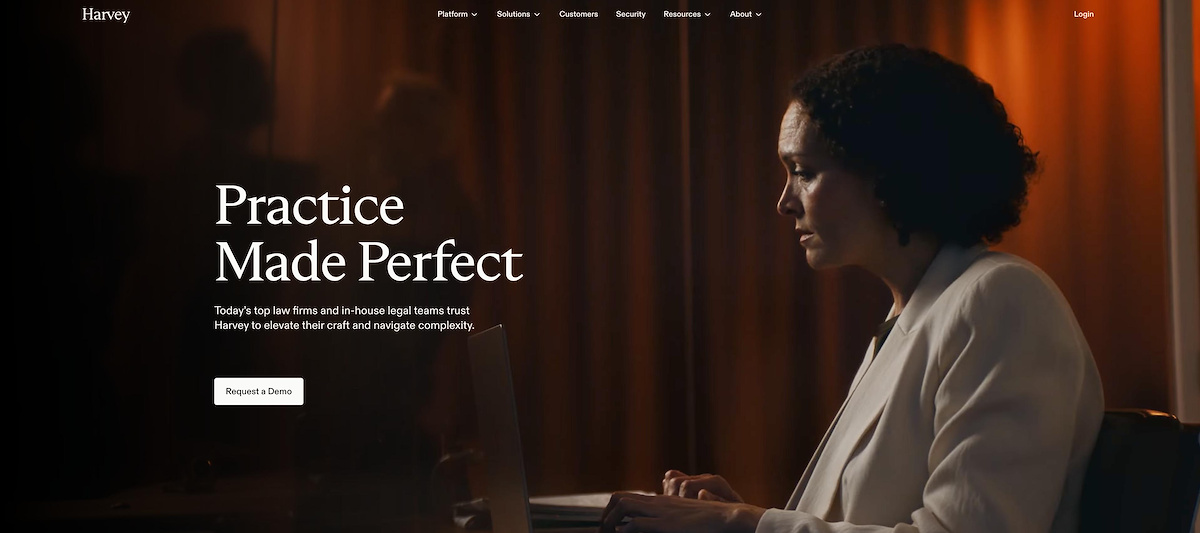
Harvey is a legal AI platform designed for large-scale legal analysis and complex transactional work. It is primarily used by enterprise legal teams for tasks like M&A diligence and reviewing large document sets in a collaborative environment. Unlike platforms grounded in proprietary legal research databases, Harvey focuses on applying legal reasoning to your firm’s documents. However, its emphasis on broad, configurable workflows can introduce setup and management overhead for teams that need a more focused drafting and redlining tool.
Harvey Features
- Vault: A central repository for analyzing up to 100,000 documents with structured data extraction tables.
- Workflows: Configurable, multi-step templates to standardize legal processes like diligence.
- Collaboration Tools: Shared workspaces with permission controls and human verification tracking for team-based review.
- AI Assistant: A prompt-based interface for document analysis, drafting, and answering legal questions.
- Word Add-in: Supports basic in-document editing, though the platform's focus is on its web-based environment.
Harvey Pricing
- Harvey is sold on an enterprise subscription basis with custom quotes.
- Indicative pricing starts at approximately $40,000 annually for a team of 10.
- The standard evaluation process includes a formal two-week pilot period with onboarding and training.
Key Considerations about Harvey
Harvey is built as a broad legal operations platform, not a dedicated drafting and redlining tool. Its emphasis on configurable, large-scale workflows can introduce significant setup and management overhead for teams that need to move quickly on individual contracts.
While powerful for complex diligence projects, its design is less optimized for the day-to-day contract execution that happens in Microsoft Word. Teams focused on improving drafting speed and precision may find its feature set too broad for their needs.
Finally, Harvey is positioned at the higher end of the market. This makes the Harvey vs LexisNexis decision a significant financial commitment and may place it out of reach for smaller teams or those with tighter budgets.
2. LexisNexis
LexisNexis offers a legal AI assistant embedded within its vast proprietary legal research database. It is designed for teams that need drafting and Q&A capabilities grounded in Lexis’s authoritative content, including case law and Practical Guidance. This approach aims to prevent issues like fake citations by anchoring answers in its own library. However, this makes it more of a research platform with AI features rather than a dedicated contract drafting and review tool, a key point in the Harvey vs LexisNexis debate.
LexisNexis Features
- AI Assistant: Provides drafting, summarization, and Q&A capabilities.
- Grounded Research: Anchors all AI-generated answers in Lexis’s proprietary content library, including case law and Practical Guidance.
- Document Analysis: Supports document uploads for summarization, comparison, and targeted questions.
- M&A Benchmarking: Compares uploaded agreements against SEC filings and Practical Guidance clauses.
- Word Add-in: Offers a separate plug-in for clause-level redlining.
LexisNexis Pricing
- Pricing is seat-based with discounts for volume and multi-year contracts.
- Promotional pricing is often available for new customers.
- Onboarding, training, and support are included in the subscription.
- The Word add-in for redlining is priced as a separate add-on.
Key Considerations about LexisNexis
LexisNexis is fundamentally a legal research platform with AI features, not a dedicated contract drafting and review tool. Its primary strength is providing citation-backed answers from its own content, which is a key factor in the Harvey vs LexisNexis comparison.
However, its contract workflow is fragmented. Redlining requires a separate Word add-in, which can disrupt the drafting process for teams that need to work quickly. Furthermore, playbook functionality is not a core feature, limiting its utility for standardizing review across a team. This makes it less suitable for transactional practices focused on operational speed and consistency.
3. Spellbook, The Smarter Alternative
While the Harvey vs LexisNexis discussion centers on broad platforms versus research databases, Spellbook is built specifically for contracts and commercial law. It integrates directly into Microsoft Word, where lawyers already work, helping legal teams draft and review contracts 10x faster and with greater precision.
Spellbook is also the only contract AI grounded in real-time market data. Its Review feature analyzes contracts against live benchmarks from thousands of similar agreements, giving lawyers data-driven answers to "What's market?" in negotiations. More than 4,000 legal teams, including those at Dropbox and Crocs, trust Spellbook to improve contract workflows and eliminate legal busywork.
Spellbook Features
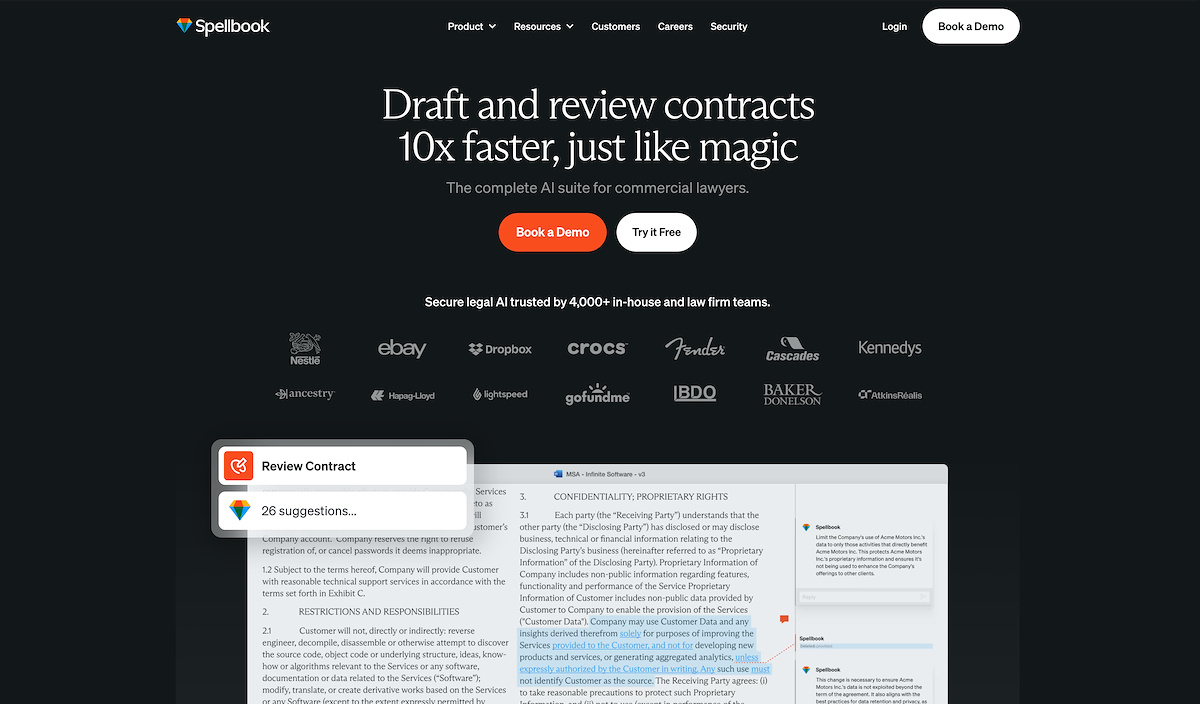
- Review: Instantly analyzes entire contracts within Microsoft Word, suggesting redlines and flagging risks. All edits appear as track changes, keeping the lawyer in full control of the final document.
- Draft: Generates new clauses or entire agreements. It can also search a firm’s historical contracts to find and adapt precedent language, matching the style and defined terms of the current document.
- Ask: A contract-specific Q&A tool that answers questions about a document directly in Word. Responses include citations to the relevant contract language for quick verification.
- Compare to Market: Analyzes contract terms against real-time data from thousands of similar agreements. This feature provides statistical benchmarks to answer "What's market?" and helps lawyers negotiate from a data-driven position.
- Associate: An AI agent that executes multi-document projects from a single instruction. It can cross-reference files, update terms across a document set, and prepare entire packages from a term sheet.
- Institutional Knowledge: Spellbook’s Library ingests and indexes a firm's contract history to ground AI suggestions in actual firm precedents. The platform also learns from a user's edits over time, adapting to individual drafting styles and risk tolerance.
- Practical Law Integration: Users can access standard documents and clauses from Thomson Reuters Practical Law directly within Spellbook, combining authoritative content with an efficient, AI-powered workflow.
Spellbook Pricing
- Spellbook uses a custom per-seat pricing model, with quotes tailored to your team's size and needs.
- Annual subscriptions include all features, onboarding, and support, with discounts available for larger teams.
Ready to see how Spellbook can help you work faster and with greater precision? Start your free 7-day trial today.
Why Commercial Lawyers Love Spellbook
Unlike broad legal operations platforms or AI-enhanced research databases, Spellbook is built specifically for the contract workflow. Its design centers on keeping lawyers in Microsoft Word, where transactional work happens.
While Spellbook is focused entirely within Word, this allows for a deeply integrated experience that improves drafting speed and precision without context switching. Lawyers can review agreements, generate clauses, and get answers about a document, all within their draft.
This approach, combined with its ability to provide market data for negotiations, makes it a practical choice for commercial teams who need to execute on contracts efficiently and consistently.
[cta-1]
LexisNexis vs Harvey vs Spellbook: Key Differences
The core difference in the Harvey vs LexisNexis comparison is their foundational approach. Harvey is a broad legal operations platform for large-scale analysis, while LexisNexis is an AI assistant integrated into a proprietary research database. Spellbook offers a third, more specialized alternative focused entirely on the contract workflow, changing the dynamic of the Harvey vs LexisNexis decision.
Here’s a breakdown of their key differences:
- Harvey is built for complex, collaborative projects like M&A diligence in a web-based environment. Its strength is large-scale document analysis, but its breadth can create setup overhead for teams that just need to draft and redline contracts quickly.
- LexisNexis excels at providing citation-backed answers from its own authoritative content library, reducing the risk of fake citations. However, its contract workflow is fragmented, with redlining requiring a separate Word add-in, positioning it more as a research tool with AI features.
- Spellbook is built specifically for contracts and commercial law, operating entirely within Microsoft Word to improve drafting speed and precision. It is the only platform grounded in real-time market data, giving lawyers statistical benchmarks for negotiations. Its AI agent, Associate, can also execute multi-document projects from a single instruction.
Ultimately, the best choice in the Harvey vs LexisNexis vs Spellbook comparison depends on your primary need: large-scale legal operations (Harvey), research-integrated AI (LexisNexis), or fast, data-driven contract execution directly in Word (Spellbook).
Which Option Is Right For Your Business?
The best platform depends on your team’s day-to-day priorities. Here is a simple breakdown based on common legal personas.
For Large Firms Managing Complex Projects
Harvey is likely the best option. Its strength lies in coordinating large-scale document analysis and managing complex, multi-step workflows common in M&A diligence or litigation.
For Practices Centered on Legal Research
LexisNexis is the clear choice. Its AI is built upon a vast library of authoritative content, making it ideal for teams that need verifiable, citation-backed answers for legal arguments or briefs.
For Transactional Teams and In-House Counsel
Spellbook is designed for this group. It focuses exclusively on the contract lifecycle and integrates directly into Microsoft Word, helping lawyers work faster and with more precision. This specialization is ideal for teams who spend most of their time drafting, reviewing, and negotiating agreements, including clauses like limitation of liability and indemnification.
The bottom line: The Harvey vs LexisNexis choice comes down to project scale versus research depth. However, for the many legal teams whose work revolves around contracts, Spellbook offers a more focused and practical tool for daily work.
Try Spellbook Free
If your work centers on contracts, Spellbook offers a more focused alternative to the broad platforms in the Harvey vs LexisNexis comparison, helping you draft and review agreements faster and with greater accuracy.
Experience the difference directly within Microsoft Word by starting your free 7-day trial today.
Frequently Asked Questions
What AI models do Harvey and LexisNexis use, and how do they handle data security?
Both platforms use a combination of leading large language models (LLMs) and proprietary technology. Harvey uses models from providers like OpenAI and Anthropic, but within a secure environment designed for enterprise legal data. They implement strict data protection protocols to ensure client information remains confidential.
LexisNexis takes a different approach by grounding its AI within its own "walled garden" of content. This is designed to improve accuracy and data security by limiting the AI's exposure to the open internet. For lawyers concerned about whether ChatGPT is private, this closed system offers a degree of reassurance.
Can Harvey or LexisNexis be used for litigation or regulatory work?
Yes, both platforms have applications beyond transactional law. Harvey's ability to analyze up to 100,000 documents in its Vault makes it useful for tasks like e-discovery and preparing for litigation, where teams must review massive document sets.
LexisNexis is fundamentally a legal research tool, making it a natural fit for litigation and regulatory practices. Its AI assistant is designed to help lawyers find case law, interpret statutes, and build legal arguments backed by its extensive library of authoritative sources.
How does Spellbook compare to Harvey and LexisNexis for contract drafting and review?
Spellbook is built specifically for transactional work, operating entirely within Microsoft Word. While Harvey is a broad web-based platform for legal operations and LexisNexis is a research tool with AI features, Spellbook focuses on improving the speed and precision of the contract workflow itself.
This means lawyers can draft, review, and negotiate agreements without context switching between different applications. Spellbook provides data-driven negotiation points by comparing clauses to market standards and learns from your firm's past agreements to suggest relevant language for new contracts, such as a confidentiality clause. This specialized approach makes it a more direct tool for teams whose primary focus is executing contracts.
[cta-2]
Our Research Methodology
This comparison is based on comprehensive research of publicly available information, including product websites, feature documentation, press releases, customer reviews, legal technology publications, and third-party analyses from sources like LawSites, Artificial Lawyer, and industry analysts.
Where pricing information is not publicly disclosed, we've included estimates based on available industry data and user reports. Information is current as of 2026 and may change as products evolve. We encourage readers to verify details directly with vendors and request demos to evaluate fit for their specific needs.
.png)
%20(1).png)

Thank you for your interest! Our team will reach out to further understand your use case.
Spellbook is the most complete AI suite for commercial legal work, trusted by more than 4,400 in-house teams and law firms worldwide.

SOC 2 Type II

HIPAA

GDPR

EU AI Act

HIPAA Compliant
