
Legora vs. LexisNexis: Which Is the Top Pick in 2026?
.jpeg)


Choosing between Legora vs LexisNexis for your legal AI needs involves weighing two very different approaches. Legora offers a platform focused on scalable, structured contract review, while LexisNexis provides an AI assistant grounded in its extensive proprietary legal research database. To help you decide, we will compare their core features, pricing models, and underlying AI architecture.
Key Takeaways
- Legora is an enterprise AI platform designed for large-scale, structured contract review and data extraction, while LexisNexis is an AI assistant grounded in its proprietary legal research database.
- The core difference lies in their approach: Legora focuses on scalable, portfolio-level analysis and governance, while LexisNexis emphasizes research-backed drafting and answers derived from its extensive legal content.
- Alternatively, Spellbook is the complete AI suite trusted by over 4,000 legal teams to draft and review contracts with greater speed and precision, operating entirely within Microsoft Word where lawyers already work.
1. Legora
Legora is a legal AI platform designed for enterprise teams managing high volumes of contracts. Its main purpose is to standardize review processes and extract structured data across large document sets, making it a tool for M&A diligence and portfolio analysis. Unlike LexisNexis, which grounds its AI in a proprietary legal research database, Legora focuses on operational scale and governance. This makes it more of a contract intelligence platform for large-scale projects rather than a day-to-day drafting assistant for individual agreements.

Legora Features
- AI Assistant: A document-confined chat interface for Q&A on specific files.
- Microsoft Word Add-in: Applies rule-based playbooks to standardize contract review.
- Tabular Review: Extracts structured data across thousands of documents for large-scale analysis, such as M&A diligence.
- Governance Focus: Emphasizes traceability and confidence scores for enterprise auditability.
Legora Pricing
Legora’s pricing is geared toward enterprise customers.
- Starts at $3,000 per user, per year.
- Requires a 10-seat minimum commitment.
- Minimum annual contract value is $30,000.
Key Considerations about Legora
Legora is built for a specific purpose: large-scale, structured data extraction across thousands of documents. Its strength is in portfolio-level analysis for projects like M&A diligence, where consistency and governance are critical.
However, it is less suited for the day-to-day drafting and review needs of most commercial lawyers. The platform is not optimized for creative drafting or individual contract workflows. Its high entry cost and 10-seat minimum also make it inaccessible for smaller legal teams.
Organizations that prioritize speed and precision in individual document workflows, rather than portfolio-wide data extraction, may find Legora’s operational focus too rigid and costly.
2. LexisNexis
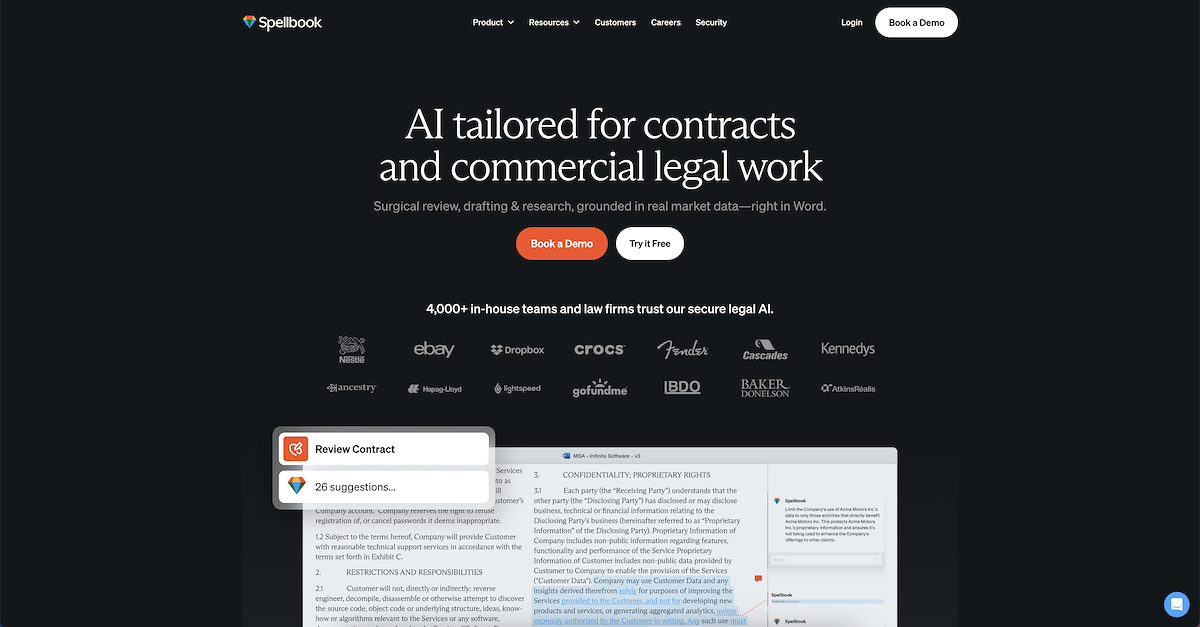
LexisNexis offers a legal AI assistant embedded within its extensive legal research and Practical Guidance ecosystem. It is designed for legal teams that prioritize citation-backed answers and drafting assistance grounded in a proprietary database of case law and templates. Unlike Legora’s focus on large-scale portfolio analysis, LexisNexis centers on individual document workflows where research integration is key. However, its core contract review functions are split, with redlining handled by a separate Word plug-in and playbook features still under development.
LexisNexis Features
- An AI assistant for legal Q&A, drafting, and summarization.
- Outputs grounded in Lexis’s proprietary database of case law and Practical Guidance.
- Document upload and analysis for individual or small sets of files.
- Side-by-side comparison for up to three documents.
- M&A clause benchmarking against SEC filings and attorney-curated content.
- Redlining and clause-level editing handled by a separate Word plug-in.
LexisNexis Pricing
- Seat-based annual subscriptions with volume discounts available.
- Training and ongoing support are included in the contract.
- The Word plug-in for redlining is priced as a separate add-on.
- Promotional pricing may be available for new customers.
Key Considerations about LexisNexis
While LexisNexis is built on an impressive foundation of proprietary legal content, its contract review workflow has practical limitations for teams focused on speed and efficiency. The core redlining function is handled by a separate Word plug-in, which can fragment the user experience by splitting work between a web platform and the document itself.
Additionally, key features for standardized review, such as playbooks, are still under development and not yet a core part of the platform. This makes the Legora vs LexisNexis decision difficult for teams that need a unified, Word-native tool for high-volume contract negotiation today, rather than a system centered on research-backed drafting.
3. Spellbook, The Smarter Alternative
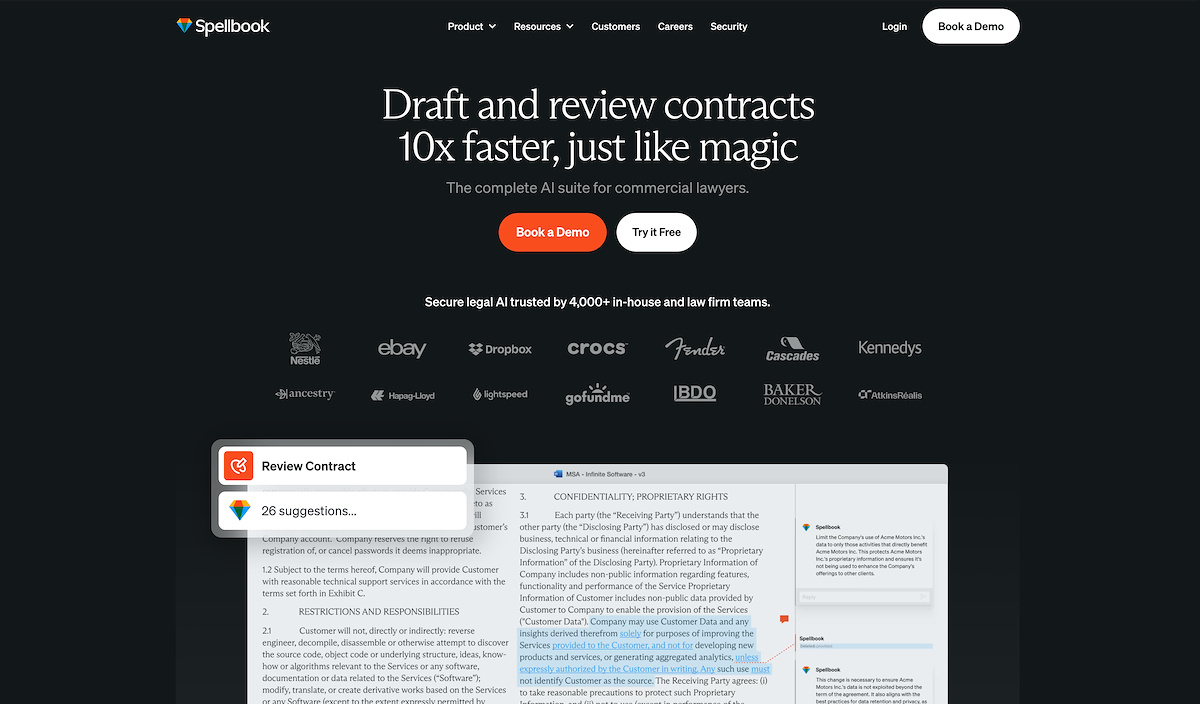
For teams considering their options in the Legora vs LexisNexis comparison, Spellbook presents a smarter alternative. It is the complete AI suite built for commercial law, integrating directly into Microsoft Word to help over 4,000 legal teams draft and review contracts 10x faster and with greater precision. It is designed for lawyers who need to work quickly without switching applications.
While other tools focus on either portfolio analysis or proprietary research, Spellbook is the only contract AI grounded in real-time market data. Its Compare to Market feature analyzes agreements against thousands of similar contracts, giving lawyers data-driven answers to "What's market?" and a practical advantage in any negotiation.
Spellbook Features
- Review: Instantly analyzes an entire contract, suggesting redlines and flagging risks directly in Microsoft Word. All edits appear as track changes, keeping the lawyer in full control of the final document.
- Draft: Generates new clauses or entire agreements from a simple instruction. It can also find and adapt language from a firm’s past contracts, automatically matching the style and defined terms of the current document, such as an indemnification clause.
- Ask: A contract-specific Q&A tool that lets lawyers ask questions about the open document. Answers are provided with citations pointing to the exact language in the contract, supporting quick verification.
- Compare to Market: Analyzes contract terms against real-time market data from thousands of similar agreements. This feature gives lawyers data-driven answers on what is standard for a specific industry or deal type, providing a factual basis for negotiations.
- Associate: An AI agent that can execute multi-document projects from a single prompt. It can cross-reference information, update terms across multiple files, and prepare entire document packages, handling work typically assigned to a junior associate.
- Supporting Capabilities: Spellbook also includes customizable Playbooks to standardize reviews, a Library that turns a firm’s past work into a knowledge base, and Preference Learning that adapts to individual drafting styles over time.
Spellbook Pricing
Spellbook uses a custom per-seat pricing model provided on an annual basis. Quotes are determined by your team’s size and specific requirements.
- Volume discounts are available for larger teams.
- All subscriptions include core features, onboarding, and ongoing support.
See how Spellbook can accelerate your contract workflows by starting a 7-day free trial.
Why Commercial Lawyers Love Spellbook
Unlike tools focused on large-scale portfolio analysis or separate research platforms, Spellbook is built for the practical, day-to-day work of commercial lawyers.
While it operates exclusively within Microsoft Word, this deep integration is what allows for its speed and precision, eliminating the need to switch between applications. It gives lawyers a practical advantage by providing real-time market data for negotiations, answering "What's market?" with facts, not guesswork.
For teams weighing the Legora vs LexisNexis decision, Spellbook offers a unified workflow designed for faster, more accurate contract review, making it a compelling choice for modern AI-assisted lawyering.
[cta-1]
LexisNexis vs Legora vs Spellbook: Key Differences
When evaluating the Legora vs LexisNexis matchup, it is important to understand their fundamental differences in architecture and purpose. Legora is built for portfolio-scale analysis, while LexisNexis is grounded in legal research. Spellbook offers a third approach, focused on practical, day-to-day contract work. Here is a breakdown of their key differences:
LegoraLexisNexisSpellbookCore FocusLarge-scale, structured data extraction across thousands of documents for portfolio-level analysis.Research-backed drafting and Q&A, grounded in a proprietary database of case law and legal guidance.Accelerating day-to-day contract drafting and review with speed and precision.Primary EnvironmentA web platform for portfolio analysis with a separate Microsoft Word add-in for playbook review.A web platform for AI assistance, with redlining handled by a separate Word plug-in, fragmenting the workflow.Operates entirely within Microsoft Word, eliminating the need to switch between applications.Key DifferentiatorTabular review for analyzing thousands of documents at once, with a focus on governance and auditability.Outputs are grounded in its extensive, proprietary library of legal content from Westlaw and Practical Law.The only AI grounded in real-time market data, providing data-driven answers to "What's market?" for negotiations.Best ForEnterprise teams performing large-scale M&A diligence or portfolio audits requiring structured data.Lawyers who prioritize citation-backed answers and drafting assistance integrated with legal research tools.Commercial lawyers who need to draft, review, and negotiate contracts faster and more accurately within their existing workflow.
Which Option Is Right For Your Business?
For Large-Scale Diligence Teams
Legora is the logical choice for this work. It is built to analyze thousands of documents in parallel, making it ideal for major M&A transactions or portfolio audits where structured data extraction is the primary objective.
For Research-Intensive Practices
LexisNexis is better suited for teams whose work is deeply tied to legal research. If your main need is drafting with direct citations to case law and other proprietary legal content, its research-grounded AI is the most direct fit.
For Most Commercial and Corporate Lawyers
Spellbook is the strongest option for daily contract work. It is designed for the practical reality of negotiation, operating entirely within Microsoft Word to avoid context switching. Its focus on speed, accuracy, and providing real-world negotiation data makes it a highly effective tool for modern AI lawyering.
The Bottom Line: Your final choice in the Legora vs LexisNexis matchup depends on your core task. Choose Legora for portfolio analysis and LexisNexis for research integration. For the majority of lawyers focused on accelerating daily contract work, Spellbook provides the most practical and efficient solution.
Try Spellbook Free
Unlike tools built for portfolio analysis or legal research, Spellbook is designed for the speed and precision required in daily contract work.
Experience how it works directly in Microsoft Word by starting a free trial today.
Frequently Asked Questions
How do Legora and LexisNexis integrate with existing legal workflows?
Both platforms use a hybrid approach that can divide a lawyer's focus. Legora's primary functions for large-scale analysis are on a web platform, while a separate Microsoft Word add-in is used to apply rule-based playbooks to individual documents.
Similarly, LexisNexis provides its main AI assistance for drafting and Q&A in a web interface. However, actual redlining and clause editing are handled by a different Word plug-in. This separation can fragment the review process, requiring users to switch between their document and a browser.
What about data security when using these AI platforms?
Data security is a critical factor for any legal team adopting AI. As enterprise-focused platforms, both Legora and LexisNexis are expected to have strong security measures in place. It is always recommended to directly confirm each vendor’s policies on data encryption, storage, and confidentiality.
It is also important to understand how AI tools handle data, particularly whether your firm's sensitive information could be used for model training. Clarifying these details is a necessary step before uploading client documents to any third-party platform.
How is Spellbook different from both Legora and LexisNexis for daily contract work?
Spellbook’s primary distinction lies in its unified workflow and unique data source. Unlike Legora’s focus on portfolio analysis or LexisNexis’s reliance on a separate research platform, Spellbook operates entirely within Microsoft Word. This design eliminates the need to switch between applications, allowing lawyers to review and draft with more speed and precision.
Furthermore, Spellbook is the only AI grounded in real-time market data. While other tools may check against internal playbooks or case law, Spellbook analyzes terms against thousands of similar, recent agreements. This gives lawyers data-driven answers on what is "market" for a specific limitation of liability clause, providing a factual basis for negotiations.
[cta-2]
Our Research Methodology
This comparison is based on comprehensive research of publicly available information, including product websites, feature documentation, press releases, customer reviews, legal technology publications, and third-party analyses from sources like LawSites, Artificial Lawyer, and industry analysts.
Where pricing information is not publicly disclosed, we've included estimates based on available industry data and user reports. Information is current as of 2026 and may change as products evolve. We encourage readers to verify details directly with vendors and request demos to evaluate fit for their specific needs.
.png)
%20(1).png)

Thank you for your interest! Our team will reach out to further understand your use case.
Spellbook is the most complete AI suite for commercial legal work, trusted by more than 4,400 in-house teams and law firms worldwide.

SOC 2 Type II

HIPAA

GDPR
EU AI Act

HIPAA Compliant
