
Spellbook vs LegalOn: Which Is The Top Pick in 2026?
.jpeg)


Choosing the right AI contract tool is a critical decision, and the Spellbook vs LegalOn comparison is one many legal teams are making today. Both platforms aim to accelerate contract review, but they take different approaches: LegalOn focuses on structured, playbook-driven review, while Spellbook offers a complete AI suite built for speed, precision, and data-driven negotiation. In this review, we will compare them across key areas including product features, pricing, and AI architecture to give you a clear picture of how they stack up.
Key Takeaways
- Both Spellbook and LegalOn are AI-powered contract review tools that integrate directly into Microsoft Word to help legal teams accelerate their work.
- The primary difference is their approach: LegalOn focuses on structured, playbook-driven review with attorney-authored guidance for consistency, while Spellbook offers a complete AI suite that combines playbooks with real-time market data for negotiation and an AI agent for complex workflows.
- Spellbook is the better option for teams that need more than just playbook review. It is trusted by over 4,000 in-house and law firm teams to draft and review contracts with greater speed and precision, and to negotiate confidently using its unique, real-time market data features.
1. LegalOn
LegalOn is a contract review platform that focuses on negotiation support and redlining within Microsoft Word. It is designed for in-house legal teams that manage recurring commercial contracts, such as MSAs, NDAs, and sales agreements. The platform uses a playbook-driven approach, applying curated legal standards to identify risks before using AI for drafting. This structured method prioritizes consistency and risk control, which differs from Spellbook’s focus on combining playbooks with real-time market data and AI-driven speed and precision.
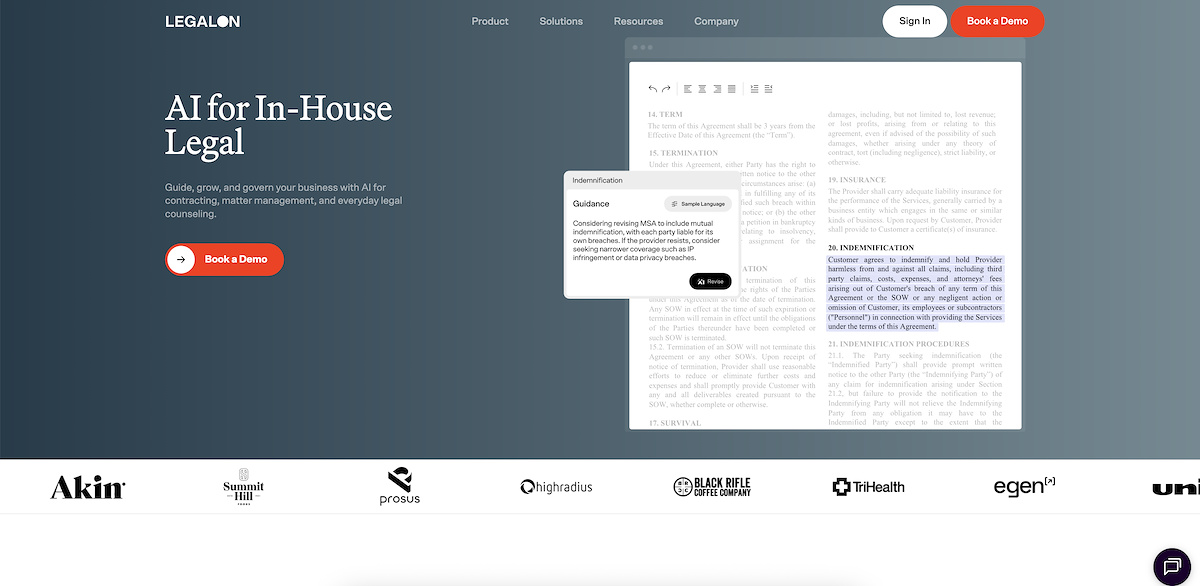
LegalOn Features
LegalOn's product is centered on its playbook-driven review engine. Key capabilities include:
- A Microsoft Word add-in for contract analysis and redlining.
- Attorney-authored guidance and sample language for identified issues.
- Conceptual issue detection for terms like indemnification and liability.
- An AI assistant for ad-hoc drafting, summarization, and Q&A.
- A web application for intake, matter management, and template storage.
LegalOn Pricing
LegalOn uses a modular, per-seat pricing model. This means costs can vary significantly based on team size and the specific features required.
- Pricing is structured per-seat and per-module.
- Individual licenses with limited features start around $3,500 per year.
- Full-featured enterprise licenses cost approximately $8,000 per user, per year.
- Final pricing depends on user count and selected modules.
Key Considerations about LegalOn
While LegalOn is strong for standardized review, its narrow focus creates limitations. The platform is designed for consistency through curated playbooks, which can feel rigid compared to more adaptive AI.
A significant factor in the Spellbook vs LegalOn comparison is data. LegalOn lacks real-time market data, which prevents teams from benchmarking terms against current standards during negotiations. This is a key area where Spellbook provides a distinct advantage with its Compare to Market feature.
Ultimately, LegalOn is best viewed as a specialized review tool, not a complete platform for drafting, negotiation, and complex workflows.
2. Spellbook, The Smarter Alternative
Spellbook is the most complete AI suite built for contracts and commercial law. It integrates directly into Microsoft Word, helping over 4,000 legal teams at companies like Dropbox and Fender draft and review agreements 10x faster and with greater precision.
Where Spellbook truly stands apart is its use of real-time market data. The platform analyzes contracts against live benchmarks from thousands of similar agreements, giving lawyers data-driven answers to "What's market?" during negotiations. This makes it a complete AI suite for drafting, review, and negotiation, not just a playbook-based review tool.
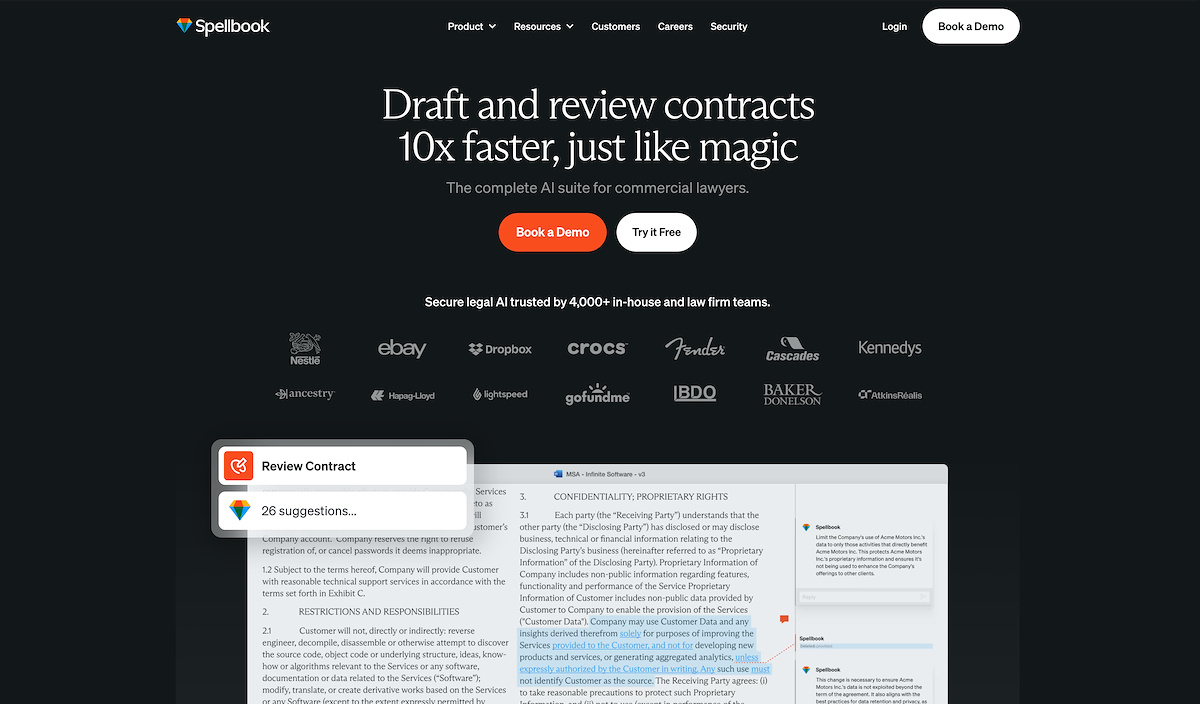
Spellbook Features
Spellbook's capabilities extend far beyond simple contract review. The platform is organized around five core tools that work together to support lawyers through every stage of the contract lifecycle, from drafting and analysis to data-driven negotiation and complex, multi-document projects.
- Review: This is Spellbook’s primary analysis engine. It conducts an instant, document-wide review to flag risks and suggest edits. All suggestions appear as track changes, keeping the lawyer in full control of the final work product.
- Draft: This feature provides clause-level and full-document generation. Lawyers can draft new language from scratch or pull from a firm’s own precedent using Spellbook Library, which automatically adapts clauses to match the style and defined terms of the current agreement.
- Ask: Functioning as a contract-specific Q&A tool, Ask allows lawyers to get quick answers about obligations, terms, and other details directly within Word. Responses are cited to the relevant contract language for easy verification.
- Compare to Market: A key differentiator in the Spellbook vs LegalOn debate, this feature allows lawyers to benchmark contract terms against real-time data from thousands of similar agreements. It provides data-driven answers to "What's market?" helping lawyers negotiate with confidence.
- Associate: This AI agent handles multi-document, multi-step projects from a single prompt. It can execute complex workflows like reviewing a data room for due diligence or preparing a full document package from a term sheet, going far beyond the scope of a standard review tool.
These features are supported by a secure, HIPAA-compliant architecture and a Preference Learning system that adapts to a user's style over time, making the platform increasingly personalized with use.
Spellbook Pricing
Spellbook uses a custom per-seat pricing model, with annual subscriptions tailored to your team’s size and needs. All core features—including Review, Draft, Ask, Compare to Market, and Associate—are included in the standard plan, along with full support and training.
- Pricing is provided via a custom quote.
- Volume discounts are available for teams of 10 or more.
See the platform in action by starting a free 7-day trial.
Why Commercial Lawyers Love Spellbook
Unlike specialized playbook review tools, Spellbook is built to support the entire contract lifecycle. While it operates exclusively within Microsoft Word, this focus allows for deep integration where legal teams do their most critical work.
Lawyers value its ability to go beyond simple risk-flagging. With real-time market data, they can negotiate terms confidently. The platform also handles complex tasks, from initial drafting to multi-document due diligence, making it a versatile partner rather than just a review tool. This makes the Spellbook vs LegalOn choice clear for teams needing more than a rigid, playbook-only system.
[cta-1]
Spellbook vs LegalOn: Key Differences
While both Spellbook and LegalOn aim to accelerate contract work within Microsoft Word, their fundamental approaches and capabilities create a clear distinction. The Spellbook vs LegalOn comparison ultimately comes down to whether a team needs a specialized review tool or a complete AI suite for the entire contract lifecycle.
1. Core Philosophy and Scope
- LegalOn is a specialized review tool that prioritizes consistency through a structured, playbook-driven approach. It applies curated legal standards to identify risks, making it effective for teams focused on standardized review processes.
- Spellbook is a complete AI suite for commercial law, supporting lawyers from initial drafting and review to negotiation and complex, multi-document projects. It combines playbooks with adaptive AI, offering greater flexibility and power beyond simple review.
2. Data and Negotiation Intelligence
- LegalOn lacks real-time market data, meaning its analysis is limited to predefined playbooks. This prevents lawyers from benchmarking terms against current market standards during negotiations.
- Spellbook is the only contract AI grounded in live market data. Its Compare to Market feature analyzes terms against thousands of similar agreements, providing data-driven answers to "What's market?" and giving lawyers a distinct advantage in negotiations.
3. AI Capabilities and Workflow Automation
- LegalOn uses a two-layer system combining its playbook engine with a separate AI assistant for ad-hoc tasks. Its focus remains on structured, single-document review.
- Spellbook offers a more advanced and integrated suite of tools. Its AI agent, Associate, can handle complex, multi-document workflows, while its core AI learns from user preferences to deliver increasingly personalized suggestions with speed and precision.
Which Option Is Right For Your Business?
The right choice in the Spellbook vs LegalOn debate depends entirely on your team’s primary needs. Here is a breakdown for common legal personas.
For teams focused on speed and negotiation
Spellbook is the better fit. It is designed for teams that handle a wide variety of agreements and need to move quickly without sacrificing precision.
- Its flexible AI supports the entire contract lifecycle, from drafting new agreements to managing complex, multi-document reviews.
- Access to real-world market data gives lawyers a critical advantage in negotiations.
For teams that prioritize playbook adherence above all
LegalOn may be a suitable option. Its strength lies in its structured, playbook-first approach to contract review.
- It excels at enforcing consistency across standardized agreements like NDAs and MSAs.
- The platform is built around a curated, risk-controlled review process.
For solo counsel and small teams needing a versatile partner
Spellbook is the clear choice. It acts as a force multiplier for lean legal departments that manage a broad range of responsibilities.
- It combines drafting, review, and negotiation support into a single, integrated tool within Word.
- The AI adapts to your work, providing personalized assistance that grows more effective over time.
The Bottom Line
Your decision comes down to scope. If you need a specialized tool for standardized, playbook-driven review, LegalOn is a focused option. However, for teams that need a powerful and adaptive AI partner for the entire contract lifecycle—from drafting and complex review to data-driven negotiation—Spellbook is the more capable and complete platform.
Try Spellbook Free
For teams that need more than a standard review tool, Spellbook offers a distinct advantage with its real-time market data and advanced AI capabilities. See how it can improve your contract workflow with greater speed and precision by starting a free 7-day trial.
Frequently Asked Questions
How do Spellbook and LegalOn handle data security?
Data security is a primary consideration for any legal AI tool. Both platforms operate within secure environments designed to protect confidential information, as they are built for legal professionals.
Spellbook provides specific security assurances, including advanced encryption and a commitment to not training its AI models on customer data. This directly addresses common concerns lawyers have about AI data privacy and ensures that your firm's and clients' information remains confidential.
What is the difference in their AI technology?
The platforms are built on different AI philosophies. LegalOn uses a two-part system: a proprietary playbook engine for structured review and a separate AI assistant for general tasks. This approach prioritizes consistency based on pre-set rules.
Spellbook uses a suite of advanced large language models to power its integrated tools. This allows for more dynamic and flexible capabilities, from drafting a specific non-competition clause from scratch to understanding complex instructions. The AI is designed to be adaptive, not just rule-based.
How does Spellbook function as more than just a review tool?
Spellbook is designed to support lawyers throughout the entire contract lifecycle, moving beyond the scope of a standard review-only tool. While its Review feature is a core component, it works in concert with other integrated tools for drafting, analysis, and negotiation.
For instance, a lawyer can use Draft to generate a new limitation of liability clause, use Ask to clarify obligations within the document, and then use Compare to Market to benchmark that clause against current standards. This integrated workflow within a single platform is what makes Spellbook a complete AI suite for commercial law.
[cta-2]
Our Research Methodology
This comparison is based on comprehensive research of publicly available information, including product websites, feature documentation, press releases, customer reviews, legal technology publications, and third-party analyses from sources like LawSites, Artificial Lawyer, and industry analysts.
Where pricing information is not publicly disclosed, we've included estimates based on available industry data and user reports. Information is current as of 2026 and may change as products evolve. We encourage readers to verify details directly with vendors and request demos to evaluate fit for their specific needs.
Lawyer-built prompts to help you draft, review, and negotiate contracts faster—with any LLM.
Get the latest news, trends, and tactics in legal Al—straight to your inbox.


Thank you for your interest! Our team will reach out to further understand your use case.
Spellbook is the most complete AI suite for commercial legal work, trusted by more than 4,000 in-house teams and law firms worldwide.

SOC 2 Type II

HIPAA

GDPR

EU AI Act

HIPAA Compliant
