
5 Best Callidus Alternatives in 2026
.jpeg)

If you are searching for Callidus alternatives, you are likely looking for a legal AI tool that moves beyond the generalist features of Callidus (StrongSuit). While Callidus provides a flexible AI co-pilot in Word, its broad approach may not be sufficient for teams needing specialized contract negotiation and analysis tools. To help you find the right fit, this guide breaks down the top options by comparing their product features, pricing, and AI architecture.
Key Takeaways
- Callidus is a generalist AI tool, and legal teams often seek alternatives for more specialized contract negotiation and analysis features that a broad platform may not offer.
- To help you evaluate companies like Callidus, this guide analyzes top alternatives by comparing their product features, pricing, and AI architecture.
- Spellbook is the leading choice, trusted by over 4,000 in-house and law firm teams to draft and review contracts faster and negotiate with confidence using real-time market data.
[cta-1]
1. Spellbook: Top Callidus Alternative
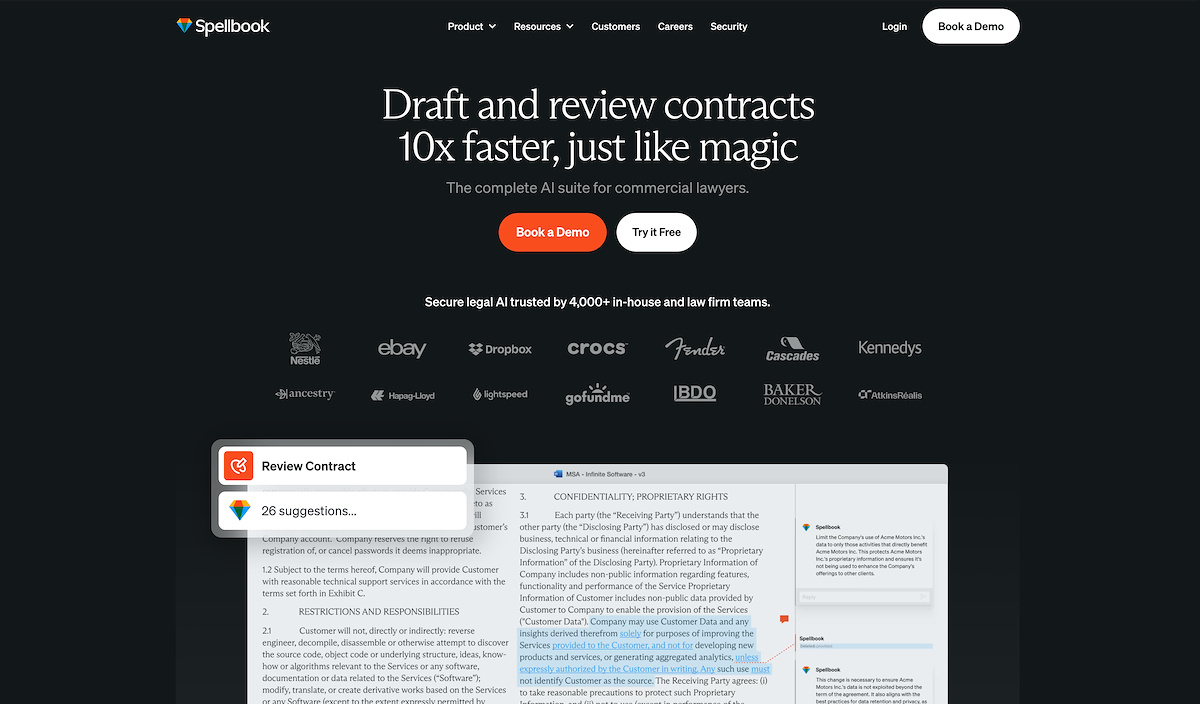
Spellbook is the most popular AI suite for commercial lawyers. It helps legal teams draft and review contracts 10x faster, with greater precision—right in Microsoft Word. Trusted by over 4,000 legal teams at companies like Dropbox, Fender, and Crocs, it is designed to handle high-volume transactional work, from commercial agreements to M&A diligence.
Unlike generalist AI tools, Spellbook is a complete AI suite tailored for contracts and commercial law. It is also the only contract review tool grounded in real-time market data, analyzing agreements against thousands of similar contracts to give lawyers data-driven answers to "What's market?" during negotiations.
Spellbook Features
Spellbook’s features are designed to address the specific challenges of contract drafting and review. For teams looking for an alternative to Callidus that offers more specialized legal tools, Spellbook provides the following capabilities, all within Microsoft Word:
- Review: Instantly analyzes entire agreements to identify risks, suggest redlines, and flag missing clauses. All edits appear as track changes under your name, and the tool can apply custom playbooks to ensure every contract meets your organization's standards.
- Draft: Generates new clauses or entire agreements from simple instructions. Spellbook can also access your firm’s historical contracts to draft new language that matches your precedent and the context of the current document.
- Ask: A contract-specific Q&A tool that lets you ask questions about the document you are working on. It provides answers with direct citations to the relevant contract language for easy verification, helping avoid issues like those seen when a lawyer was fined for fake citations from a general AI tool.
- Compare to Market: This feature analyzes your contract against a database of thousands of similar agreements to provide real-time, data-driven answers on whether a term is market standard. This is unique to Spellbook and provides statistical evidence for negotiations.
- Associate: An AI agent that can manage complex, multi-document projects from a single prompt. It can perform tasks like due diligence review or preparing a full document package from a term sheet, functioning much like a junior associate.
- Institutional Knowledge: Spellbook learns from your team’s edits and integrates with your document history through its Library and Preference Learning features. This allows the AI to adapt to your firm’s specific style and risk tolerance over time, making it a more personalized Callidus alternative.
Spellbook's AI Models & Architecture
Spellbook uses a multi-model approach, selecting from top OpenAI and Anthropic models for optimal performance depending on the task.
It uses retrieval-augmented generation (RAG) to ground outputs in your team's precedents, definitions, and playbooks and enriches them with real-time market data.
This "Market Grounding" approach ensures suggestions are relevant and defensible, a key distinction from generalist AI tools.
The system also improves over time through Preference Learning, adapting to your team's specific contract review style and making it a strong Callidus alternative.
Spellbook's Security and Compliance
For teams seeking a secure Callidus alternative, Spellbook is built with enterprise-grade security to protect sensitive legal data. Key compliance and security features include:
- SOC 2 Type II Certification: Ensures rigorous security and data protection standards.
- Data Privacy Compliance: Adheres to GDPR, CCPA, and PIPEDA regulations.
- HIPAA Compliance: Supports work with protected health information (PHI) and allows for Business Associate Agreements (BAAs).
- Zero Data Retention: Customer documents are never stored or used to train AI models, a critical consideration for maintaining confidentiality.
- End-to-End Encryption: All data is encrypted in transit and at rest.
Spellbook Pricing
Spellbook offers custom pricing on a per-seat, annual basis, with quotes tailored to your team's specific needs. The model is designed to be straightforward:
- Volume discounts are available for larger teams.
- All core features, training, and support are included.
You can explore all features and see the value for yourself by starting a 7-day free trial.
Other Alternatives to Callidus
While many legal teams seek specialized contract tools, other platforms offer a broader range of AI-powered assistance. Here is a look at several other companies like Callidus to consider in your search.
2. LegalOn
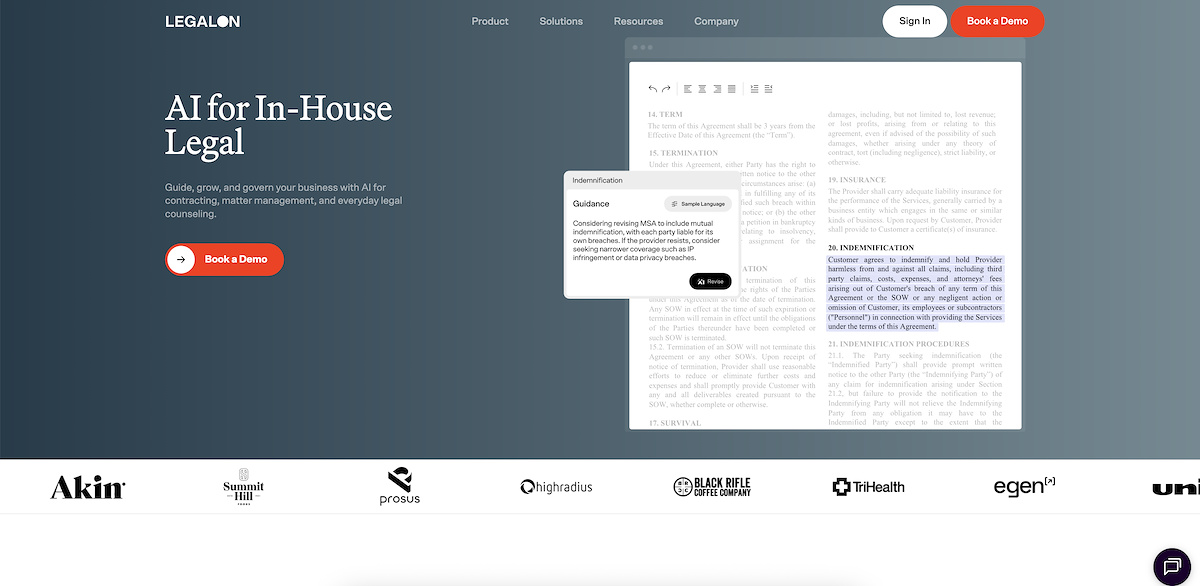
As a Callidus alternative, LegalOn is a contract review platform focused on negotiation and redlining through curated playbooks. It is primarily for in-house teams managing recurring commercial agreements. Unlike the generalist approach of Callidus, LegalOn prioritizes rigid, policy-driven review. This narrow focus on consistency can be a limitation for teams that require more flexible drafting and analysis capabilities.
LegalOn Features
- Word Add-in: For contract analysis and redlining in Word.
- Playbooks: Applies curated legal standards to identify risks.
- AI Assistant: For ad hoc drafting, summarization, and Q&A.
- Web Application: For intake, matter management, and template access.
LegalOn Pricing
- LegalOn offers per-seat, per-module pricing that varies by team size and features.
- Individual licenses start around $3,500 per user annually.
- A five-user enterprise plan with all modules is approximately $40,000 per year.
3. Gavel
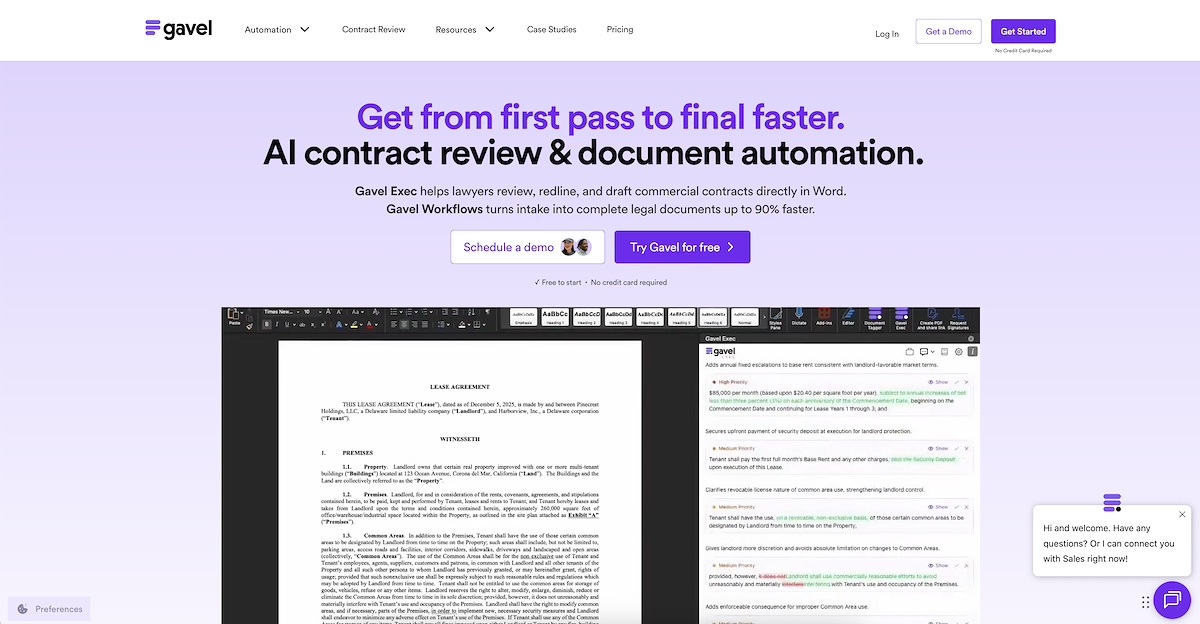
Gavel is a document automation platform that generates legal documents from structured inputs and rule-based logic. It is mainly for teams with highly repeatable workflows, like estate planning or real estate. While it serves as a Callidus alternative for document creation, its focus on production over analysis makes it less suitable for legal teams needing to review and negotiate complex third-party contracts, a core function of more specialized tools.
Gavel Features
- Word Add-in: For AI-assisted drafting, redlining, and summarizing.
- Web Application: Generates documents from questionnaires and logic-based workflows.
- Playbooks: Defines and applies rule-based standards to documents.
- Projects: Creates shared knowledge bases with clause libraries and templates.
Gavel Pricing
- Gavel uses a subscription model, priced at approximately $160 per user per month.
- Discounts are available for teams with 10 or more users.
- The platform does not require long-term contracts by default.
4. GC AI
GC AI is another alternative to Callidus, positioned as a workspace for in-house legal teams. It combines a web application for research and analysis with a separate Microsoft Word add-in for contract review. While it offers broad functionality similar to Callidus, this dual-surface approach can create a disjointed workflow for teams that primarily work within Word.
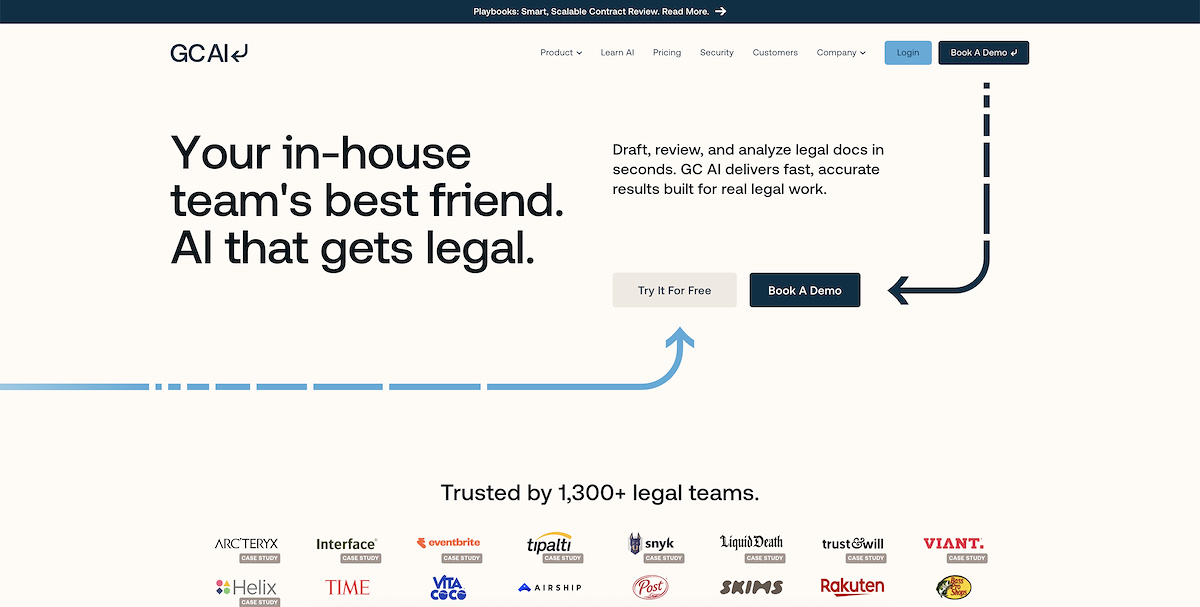
GC AI Features
- A web application for research, analysis, and knowledge management.
- A Microsoft Word add-in for contract review and redlining.
- Playbooks to apply standardized review processes.
- Shared prompts and knowledge bases to support team collaboration.
GC AI Pricing
- GC AI uses a seat-based annual pricing model.
- A solo seat is $5,000 per user, while the team tier is $7,000 per user and includes collaboration tools.
- Volume discounts are available for teams of 10 or more.
5. Iqidis
Iqidis (Irys) is another Callidus alternative, positioning itself as a "legal operating system" for centralizing document analysis and matter organization. It is designed for teams managing multiple concurrent projects, like transactional or vendor-contract workflows. Unlike the Word-native focus of Callidus, Iqidis aims to pull all work into its own centralized platform, which can be a significant shift for teams accustomed to their existing tools.
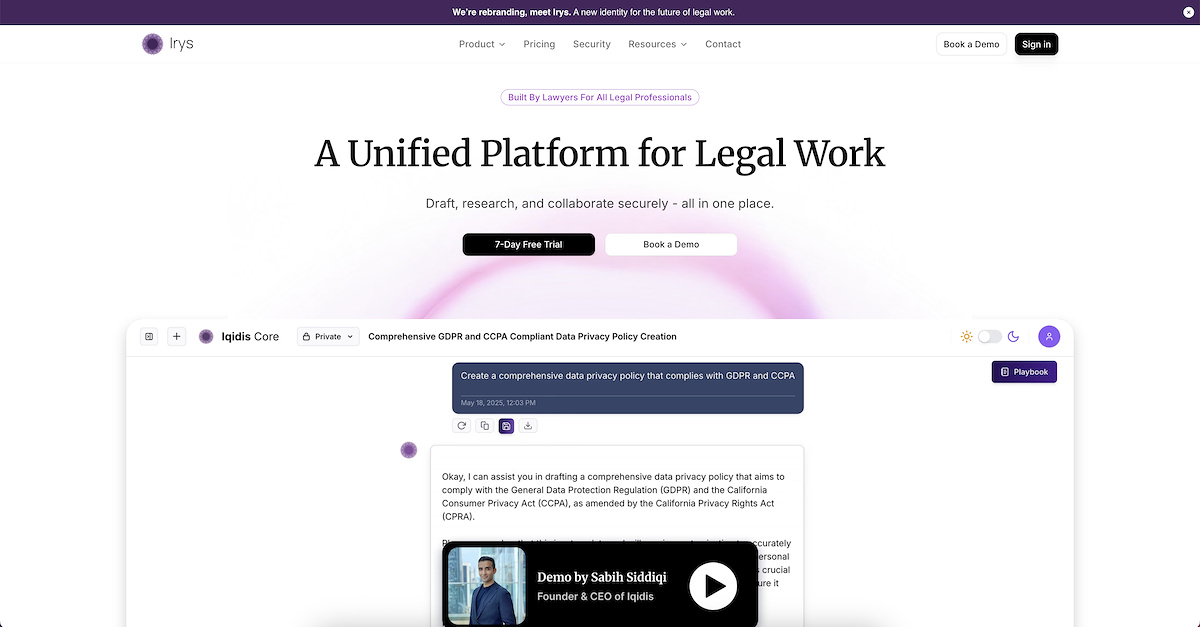
Iqidis Features
- Matter Folders for organizing projects by client or matter.
- Multi-document analysis for reviewing large document sets.
- An AI assistant for drafting, redlining, and summarizing.
- Precedent Finder for searching and retrieving information from historical documents.
- Collaboration tools for sharing work with internal and external teams.
Iqidis Pricing
Iqidis offers enterprise seat-based pricing with the following details:
- Costs range from $329 to $399 per seat, per month.
- Billing is done on a semi-annual or annual contract basis.
How To Choose The Best Callidus Alternative
Choosing the right Callidus alternative requires looking beyond surface-level features to find a tool that fits your specific legal workflows. Consider these key factors to ensure you select a platform that genuinely improves your contract drafting and review process.
1. Specialization for Contract Law
Generalist AI tools can handle a variety of tasks but often lack the precision needed for complex legal work. A platform built specifically for contracts and commercial law will offer more relevant features, understand legal nuances, and provide more accurate outputs for drafting and review.
2. Integration with Existing Workflows
The best tools work where you do, minimizing disruption and context-switching. An AI assistant that integrates directly into Microsoft Word allows you to draft, review, and redline without leaving your primary document editor, saving time and reducing friction.
3. Access to Market Data
Negotiations are stronger when backed by data, not just intuition. An ideal alternative to Callidus should provide real-time market data, allowing you to benchmark your contract terms against thousands of similar agreements to confidently determine what is standard.
Try Spellbook Free
Among the available Callidus alternatives, Spellbook is the only platform that grounds contract review in real-time market data, giving you a data-driven edge in negotiations. To see how its specialized features can fit into your workflow, you can start a 7-day free trial today.
Frequently Asked Questions
Why do legal teams look for alternatives to generalist AI tools like Callidus?
Generalist tools provide broad AI assistance but often lack the specific functionality needed for contract law. Legal teams require tools that understand legal terminology, contract structure, and risk analysis with greater precision.
Specialized platforms are trained on legal data, leading to more accurate redlines, relevant clause suggestions, and a deeper understanding of legal context. This focus helps avoid the risks associated with general AI, such as generating incorrect or non-compliant language.
What security considerations are most important when choosing a legal AI tool?
Data security is paramount. Look for platforms with SOC 2 Type II certification, which confirms they meet high standards for data protection. It is also critical to confirm the provider's data retention policy; a "zero data retention" policy means your confidential documents are not stored or used to train the AI models.
This addresses key questions about AI privacy. You should also verify compliance with regulations like GDPR and CCPA and check for end-to-end encryption to protect data.
How does a tool with "market data" differ from one without it?
A tool with market data analyzes your contract against a large database of similar, executed agreements. This allows you to see if a specific clause, like a limitation of liability, is standard for your industry, deal size, and jurisdiction.
It provides statistical evidence to support your negotiation position, moving beyond subjective arguments about what is "market." Tools without this feature can suggest language but cannot validate whether it aligns with current market practices, leaving you to rely on personal experience or manual research.
How does Spellbook compare directly to Callidus for contract review?
Spellbook is designed specifically for contract drafting and review, while Callidus is a more generalist AI assistant. This specialization means Spellbook's features are more aligned with legal workflows.
For example, Spellbook's "Compare to Market" feature provides data-driven insights on negotiation terms by analyzing thousands of similar contracts, a capability not found in generalist tools. Furthermore, Spellbook's AI is grounded not only in your firm's precedents but also in this real-time market data. This makes its suggestions both contextually relevant and commercially sound, offering a distinct advantage for legal professionals focused on contract work.
[cta-2]
Our Research Methodology
This comparison is based on comprehensive research of publicly available information, including product websites, feature documentation, press releases, customer reviews, legal technology publications, and third-party analyses from sources like LawSites, Artificial Lawyer, and industry analysts.
Where pricing information is not publicly disclosed, we've included estimates based on available industry data and user reports. Information is current as of 2026 and may change as products evolve. We encourage readers to verify details directly with vendors and request demos to evaluate fit for their specific needs.
Lawyer-built prompts to help you draft, review, and negotiate contracts faster—with any LLM.
Get the latest news, trends, and tactics in legal Al—straight to your inbox.

Thank you for your interest! Our team will reach out to further understand your use case.
Spellbook is the most complete AI suite for commercial legal work, trusted by more than 4,000 in-house teams and law firms worldwide.

SOC 2 Type II

HIPAA
GDPR

EU AI Act

HIPAA Compliant
