
Callidus vs CoCounsel: Which Is The Top Pick in 2026?
.jpeg)

Choosing between Callidus (StrongSuit) vs CoCounsel for your legal AI needs involves weighing a flexible, multi-model assistant against an established ecosystem grounded in proprietary legal research. Callidus offers a broad set of features within Microsoft Word powered by multiple AI models, while CoCounsel integrates Thomson Reuters' extensive Westlaw and Practical Law content for citation-backed answers. To help you decide, this review breaks down their core features, AI architecture, and pricing models, giving you the information needed to select the right tool for your practice.
Key Takeaways
Callidus (StrongSuit) is a flexible AI assistant that uses multiple AI models for contract review and legal research within Microsoft Word, while CoCounsel is an AI platform from Thomson Reuters that grounds its analysis in proprietary legal content from Westlaw and Practical Law.
The primary difference is their approach to grounding information; Callidus offers flexibility through a multi-model system, whereas CoCounsel provides answers backed by its own curated legal databases.
For teams seeking a data-driven advantage, Spellbook is a leading alternative trusted by over 4,000 legal teams to draft and review contracts 10x faster. It is the only legal AI that allows lawyers to compare contract terms against real-time market data, providing data-driven answers to "What's market?" in any negotiation.
1. Callidus
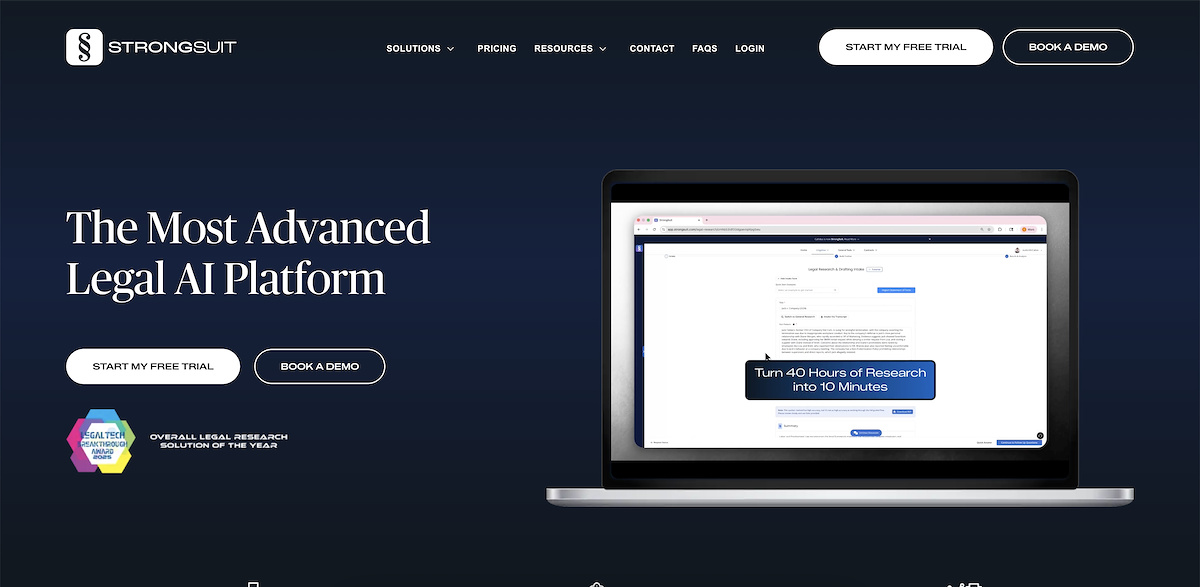
Callidus (StrongSuit) is a flexible AI co-pilot for legal teams that operates as a Microsoft Word add-in. It uses a proprietary system to route tasks to different AI models, such as GPT-4 and Claude, to handle contract review, drafting, and legal Q&A. While CoCounsel grounds its analysis in the proprietary Westlaw and Practical Law databases, Callidus takes a more model-agnostic approach. This makes it a generalist tool, but its playbook features are less developed, and the platform is still establishing its identity in the market.
Callidus Features
Callidus provides its features through a Microsoft Word add-in organized into several modules. Its core capabilities include:
Negotiate: Analyzes contracts against playbooks and provides redlines categorized by risk.
Draft: Generates new clauses with awareness of the document's context.
Legal Q&A: Answers legal questions with citations backed by an exclusive partnership with CourtListener.
Compare Contracts: Aligns a third-party document with an internal template.
Callidus Pricing
Callidus uses a flat-rate pricing model that includes all features and unlimited usage. Key details include:
Annual Cost: $3,000 per user per year.
Inclusions: All features, onboarding, and support are included with no extra fees.
Discounts: Available for larger teams and multi-year agreements.
Key Considerations about Callidus
While Callidus offers flexibility with its multi-model system, teams should be aware of several points. Its playbook features are less developed than more specialized tools, lacking the deep, automatic fallback logic needed for highly standardized review. The platform is positioned as a generalist tool, which may not suit teams focused purely on contract execution.
Furthermore, the company is still establishing its brand and product-market fit in the legal AI space. An upcoming rebrand and platform redesign also introduce uncertainty for potential adopters. These factors are important when evaluating Callidus vs CoCounsel for long-term use.
2. CoCounsel
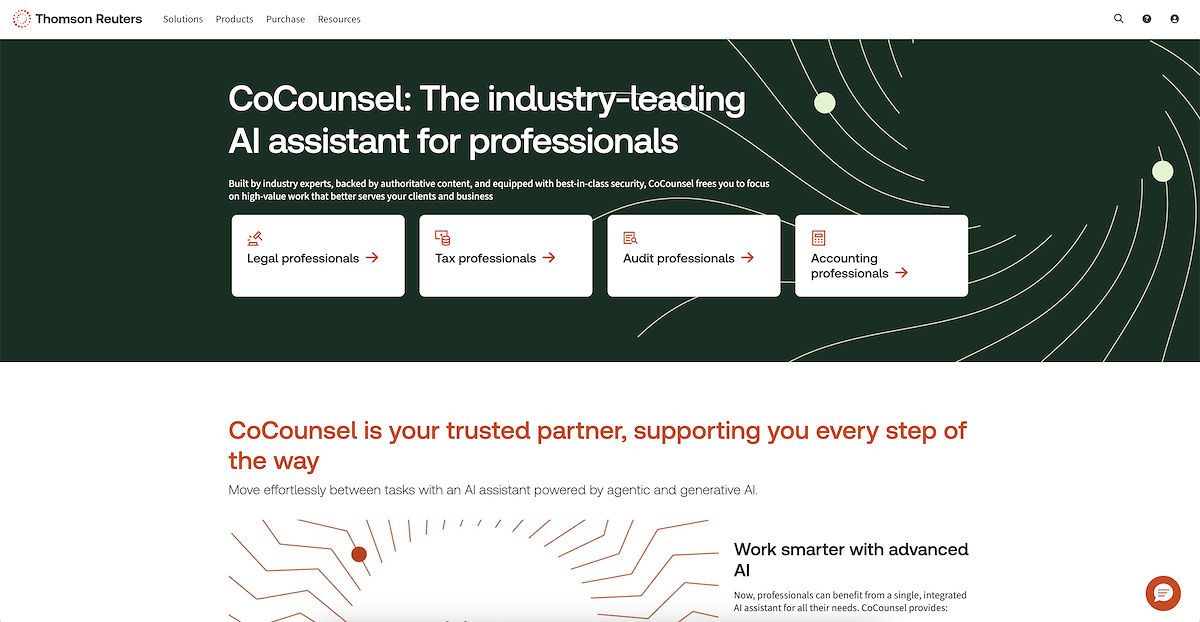
CoCounsel is an AI legal platform from Thomson Reuters that assists with drafting, summarization, and contract review. Its primary feature is its integration with proprietary content databases like Westlaw and Practical Law, grounding its analysis in curated legal research. While Callidus offers flexibility through a multi-model system, CoCounsel's value is closely tied to this ecosystem. This makes it a potential fit for legal teams who prioritize citation-backed answers from established sources, but it also creates dependence on the broader Thomson Reuters platform.
CoCounsel Features
CoCounsel provides its features through a Microsoft Word add-in and a separate web portal. Its capabilities are organized to support various legal workflows.
AI-assisted drafting, summarization, and contract review.
Playbook creation and enforcement for standardized analysis.
Multi-document analysis and knowledge management in a web portal.
Optional integration with Westlaw and Practical Law for research-backed answers.
Pre-built prompt libraries to guide common legal tasks.
CoCounsel Pricing
CoCounsel uses a tiered, per-user subscription model. Costs increase significantly when proprietary Thomson Reuters data sources are included.
Core: Starts at $150 per user per month.
With Practical Law: $275 per user per month.
With Westlaw: $375 per user per month.
All Access: $425 per user per month.
Key Considerations about CoCounsel
CoCounsel's main advantage is its integration with the Thomson Reuters ecosystem. Without subscribing to the expensive Westlaw or Practical Law tiers, its value is diminished, functioning more like other tools that rely solely on user-provided documents.
The platform's functionality is also split between a Word add-in and a separate web portal. This can interrupt the natural flow of drafting, requiring users to switch between interfaces to access all features.
Furthermore, the "no data" mode requires legal teams to invest considerable time building their own playbooks from scratch. When evaluating Callidus vs CoCounsel, this upfront workload and high price point are critical factors to consider.
3. Spellbook, The Smarter Alternative
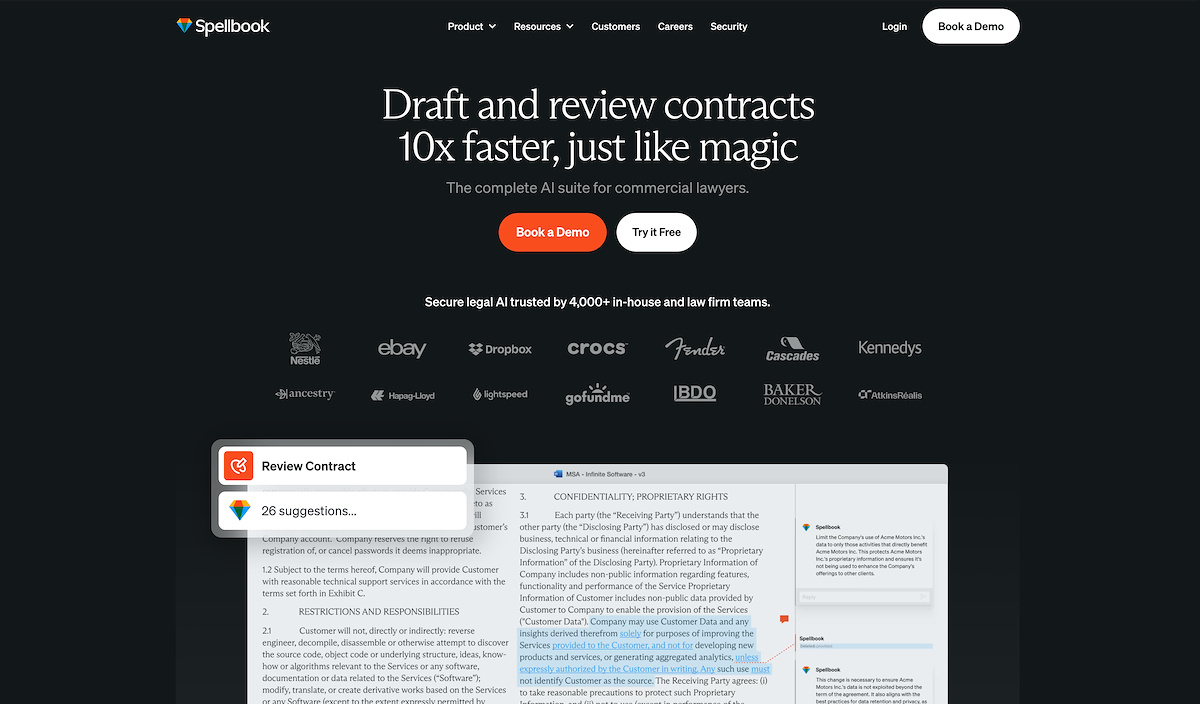
For teams weighing Callidus vs CoCounsel, Spellbook is a smarter alternative. It is a complete AI suite for commercial law that integrates into Microsoft Word, helping legal teams draft and review contracts 10x faster and with greater precision.
Spellbook is also the only contract AI grounded in real-time market data. The Review feature analyzes contracts against live benchmarks from thousands of similar agreements, giving lawyers data-driven answers to "What's market?" in any negotiation. Over 4,000 legal teams, including those at Dropbox, Fender, and Crocs, trust Spellbook to streamline contract workflows.
Spellbook Features
Review: Instantly analyzes entire contracts to provide AI-generated redlines and flag risks directly within Microsoft Word. The review can be customized with playbooks to enforce your firm's specific standards, ensuring both speed and precision.
Draft: Generate new clauses, such as for indemnification, or entire agreements that automatically match the context and defined terms of your document. Spellbook can also index your firm's historical contracts, allowing you to find and reuse your best precedent language with a simple search.
Ask: Get quick, accurate answers to questions about a contract without leaving Microsoft Word. This feature functions like a contract-specific research tool, providing citations to the relevant language in the document to support its answers.
Compare to Market: This is a key differentiator when evaluating Callidus vs CoCounsel. Instead of relying on static legal databases, Spellbook allows you to compare contract terms against real-time market data from thousands of similar agreements. You get data-driven answers on what is "market" for specific industries and deal types, strengthening your negotiation position.
Associate: An AI agent that handles complex, multi-document tasks from a single instruction. It can cross-reference files, update terms across an entire deal package, or perform due diligence reviews, acting like a junior associate to handle time-consuming projects.
Spellbook Pricing
Spellbook offers custom per-seat pricing based on team size. All annual plans are provided via a custom quote and include:
All features with unlimited usage
Onboarding, training, and support
Volume discounts for larger teams
See how Spellbook helps you draft and review contracts with more speed and precision. Start your free 7-day trial.
Why Commercial Lawyers Love Spellbook
Unlike AI assistants that rely on broad language models or static legal databases, Spellbook is built specifically for the realities of commercial contract work. While its functionality is centered within Microsoft Word to keep lawyers in their primary drafting environment, its main strength is its unique data-driven approach.
Spellbook is the only tool that grounds its analysis in real-time market data, giving lawyers a data-backed edge in negotiations. This focus on live benchmarks provides practical answers to "what's market" for any term, moving beyond the theoretical guidance offered by other platforms in the Callidus vs CoCounsel debate.
[cta-1]
CoCounsel vs Callidus vs Spellbook: Key Differences
When comparing Callidus vs CoCounsel vs Spellbook, the core differences lie in their data sources, workflow integration, and overall focus. Each platform takes a distinct approach to providing AI assistance for legal work.
1. Callidus (StrongSuit): The Flexible Generalist
Callidus operates as a Microsoft Word add-in that uses a multi-model system, routing tasks to different AI models like GPT-4 and Claude based on the specific request.
It grounds its legal research answers in an exclusive partnership with the CourtListener database, offering a different source of authority than its competitors.
The platform is positioned as a generalist tool, but its playbook features are less developed, and it is still establishing its market identity.
2. CoCounsel: The Ecosystem Play
CoCounsel’s primary value comes from its integration with Thomson Reuters' proprietary and static databases, Westlaw and Practical Law.
Its effectiveness is closely tied to expensive subscriptions to these data tiers. Without them, its functionality is significantly reduced.
The platform’s features are split between a Word add-in and a separate web portal, which can interrupt the natural flow of drafting.
3. Spellbook: The Data-Driven Specialist
Spellbook is a complete AI suite built specifically for commercial law, operating entirely within Microsoft Word to help legal teams work with greater speed and precision.
It is the only platform that grounds its analysis in real-time market data. Its Review feature analyzes contract terms against thousands of similar, recent agreements.
This provides lawyers with data-backed answers to "What's market?" during negotiations, a unique advantage in the Callidus vs CoCounsel debate. The platform also meets key compliance standards, including HIPAA.
Which Option Is Right For Your Business?
For Teams Deeply Integrated with Thomson Reuters
CoCounsel is the logical choice. Its value is maximized when paired with Westlaw and Practical Law, creating a unified research and drafting environment for firms already invested in that ecosystem.
For Commercial Teams Focused on Negotiation
Spellbook is the superior option. It is built specifically for commercial contract work and operates entirely in Word. Its ability to provide data-driven market insights gives teams a tangible advantage in negotiations, moving beyond static legal databases.
For Firms Needing a Predictable, All-in-One Tool
Spellbook offers the best value. Its flat-rate pricing includes all features and unlimited use, providing cost certainty. This contrasts with the tiered models of competitors and provides a focused, mature tool for contract work without the uncertainty of a generalist platform.
The Bottom Line
Your decision in the Callidus vs CoCounsel comparison depends on your priorities. CoCounsel suits those embedded in the Thomson Reuters world, while Callidus offers AI model flexibility but is less specialized. For most legal teams focused on commercial contracts, Spellbook provides the most direct and data-driven path to improving drafting and review workflows with both speed and precision.
Try Spellbook Free
Unlike generalist AI assistants or tools tied to static legal databases, Spellbook is built specifically for the demands of commercial contract work, improving both speed and precision. It provides a data-driven advantage by analyzing contract terms against thousands of live market examples. Start your free trial today to see how Spellbook can strengthen your negotiations.
Frequently Asked Questions
How do Callidus and CoCounsel handle data security and client confidentiality?
This is a critical point for legal teams. CoCounsel, as part of Thomson Reuters, operates within a large, established security framework. They offer a "no data" mode where the AI only uses user-provided documents and playbooks, preventing data from being used for model training.
Callidus also emphasizes security, but its use of third-party AI models like GPT-4 and Claude means firms must trust the data policies of those providers as well. It is important to review the specific terms of service for each platform, as many lawyers are cautious about how their data is handled, raising questions about whether ChatGPT is private.
What does the implementation and training process look like for these platforms?
Both Callidus and CoCounsel include onboarding and support in their subscription plans. The process typically involves installing the Microsoft Word add-in and providing training sessions for the legal team.
However, the initial setup can differ in intensity. For CoCounsel, especially without the Westlaw or Practical Law data tiers, teams may need to invest significant time building their own playbooks from scratch to make the tool effective. Callidus also requires playbook setup, but its generalist nature might allow for more immediate use on simpler tasks.
How is Spellbook’s data-driven approach different from the research features in CoCounsel or Callidus?
This is a key distinction in the Callidus vs CoCounsel discussion. CoCounsel grounds its answers in static, curated legal databases like Westlaw and Practical Law. Callidus uses the CourtListener database for legal Q&A. Both provide historical or established legal information.
Spellbook, in contrast, is the only platform that uses real-time market data. Its Compare to Market feature analyzes a contract's terms against thousands of similar, recent agreements. This gives lawyers data-backed answers on what is currently "market" for a specific clause, like a limitation of liability provision, in a live negotiation. It moves the analysis from "what has been done" to "what is being done now," providing a practical advantage.
[cta-2]
Our Research Methodology
This comparison is based on comprehensive research of publicly available information, including product websites, feature documentation, press releases, customer reviews, legal technology publications, and third-party analyses from sources like LawSites, Artificial Lawyer, and industry analysts.
Where pricing information is not publicly disclosed, we've included estimates based on available industry data and user reports. Information is current as of 2026 and may change as products evolve. We encourage readers to verify details directly with vendors and request demos to evaluate fit for their specific needs.
.png)
%20(1).png)


Thank you for your interest! Our team will reach out to further understand your use case.
Spellbook is the most complete AI suite for commercial legal work, trusted by more than 4,400 in-house teams and law firms worldwide.

SOC 2 Type II

HIPAA

GDPR
EU AI Act

HIPAA Compliant
