
Harvey vs. Gavel: Which Is The Top Pick for 2026?
.jpeg)


Deciding between Harvey vs Gavel means choosing between two different philosophies for legal AI. Harvey provides a platform for large-scale analysis and collaborative diligence, while Gavel is focused on automating document production with structured rules. To help you decide, this review breaks down their core features, pricing, and underlying AI architecture.
Key Takeaways
- Harvey is a legal AI platform for large-scale analysis and collaborative diligence, while Gavel is a document automation tool that uses structured rules to produce legal documents.
- The main difference lies in their focus: Harvey is built for analyzing large sets of documents and managing complex, collaborative workflows. Gavel, on the other hand, is designed to systematize document creation through rule-based automation.
- Spellbook offers a third approach, trusted by over 4,000 legal teams to draft, review, and negotiate contracts with greater speed and precision. It operates entirely within Microsoft Word and is the only legal AI grounded in real-time market data, giving lawyers data-driven answers to “What’s market?” in any negotiation.
1. Harvey
Harvey is a legal AI platform built for large-scale analysis and collaborative work, particularly for teams managing complex transactions and large sets of documents. It is designed for enterprise and mid-market legal teams to handle tasks like structured diligence and multi-contributor reviews within a shared workspace. Unlike Gavel's focus on automating document creation, Harvey is architected as a broader legal operations platform. This can introduce more setup and management overhead for teams who primarily need a fast, simple tool for contract redlining within Word.

Harvey Features
Harvey’s platform is organized around several core components designed for large-scale legal work. These are not standalone tools but parts of an integrated system.
- Vault: A repository for analyzing large document sets, supporting up to 100,000 documents for cross-document review and data extraction.
- Workflows: Configurable, multi-step processes that guide teams through standardized tasks like diligence or document generation.
- Assistant: A prompt-based interface for asking legal questions, analyzing documents, and generating initial drafts.
- Word Add-in: Supports in-document editing, though the platform's main functions are in its separate web interface.
Harvey Pricing
Harvey uses an enterprise subscription model with pricing negotiated based on team size and contract structure. A formal pilot is usually part of the evaluation process.
- Indicative pricing starts around $40,000 annually for a team of 10.
- The per-user cost is approximately $290 to $333 per month, depending on scale.
- A two-week, structured pilot is typically required before full deployment.
Key Considerations about Harvey
While Harvey is a powerful platform, its architecture comes with specific trade-offs. It is built as a broad legal operations system, which introduces management overhead that may not be suitable for all teams.
For legal departments that primarily need to accelerate contract drafting and review inside Microsoft Word, Harvey’s platform-centric approach can feel cumbersome. Its strengths are in large-scale, collaborative diligence rather than rapid, individual redlining.
Finally, Harvey is priced at the higher end of the market. This makes the Harvey vs Gavel decision more complex for teams that may not need its full suite of enterprise legal operations features and are looking for a more focused tool for contract work.
2. Gavel
Gavel is a document automation platform that uses rule-based logic to generate legal documents. It is designed for teams in document-heavy practice areas like real estate and commercial contracting who want to systematize document creation. Unlike Harvey's focus on large-scale analysis, Gavel is centered on document production through structured questionnaires and predefined rules. This approach makes it more of a document assembly tool than a dynamic contract review platform, which may not suit teams needing sophisticated analysis for complex negotiations.
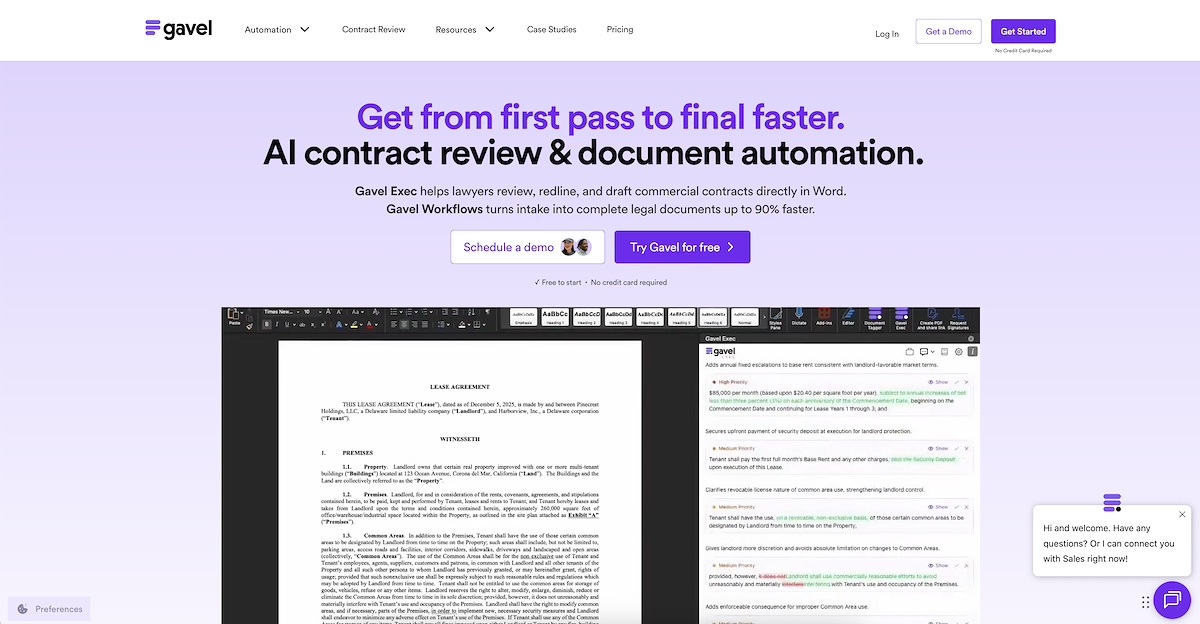
Gavel Features
Gavel’s platform is built to systematize document creation through a combination of rule-based logic and AI assistance. Its main capabilities are delivered through a Word add-in and a web application.
- Word Add-in: A chat-based interface for drafting, redlining, and summarizing documents based on user prompts.
- Playbooks: Rule sets that define standards for specific contract types, flagging violations and suggesting changes.
- Document Generation: A web-based tool that creates documents from structured questionnaires and predefined logic.
- Projects: Shared knowledge bases for storing and reusing clause libraries, templates, and internal standards.
Gavel Pricing
Gavel uses a straightforward subscription model with pricing that is generally in the lower to mid-range of the legal AI market.
- Pricing starts at approximately $160 per user per month.
- Discounts are available for teams of 10 or more.
- Billing is typically monthly, and long-term contracts are not required by default.
Key Considerations about Gavel
Gavel's strength is in document production, not dynamic analysis. It excels at generating standardized documents from structured questionnaires and rule-based logic, making it more of a document assembly tool than a sophisticated contract review platform.
For teams focused on negotiating complex, third-party agreements, this approach can feel rigid. The platform is not designed for the nuanced analysis required in high-stakes deals, where data-driven insights into market standards are critical. The choice in the Harvey vs Gavel debate often comes down to whether a team needs document automation or a more powerful analysis engine.
3. Spellbook, The Smarter Alternative
While the Harvey vs Gavel discussion highlights two distinct approaches to legal AI, Spellbook offers a third alternative. It is a complete AI suite for contracts and commercial law that integrates directly into Microsoft Word, helping legal teams draft and review contracts 10x faster and with greater precision, all within their existing workflow.
Spellbook is the only contract AI grounded in real-time market data. Its Review feature analyzes agreements against thousands of similar contracts, giving lawyers data-driven answers to "What's market?" in any negotiation. More than 4,000 legal teams, including those at Dropbox, Fender, and Crocs, use Spellbook to manage contract workflows.
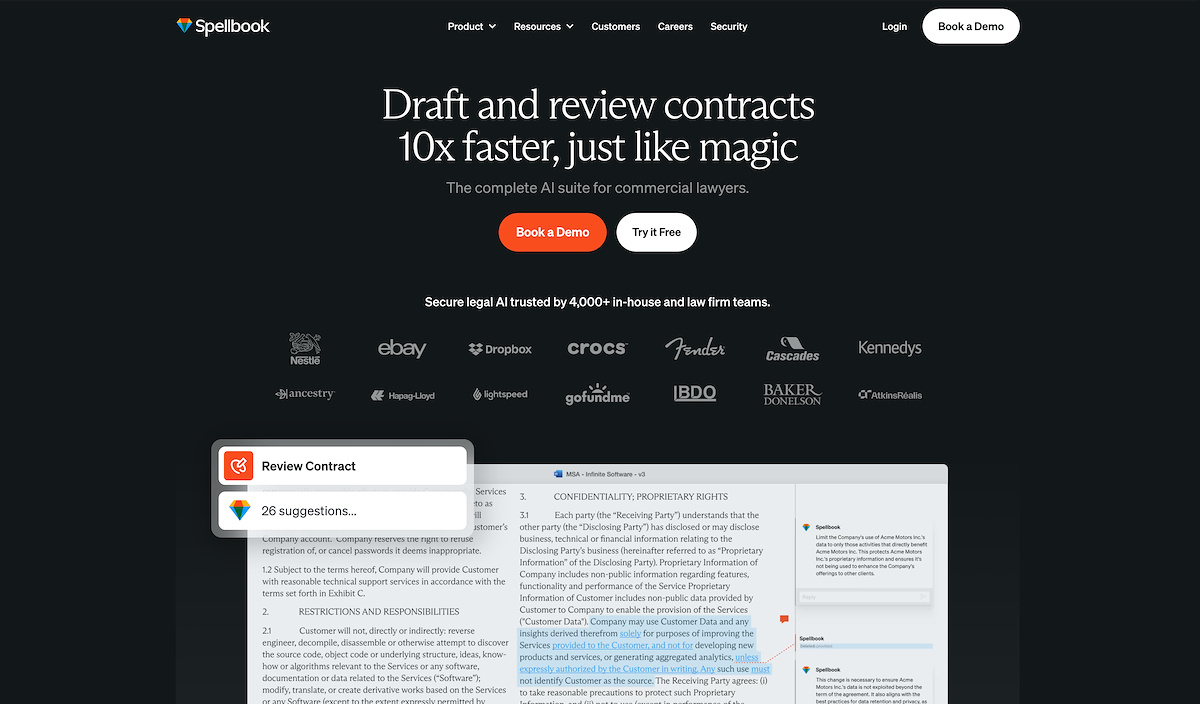
Spellbook Features
- Review: Spellbook’s primary analysis engine reviews entire contracts instantly within Microsoft Word. It generates redlines, identifies risks, and flags issues, with all edits appearing as track changes under the lawyer’s name to maintain authorship. This is different from Harvey’s platform-centric approach and more dynamic than Gavel’s rule-based document assembly.
- Draft: This feature provides clause-level and full-document generation. It can draft new clauses from scratch or pull from a library of standard provisions. Spellbook also indexes a firm’s historical contracts, allowing lawyers to find and reuse their own precedent language. When a clause, such as for indemnification, is inserted, the AI automatically adapts it to match the style and defined terms of the current agreement.
- Ask: A contract-specific Q&A tool that functions directly in Word. Lawyers can ask questions about contractual obligations or specific terms, and the system provides answers with citations to the relevant language in the document. This grounding helps ensure that lawyers can verify the AI’s outputs and avoid the risks of fake citations.
- Compare to Market: A unique feature that allows lawyers to compare contract terms against real-time market data from thousands of similar agreements. It provides data-driven answers to "What's market?" for key terms, helping lawyers negotiate from a position of statistical evidence rather than subjective experience. This data-grounded approach is a key factor in the Harvey vs Gavel comparison, as neither competitor offers this capability.
- Associate: An AI agent that can execute multi-document, multi-step projects from a single prompt. It can cross-reference document sets, update terms across multiple files, and prepare entire document packages. This allows teams to delegate complex tasks that go beyond the scope of simple document review or generation.
Spellbook Pricing
Spellbook uses a custom per-seat pricing model, with quotes tailored to your team’s size and needs. All plans are provided on an annual basis.
- Subscriptions include all features, onboarding, and support.
- Volume discounts are available for teams of 10 or more.
You can test the full platform with no commitment. Get started with a free trial.
Why Commercial Lawyers Love Spellbook
Unlike legal AI platforms that require working in a separate web interface or depend on rigid, rule-based systems, Spellbook operates entirely within Microsoft Word. This deep integration helps lawyers work faster and with greater precision, without having to switch contexts between drafting and analysis. While Spellbook is built exclusively for Word, this focus allows it to provide powerful analysis and drafting assistance directly where lawyers do their most critical work. It gives them a data-backed edge in negotiations, something central to the Harvey vs Gavel discussion, as neither competitor offers real-time market benchmarks.
[cta-1]
Gavel vs Harvey vs Spellbook: Key Differences
The Harvey vs Gavel decision highlights two different approaches to legal AI, but a third option, Spellbook, offers a more integrated solution for contract work. The key differences lie in their core architecture, primary use case, and workflow integration.
1. Harvey: Collaborative Analysis Platform
Harvey is built for large-scale analysis and collaborative diligence. Its strengths are in managing complex transactions and reviewing up to 100,000 documents in a shared, web-based workspace. This platform-centric model is designed for enterprise teams coordinating multi-contributor reviews, which can introduce management overhead for teams focused on drafting.
2. Gavel: Rule-Based Document Automation
Gavel is a document automation tool that generates legal documents from structured questionnaires and predefined rules. It excels at systematizing the creation of standardized documents, making it more of a document assembly engine than a dynamic review platform for complex, third-party paper.
3. Spellbook: Word-Native Contract Suite
Spellbook is a complete AI suite for commercial law that operates entirely within Microsoft Word. This helps over 4,000 legal teams draft and review contracts 10x faster and with greater precision, without context switching. It is the only contract AI grounded in real-time market data, giving lawyers data-driven answers to “What’s market?” in any negotiation. This capability, along with an AI agent like Associate for complex tasks, offers a distinct advantage in the Harvey vs Gavel comparison, as neither competitor provides data-backed negotiation intelligence.
Which Option Is Right For Your Business?
For Large Teams Managing Complex Diligence
Harvey is the appropriate choice. Its platform is designed specifically for large-scale analysis and collaborative workflows, making it a strong tool for coordinating complex reviews across large teams.
For Firms Automating Document Assembly
Gavel is the better fit here. Its strength lies in rule-based document generation, which is ideal for practices looking to systematize the creation of high-volume, standardized legal documents.
For In-House and Commercial Law Teams
Spellbook is the most practical option. It integrates directly into Microsoft Word, where contract work happens. This focus allows lawyers to draft, review, and negotiate with more speed and precision without changing their existing workflow.
The Bottom Line
The best tool depends on your core task. Harvey is for large-scale diligence, and Gavel is for document assembly. For the daily work of drafting and negotiating commercial contracts, Spellbook provides the most direct and efficient solution by operating entirely within Word.
Try Spellbook Free
In the Harvey vs Gavel comparison, Spellbook offers a more practical approach by working directly inside Microsoft Word, where your team already operates. It provides data-driven negotiation intelligence, helping you draft and review with greater speed and precision. Start a free trial today to experience the full platform with no commitment.
Frequently Asked Questions
What is the implementation process like for Harvey and Gavel?
The implementation process for each tool reflects its core purpose. Harvey, being an enterprise platform for large-scale analysis, typically requires a structured pilot program and more involved setup. Since its main functions operate in a separate web interface, teams need to be onboarded onto a new system for managing documents and collaborative reviews.
Gavel's setup is centered on its rule-based document automation. Implementation involves building the logic and questionnaires that will generate your documents. While this can be faster for simple workflows, it requires an upfront investment in defining the rules for each document type you want to automate.
How do Harvey and Gavel handle data security and confidentiality?
Data security is a primary concern for any legal team adopting AI. Both Harvey and Gavel are built for the legal market and have security protocols in place. However, it is essential for any firm to perform its own due diligence on data handling, encryption, and confidentiality policies during the evaluation process.
Key questions to ask include where data is stored, who has access, and whether your firm's confidential information could be used to train the provider's AI models. Understanding whether AI is private is a critical step before uploading any client documents to a third-party platform.
How does Spellbook's AI approach compare to Harvey and Gavel for contract work?
Spellbook’s approach is fundamentally different from both Harvey and Gavel because it is designed to assist lawyers directly within their existing Microsoft Word workflow. It does not require moving to a separate platform for analysis like Harvey, nor is it limited to the rigid, rule-based document assembly of Gavel.
Instead, Spellbook acts as an AI assistant for the dynamic tasks of drafting, reviewing, and negotiating. It provides clause suggestions, risk analysis, and data-driven market benchmarks on the fly. This makes it a more practical tool for lawyers who need to improve the speed and precision of their day-to-day contract work, functioning much like a specialized version of ChatGPT for lawyers but with legal-specific safeguards and features.
[cta-2]
Our Research Methodology
This comparison is based on comprehensive research of publicly available information, including product websites, feature documentation, press releases, customer reviews, legal technology publications, and third-party analyses from sources like LawSites, Artificial Lawyer, and industry analysts.
Where pricing information is not publicly disclosed, we've included estimates based on available industry data and user reports. Information is current as of 2026 and may change as products evolve. We encourage readers to verify details directly with vendors and request demos to evaluate fit for their specific needs.
.png)
%20(1).png)


Thank you for your interest! Our team will reach out to further understand your use case.
Spellbook is the most complete AI suite for commercial legal work, trusted by more than 4,400 in-house teams and law firms worldwide.

SOC 2 Type II

HIPAA

GDPR

EU AI Act

HIPAA Compliant
