
Harvey vs Iqidis: Which Is The Top Pick in 2026?
.jpeg)

Choosing the right legal AI platform is a critical decision, and the Harvey vs Iqidis comparison highlights two distinct approaches to legal work. Harvey is built for large-scale, collaborative legal operations and diligence, while Iqidis (Irys) offers a centralized "legal operating system" to manage entire matters from a single workspace. To help you decide, we will compare their core features, AI architecture, and pricing models.
Key Takeaways
- Harvey is a legal AI platform built for large-scale, collaborative legal operations and diligence, while Iqidis (Irys) offers a centralized “legal operating system” to manage entire matters from a single workspace.
- The core difference in the Harvey vs Iqidis comparison is their primary focus: Harvey excels at repository-scale analysis for teams, whereas Iqidis aims to centralize the entire legal workflow into matter-specific folders.
- Alternatively, Spellbook is a legal AI suite trusted by over 4,000 in-house and law firm teams to draft and review contracts with greater speed and precision, all within Microsoft Word. It is the only tool that provides real-time market data, helping lawyers negotiate with data-driven confidence.
1. Harvey
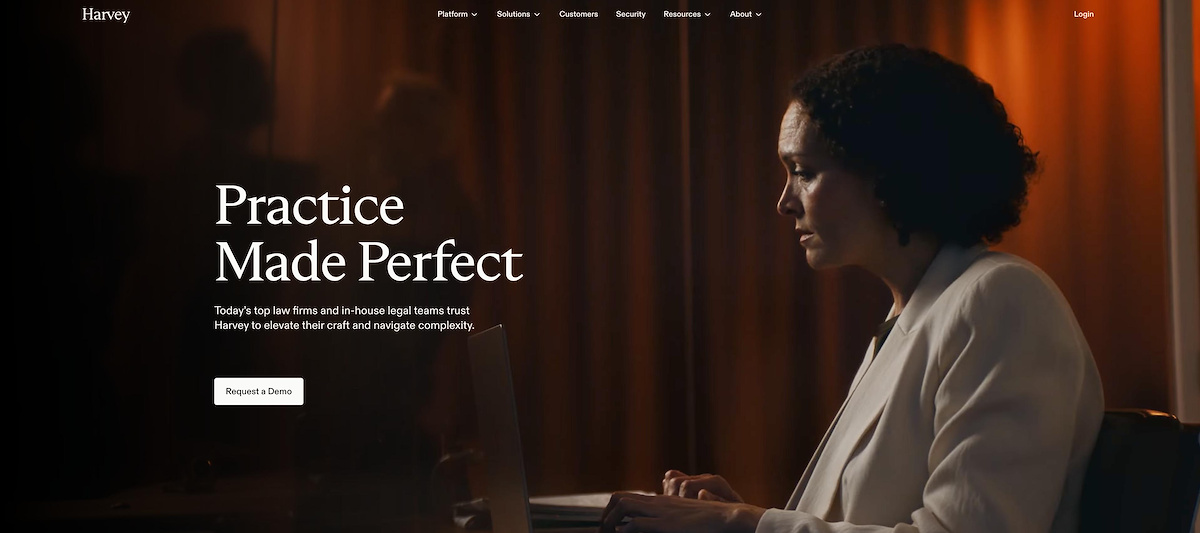
Harvey is a legal AI platform built for large-scale, collaborative legal operations. It is designed for enterprise legal departments and large law firms that manage complex transactional workflows and large document sets.
Unlike more focused tools, Harvey provides a broad system for legal operations, emphasizing repository-scale analysis and diligence. This approach can be powerful for large-scale projects, but may introduce complexity for teams whose primary need is fast, efficient contract drafting and review within their existing workflows.
Harvey Features
Harvey is organized around three main components designed for large-scale legal work, rather than individual document tasks.
- Vault: A central repository for analyzing up to 100,000 documents, with tools for structured data extraction.
- Workflows: Configurable, multi-step processes that help standardize legal tasks like diligence across teams.
- Collaboration: Shared workspaces with permission controls and human verification of AI outputs to support team-based review.
- Word Add-in: Provides in-document editing, but the platform’s main functions exist in a separate environment.
Harvey Pricing
Harvey uses an enterprise subscription model with pricing negotiated based on team size and contract length.
- Annual Subscription: Pricing starts at approximately $40,000 per year for a team of 10 users.
- Custom Quotes: Final pricing is determined through a sales process, not public tiers.
- Structured Pilots: Customers typically go through a two-week pilot to evaluate the platform before committing.
Key Considerations about Harvey
While powerful for large-scale operations, Harvey’s architecture introduces trade-offs that may not suit every legal team. Its focus on being a broad system for legal operations can create complexity for teams that primarily need to accelerate contract drafting and review.
The platform’s flexibility requires significant setup and management. Unlike tools designed for immediate use within Microsoft Word, Harvey’s configurable workflows and repository-based approach demand more initial overhead.
It is also less specialized for rapid redlining and drafting. Teams looking for a tool to speed up day-to-day contract work may find its broader system cumbersome. This is a key point in the Harvey vs Iqidis comparison, as both platforms require work outside of a lawyer's typical document editor.
2. Iqidis
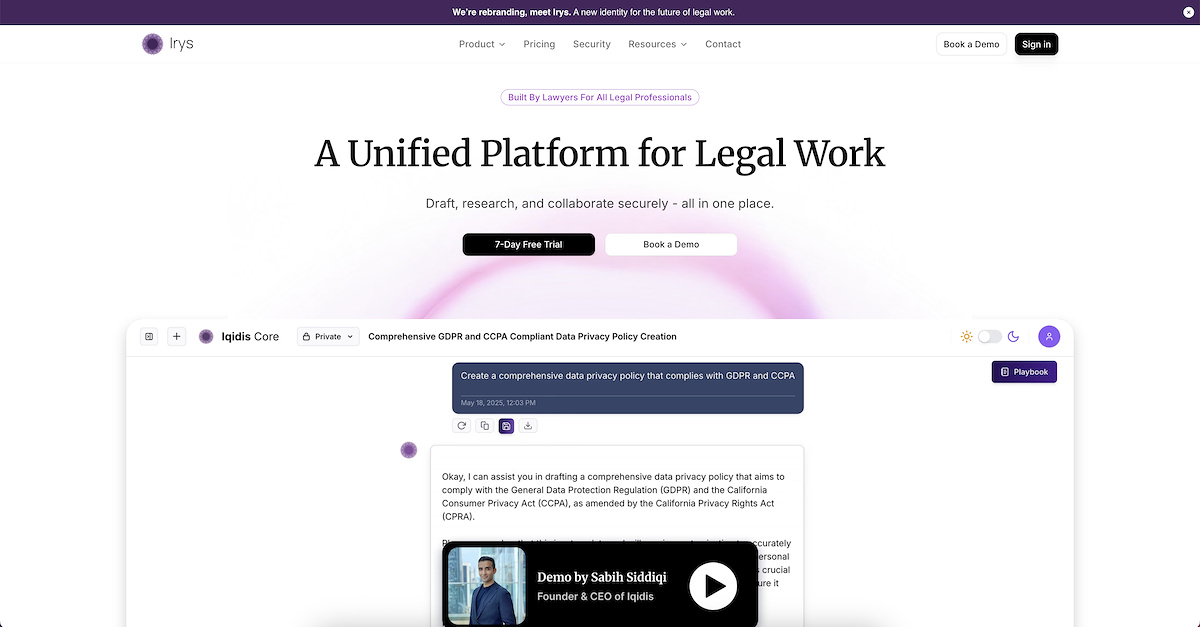
Iqidis (Irys) is positioned as a “legal operating system” that aims to centralize entire legal projects into a single platform. It organizes work into matter-specific folders to support multi-document analysis for transactional and vendor-contract workflows. Unlike Harvey’s focus on repository-scale analysis, Iqidis attempts to manage the full legal workflow from end to end. This approach requires legal teams to adopt a new, separate workspace, which can be a significant shift from working within familiar document editors.
Iqidis Features
Iqidis is built as a central workspace, organizing legal work into distinct matter-specific folders. Its features are designed to manage projects from end to end within its own platform.
- Matter Folders: A dedicated space to group all documents, instructions, and analysis for a single project.
- Multi-Document Analysis: Tools to review and extract information from large document sets simultaneously.
- Collaboration: Shared workspaces for internal teams, business stakeholders, and external counsel.
- Planned Word Add-in: An integration with Microsoft Word is on the roadmap, but the platform is currently web-based.
Iqidis Pricing
Iqidis uses an enterprise subscription model with pricing based on the number of users.
- Per-Seat Cost: Pricing ranges from $329 to $399 per user, per month.
- Billing Cycle: Contracts are typically billed on a semi-annual or annual basis.
- Minimums: The model is designed for teams, not individual users.
Key Considerations about Iqidis
The primary consideration for Iqidis is its "legal operating system" approach, which requires teams to move their work into a new, separate platform. This can create significant friction and training overhead compared to tools that integrate directly into Microsoft Word, where lawyers already have established AI workflows.
Furthermore, key functionality, including a Microsoft Word add-in and an in-platform drafting editor, are on the company's roadmap and not yet available. This reliance on future releases introduces uncertainty for teams needing a ready-to-use solution today.
The core issue in the Harvey vs Iqidis comparison is often workflow disruption. Both platforms pull lawyers out of their familiar editor, but Iqidis's vision of managing the entire legal workflow makes this shift particularly demanding.
3. Spellbook, The Smarter Alternative
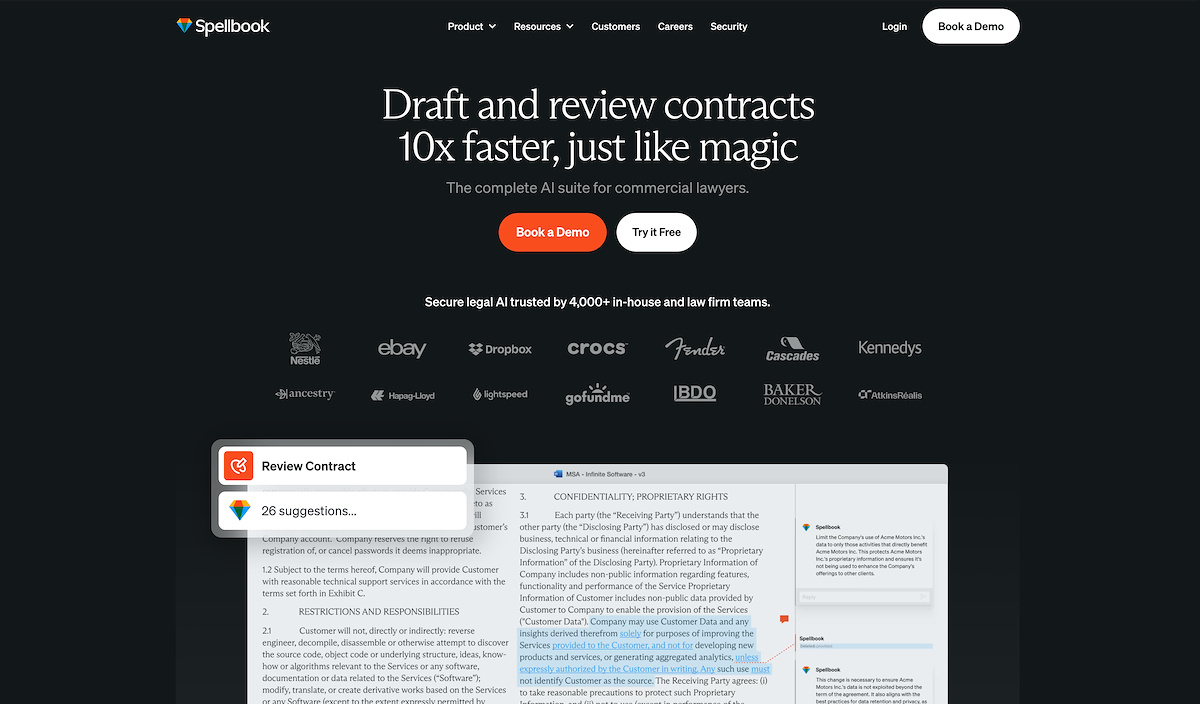
While both Harvey and Iqidis require legal teams to adopt new platforms, Spellbook is an AI suite built specifically for contracts and commercial law that integrates directly into Microsoft Word. This eliminates context switching, helping over 4,000 legal teams draft and review agreements with greater speed and precision.
Spellbook is also the only contract AI grounded in real-time market data. Its Review feature analyzes contracts against live benchmarks from thousands of similar agreements, giving lawyers data-driven answers to "What's market?" in any negotiation. This provides a practical advantage for teams focused on commercial law.
Spellbook Features
- Review: Instantly analyzes an entire document to identify risks, suggest redlines, and flag missing clauses. All edits appear as standard track changes in Word, keeping the lawyer in full control of the final work product.
- Draft: Generates new clauses or entire agreements from simple instructions. Lawyers can also pull language from a built-in clause library or their firm’s own precedent documents, and Spellbook automatically adapts the text to match the context of the current agreement.
- Ask: A chat-based tool that allows lawyers to ask specific questions about the contract they are working on, directly within Word. It provides answers with citations to the relevant language in the document, supporting quick verification.
- Compare to Market: Analyzes contract terms against real-time data from thousands of similar agreements. This feature gives lawyers data-driven answers to the common question of "What's market?" for any given term, strengthening their negotiation position.
- Associate: An AI agent that manages multi-document, multi-step projects from a single prompt. It can handle complex tasks like preparing a full document package from a term sheet or conducting diligence reviews across a data room.
Spellbook Pricing
Spellbook offers custom per-seat pricing based on your team's size and feature requirements. All subscriptions are annual and include every feature, from Review and Draft to the AI agent, Associate.
- Pricing is provided through a custom quote.
- Volume discounts are available for larger teams.
Get started today with a free 7-day trial to see how Spellbook fits your workflow.
Why Commercial Lawyers Love Spellbook
Unlike separate legal platforms that require adopting a new system, Spellbook is built to work directly within Microsoft Word. While this focus means Spellbook offers a dedicated Word integration instead of a web-based editor, it eliminates the friction of switching between applications.
This approach allows commercial lawyers to accelerate their existing contract drafting and review process with greater precision, without a steep learning curve. The ability to get data-driven negotiation insights directly within the document provides a practical advantage for day-to-day commercial work, a key distinction in the Harvey vs Iqidis landscape.
[cta-1]
Iqidis vs Harvey vs Spellbook: Key Differences
The fundamental difference in the Harvey vs Iqidis vs Spellbook comparison lies in their core philosophy. Harvey and Iqidis are standalone platforms that require lawyers to work outside of their document editor, while Spellbook integrates directly into Microsoft Word to enhance existing workflows.
1. Harvey
Harvey is built for large-scale legal operations and collaborative diligence. Its strength is analyzing massive document repositories within its own environment, making it suitable for complex projects. This approach, however, can introduce complexity for teams focused on daily contract drafting and review.
2. Iqidis (Irys)
Iqidis aims to be a centralized "legal operating system" for managing entire matters. This requires moving all work into its platform, a significant operational shift. While its vision is broad, key functionality like a Microsoft Word add-in is still on the company's roadmap, limiting its utility for teams that work primarily in Word.
3. Spellbook
Spellbook is an AI suite for commercial law that operates entirely within Microsoft Word. This eliminates context switching, helping legal teams draft and review contracts with greater speed and precision. It is the only platform grounded in real-time market data, analyzing terms against thousands of agreements to give lawyers data-driven answers to "What's market?" during negotiations.
Ultimately, the Harvey vs Iqidis decision centers on which external platform best suits a firm's operational model. Spellbook presents a practical alternative, focused on accelerating the core tasks of commercial lawyers without requiring them to learn a new system.
Which Option Is Right For Your Business?
For Large Law Firms Managing Complex Diligence
Harvey is the logical choice for enterprise legal departments handling large-scale diligence. Its architecture is designed for analyzing massive document sets and managing complex, multi-step projects across large teams.
For Commercial Teams Focused on Contract Velocity
Spellbook is the ideal fit for most in-house and law firm teams that prioritize efficient contract drafting and review.
It works directly within Microsoft Word, allowing lawyers to increase their speed and precision without changing their existing process. This direct integration eliminates the learning curve associated with adopting a separate platform.
For Teams Building a New, Centralized Workflow
Iqidis is best suited for teams that want to build their entire legal operation within a new, all-in-one system. If your goal is to centralize all matter-related documents and communication into a single web-based platform and are willing to adopt a new workflow, its approach may be a good fit.
The bottom line: Your decision in the Harvey vs Iqidis debate, with Spellbook as a key alternative, comes down to a simple question: do you want to replace your workflow or accelerate it?
Harvey and Iqidis require you to work in a new, separate platform. Spellbook is built to make you faster and more precise in the tools you already use.
Try Spellbook Free
While the Harvey vs Iqidis comparison centers on which external platform to adopt, Spellbook offers a different approach by working directly within Microsoft Word. See how you can accelerate your existing contract process with greater precision by starting a free trial today.
Frequently Asked Questions
What AI models do Harvey and Iqidis use?
Harvey is built on a combination of large language models, including those from OpenAI and Anthropic. This allows it to perform a wide range of analytical tasks. Iqidis has not publicly disclosed the specific AI models that power its platform.
For legal teams, the underlying AI model is a critical consideration, as it directly impacts data security and confidentiality. It is important to understand the provider’s data handling policies before uploading sensitive client information to any third-party platform.
How do Harvey and Iqidis integrate with other legal tech tools?
Both Harvey and Iqidis function primarily as standalone platforms, which means their ability to integrate with other tools in your legal tech stack is limited. Their design centers on creating an all-in-one environment for legal work, rather than connecting with other specialized software.
While Harvey offers a Word add-in, its core functionality resides in its separate web application. This approach can create silos, requiring manual data transfer between systems instead of a connected workflow.
Is Harvey or Iqidis better for solo practitioners or small firms?
Neither platform is well-suited for solo practitioners or small law firms. Both Harvey and Iqidis use enterprise-focused subscription models that involve significant annual costs, per-seat licenses, and potential user minimums.
Their feature sets are also designed for the complexity of large-scale corporate transactions and diligence projects, which may be more than what a smaller practice requires for day-to-day work.
How does Spellbook fit into the Harvey vs Iqidis comparison?
Spellbook offers a fundamentally different approach. Instead of requiring you to adopt a new, separate platform like Harvey or Iqidis, Spellbook integrates directly into Microsoft Word to accelerate your existing workflow.
This allows lawyers to increase their speed and precision on core tasks without context switching. For example, you can draft a new limitation of liability clause or review an entire agreement for risks without ever leaving your document. Spellbook is built for the practical, daily needs of commercial lawyers, not for replacing their entire operational structure.
[cta-2]
Our Research Methodology
This comparison is based on comprehensive research of publicly available information, including product websites, feature documentation, press releases, customer reviews, legal technology publications, and third-party analyses from sources like LawSites, Artificial Lawyer, and industry analysts.
Where pricing information is not publicly disclosed, we've included estimates based on available industry data and user reports. Information is current as of 2026 and may change as products evolve. We encourage readers to verify details directly with vendors and request demos to evaluate fit for their specific needs.
.png)
%20(1).png)

Thank you for your interest! Our team will reach out to further understand your use case.
Spellbook is the most complete AI suite for commercial legal work, trusted by more than 4,400 in-house teams and law firms worldwide.

SOC 2 Type II

HIPAA

GDPR

EU AI Act

HIPAA Compliant
