
Ivo vs Gavel: Which Is The Top Pick in 2026?
.jpeg)


The Ivo vs Gavel comparison is a common one for legal teams looking to improve their contract processes. Ivo offers a system for enforcing negotiation standards through playbooks, while Gavel automates document creation with structured workflows. This article breaks down their product features, pricing, and underlying technology to help you determine which tool, if either, is the right choice for your practice.
Key Takeaways
Ivo is a contract review tool for enforcing negotiation standards through playbooks, while Gavel is a document automation platform that builds documents from structured workflows.
The main difference lies in their primary function: Ivo focuses on reviewing contracts against predefined playbooks, while Gavel concentrates on automating the creation of new documents.
In contrast, Spellbook is a complete AI suite trusted by over 4,000 legal teams to draft, review, and negotiate contracts with greater speed and precision. It combines the strengths of both tools and adds unique capabilities like real-time market data for negotiation and an AI agent, Spellbook Associate, for handling complex, multi-document work.
1. Ivo
Ivo is a contract review platform that operates within Microsoft Word. It is designed to help legal teams, particularly in-house departments, enforce their negotiation standards consistently across high volumes of commercial contracts.
The platform uses a system of predefined “playbooks” to review agreements. Unlike Gavel, which focuses on automating the creation of new documents, Ivo is built for reviewing incoming contracts against a strict set of rules. This deterministic approach prioritizes rigid policy enforcement over the more flexible analysis offered by other AI tools.

Ivo Features
- Operates as a Microsoft Word add-in for in-document review.
- Uses predefined playbooks to redline contracts and flag issues.
- Generates issue lists and summary reports for internal review.
- Playbooks are built and updated by Ivo’s internal legal team based on customer materials.
- Future plans include a contract repository and structured approval workflows.
Ivo Pricing
Ivo uses a straightforward pricing model based on a per-user annual subscription.
- $6,000 per user, per year.
- Includes playbook creation, onboarding, and ongoing support.
- Discounts are available for teams with 10 or more users.
Key Considerations about Ivo
While Ivo’s deterministic approach ensures consistency, it comes with trade-offs. The platform’s reliance on rigid, pre-built playbooks means it lacks the flexibility of more adaptive AI tools. Since Ivo's team builds the playbooks, users are dependent on them for initial setup and modifications, which may not be ideal for teams needing to adapt quickly.
The platform is also intentionally limited. It does not offer legal research, jurisdictional analysis, or the ability to compare terms against market data. For legal teams looking for a tool that supports data-driven negotiation or handles more dynamic legal work, these limitations are an important factor in the Ivo vs Gavel decision.
2. Gavel
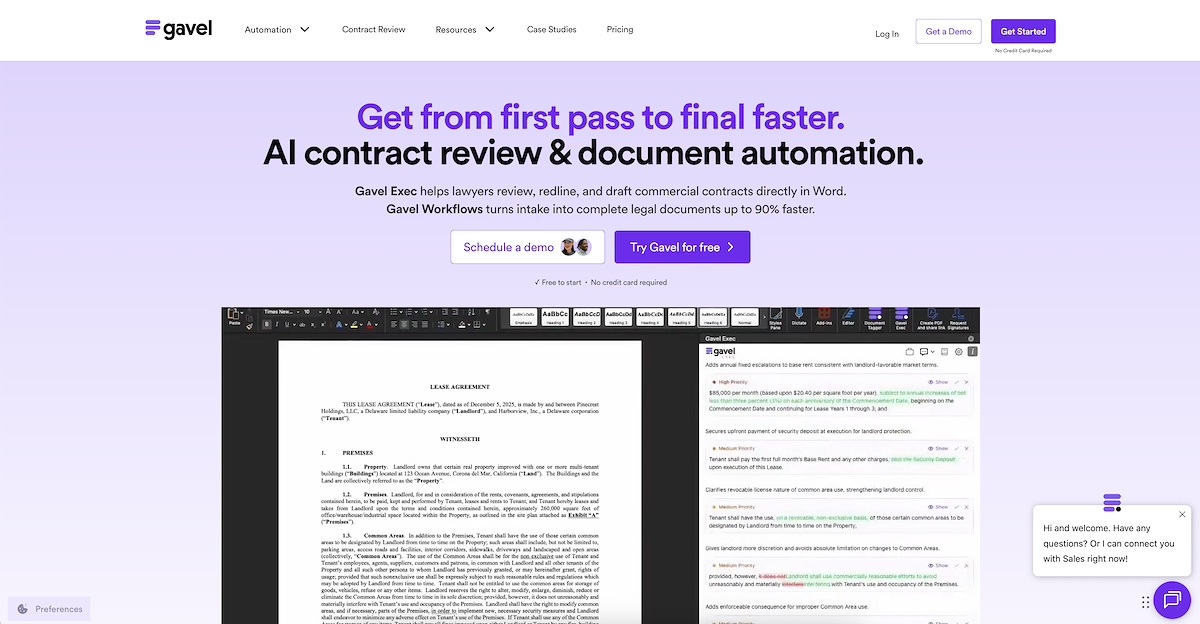
Gavel is a document automation platform that focuses on creating new legal documents through structured workflows and rule-based logic. It is designed for teams in document-heavy practice areas, such as real estate or commercial contracting, who want to systematize repetitive drafting tasks. Unlike Ivo, which is built for reviewing incoming contracts, Gavel’s main purpose is document production. This makes it a tool for controlling how documents are created, rather than for analyzing risk in agreements from third parties.
Gavel Features
- Operates as a Microsoft Word add-in and a web application.
- Automates document creation using structured questionnaires and rule-based logic.
- Supports drafting, redlining, and summarizing with a chat-based AI interface.
- Uses playbooks to apply predefined standards to contracts.
- “Projects” feature allows teams to create and reuse shared knowledge bases.
Gavel Pricing
- Approximately $160 per user, per month.
- Billed monthly, with no long-term contract required by default.
- Discounts are available for teams with 10 or more users.
Key Considerations about Gavel
Gavel's focus on document automation makes it less suited for teams whose primary need is reviewing and negotiating incoming third-party contracts. Its rule-based logic is effective for standardizing document production but can be less flexible than adaptive AI when handling novel or complex terms found in external agreements.
The platform is not optimized for high-stakes negotiations or enterprise-level governance. When considering the Ivo vs Gavel choice, teams should recognize that Gavel is built to control how documents are created, not to analyze risk in contracts from other parties. It is also important for legal teams to understand the data privacy implications of tools built on general AI models.
3. Spellbook, The Smarter Alternative
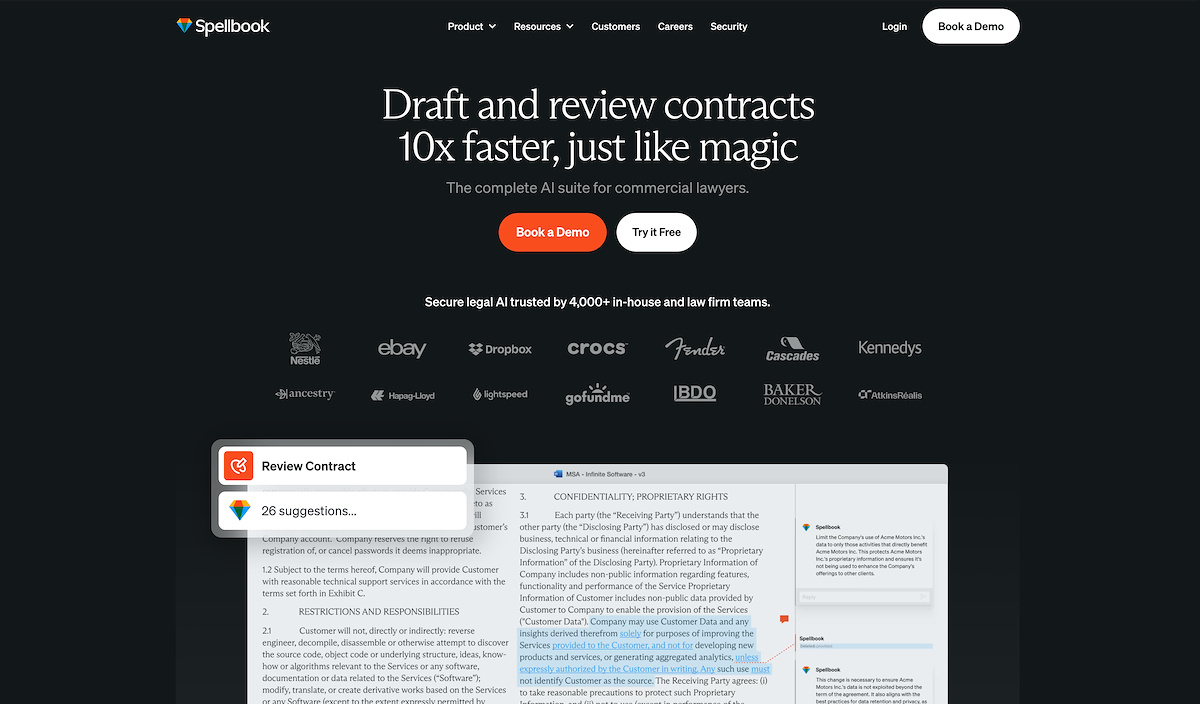
While Ivo and Gavel offer specialized tools, Spellbook is a complete AI suite for contracts and commercial law. It works directly within Microsoft Word, helping over 4,000 legal teams at companies like Dropbox and Fender draft and review agreements with greater speed and precision.
Spellbook is also the only contract AI grounded in real-time market data. Its Review feature lets lawyers compare terms against live benchmarks from thousands of similar agreements, providing data-driven answers to "What's market?" in any negotiation. This gives teams an advantage not available in the other platforms.
Spellbook Features
Review: Instantly analyzes entire contracts to identify risks, suggest redlines, and flag issues. All edits are tracked under the lawyer’s name, maintaining full control and professional presentation.
Draft: Generates new clauses or entire agreements from simple instructions. The AI automatically adapts new language to match the style, defined terms, and context of the document you are working on.
Ask: Functions as a contract-specific Q&A tool. You can ask questions about obligations, dates, or specific terms, and receive answers with citations pointing directly to the relevant contract language.
Compare to Market: Compares contract terms against real-time data from thousands of similar agreements. This feature provides statistical benchmarks to support negotiation positions, answering the question of "What's market?" with data.
Spellbook Associate: An AI agent that handles complex, multi-document work from a single prompt. It can cross-reference documents, update terms across multiple files, and prepare entire document packages.
Playbooks & Preference Learning: While supporting playbooks for standardized review, Spellbook also learns from the edits you accept or reject. Over time, its suggestions become more aligned with your individual or team-level preferences and risk tolerance.
Security & Compliance: Spellbook is SOC 2 Type II certified and operates with a zero data retention policy, meaning your documents are never stored or used for model training. This addresses key data privacy concerns for legal teams.
Spellbook Pricing
Spellbook offers custom per-seat pricing based on team size and needs. Quotes are provided through a demo process.
- Annual subscription per user with volume discounts available.
- Includes all features, onboarding, and ongoing support.
You can test all features and workflows with no commitment. Get started with a free trial.
Why Commercial Lawyers Love Spellbook
Unlike specialized point solutions, Spellbook integrates drafting, review, and negotiation support into a single platform. While it operates exclusively within Microsoft Word to keep legal work focused, it provides a complete AI toolkit for contract work. It combines the playbook-based review of tools like Ivo with the document generation capabilities of Gavel, but with greater flexibility.
Lawyers gain a significant advantage with features unavailable elsewhere, such as real-time market data for negotiations and an AI agent for complex, multi-document tasks. The platform also learns from user edits, improving its suggestions over time to match a team’s specific preferences and risk tolerance.
[cta-1]
Gavel vs Ivo vs Spellbook: Key Differences
When comparing Ivo vs Gavel, the choice often comes down to a team’s primary need: enforcing review standards or automating document creation. Spellbook offers a third, more integrated approach that combines both functions and adds unique capabilities for data-driven negotiation and complex legal work.
Primary Workflow: Ivo focuses exclusively on reviewing third-party contracts against rigid, pre-built playbooks. Gavel concentrates on automating the creation of new documents using structured questionnaires. In contrast, Spellbook is a complete AI suite for the entire contract lifecycle, supporting drafting, review, and negotiation with speed and precision directly within Microsoft Word.
Technology and Flexibility: Both Ivo and Gavel rely on deterministic, rule-based systems that ensure consistency but offer less flexibility. Spellbook combines playbook support with adaptive AI that learns from user edits, making its suggestions more personalized over time. It also includes an AI agent, Spellbook Associate, for handling complex, multi-document work.
Negotiation Intelligence: Ivo and Gavel lack tools for data-driven negotiation. Spellbook is the only platform of the three grounded in real-time market data. Its Compare to Market feature provides statistical benchmarks from thousands of similar agreements, giving lawyers data-backed answers to "What's market?"
Security and Compliance: While all platforms address security, Spellbook provides enterprise-grade assurances, including SOC 2 Type II certification, HIPAA compliance, and a zero data retention policy to protect sensitive information.
Which Option Is Right For Your Business?
For Teams Focused on Document Production
Gavel is the logical choice for teams whose primary goal is to automate the creation of high-volume, standardized documents. Its strength lies in building new agreements from structured workflows, making it ideal for practices centered on repetitive drafting.
For Teams Prioritizing Strict Policy Enforcement
Ivo is built for legal departments that need to enforce rigid negotiation standards on incoming third-party paper. If your main concern is applying a fixed set of rules consistently across every contract review, Ivo’s specialized, playbook-driven system is designed for that exact task.
For Agile Teams Needing Full-Cycle Support
Spellbook is the best fit for most modern legal teams who handle the entire contract lifecycle. It supports drafting, review, and negotiation in one platform, offering more flexibility than single-purpose tools. For teams that need to move quickly without sacrificing precision, it provides an adaptable toolkit with strong security assurances, addressing key questions about how lawyers can use AI responsibly.
The Bottom Line
Your decision in the Ivo vs Gavel comparison depends on your team’s main workflow. Gavel is for creation, and Ivo is for enforcement. Spellbook is the superior choice for teams that need a single, intelligent platform to manage the entire contract process with greater speed and data-backed insight.
Try Spellbook Free
While the Ivo vs Gavel debate centers on single-purpose tools, Spellbook offers an integrated platform for the entire contract lifecycle, combining drafting, review, and data-backed negotiation support for greater speed and precision. You can see how it works for your practice by starting a free trial today.
Frequently Asked Questions
What is the implementation process for Ivo and Gavel?
The setup process for each tool reflects its core function. With Ivo, implementation is managed by their internal team, who builds your negotiation playbooks based on your existing guides and standard agreements. This process requires you to provide materials and wait for the playbooks to be created and updated.
For Gavel, the user is responsible for building the document automation workflows. This involves creating the structured questionnaires and defining the rule-based logic that will generate the documents, which requires a significant time investment from your team to get started.
Can these tools analyze non-standard or highly negotiated agreements?
Ivo’s effectiveness is highest on contracts that can be measured against its predefined playbooks. For highly negotiated or unusual agreements with terms that fall outside the playbook rules, its deterministic system may struggle to provide nuanced feedback and will simply flag deviations.
Gavel is not designed for analyzing incoming agreements; its purpose is to generate new documents based on a set of inputs. While its AI chat can summarize or redline, its primary strength is in creation, not in the analysis of complex third-party paper.
How is Spellbook different from just using Ivo and Gavel together?
While combining Ivo and Gavel might seem to cover both review and drafting, Spellbook offers a more integrated and intelligent approach. Instead of switching between two separate, rule-based systems, Spellbook provides a single AI toolkit within Microsoft Word that handles the entire contract lifecycle.
Spellbook’s AI is also adaptive. It learns from the changes you make, so its suggestions become more aligned with your preferences over time, unlike the static playbooks of Ivo or Gavel. Furthermore, Spellbook includes unique features like real-time market data for negotiation and an AI agent for complex work, capabilities that are not available in either of the other tools. This approach grounds its output in reliable data and specific document context, avoiding the risks of unreliable AI that have led to issues like fake case citations.
[cta-2]
Our Research Methodology
This comparison is based on comprehensive research of publicly available information, including product websites, feature documentation, press releases, customer reviews, legal technology publications, and third-party analyses from sources like LawSites, Artificial Lawyer, and industry analysts.
Where pricing information is not publicly disclosed, we've included estimates based on available industry data and user reports. Information is current as of 2026 and may change as products evolve. We encourage readers to verify details directly with vendors and request demos to evaluate fit for their specific needs.
.png)
%20(1).png)


Thank you for your interest! Our team will reach out to further understand your use case.
Spellbook is the most complete AI suite for commercial legal work, trusted by more than 4,400 in-house teams and law firms worldwide.

SOC 2 Type II

HIPAA

GDPR

EU AI Act

HIPAA Compliant
