
LegalOn vs CoCounsel: Which Is The Top Pick in 2026?
.jpeg)


Deciding between LegalOn vs CoCounsel involves weighing a playbook-driven review system against a research-integrated legal assistant. LegalOn is built for consistency in commercial contract review, while CoCounsel connects AI workflows to Thomson Reuters' vast content library.
In this 2026 review, we'll compare their product features, pricing models, and AI architecture to give you a clear picture of which tool might fit your team's needs.
Key Takeaways
LegalOn is a contract review tool that uses curated playbooks to standardize negotiation, while CoCounsel is an AI assistant that integrates with Thomson Reuters’ legal research content.
The main difference in the LegalOn vs CoCounsel matchup is their core focus. LegalOn prioritizes consistency and risk control through its structured, playbook-driven system. CoCounsel offers broader, research-backed workflows by connecting AI to Westlaw and Practical Law.
Spellbook is a complete AI suite trusted by over 4,000 legal teams to draft and review contracts 10x faster with greater precision. It operates directly in Microsoft Word and is the only legal AI grounded in real-time market data, allowing lawyers to benchmark agreements against thousands of similar contracts with its Compare to Market feature.
1. LegalOn
LegalOn is a contract review platform that focuses on a specific niche: review, negotiation support, and redlining. It is designed for in-house legal teams that handle a high volume of recurring commercial contracts, such as MSAs, NDAs, and sales agreements.
The platform's core is its playbook-driven system, which applies curated legal standards to identify risks and deviations. This makes its approach more rigid compared to the broader, research-backed workflows offered by CoCounsel, positioning it as a tool for risk control rather than a flexible drafting assistant.
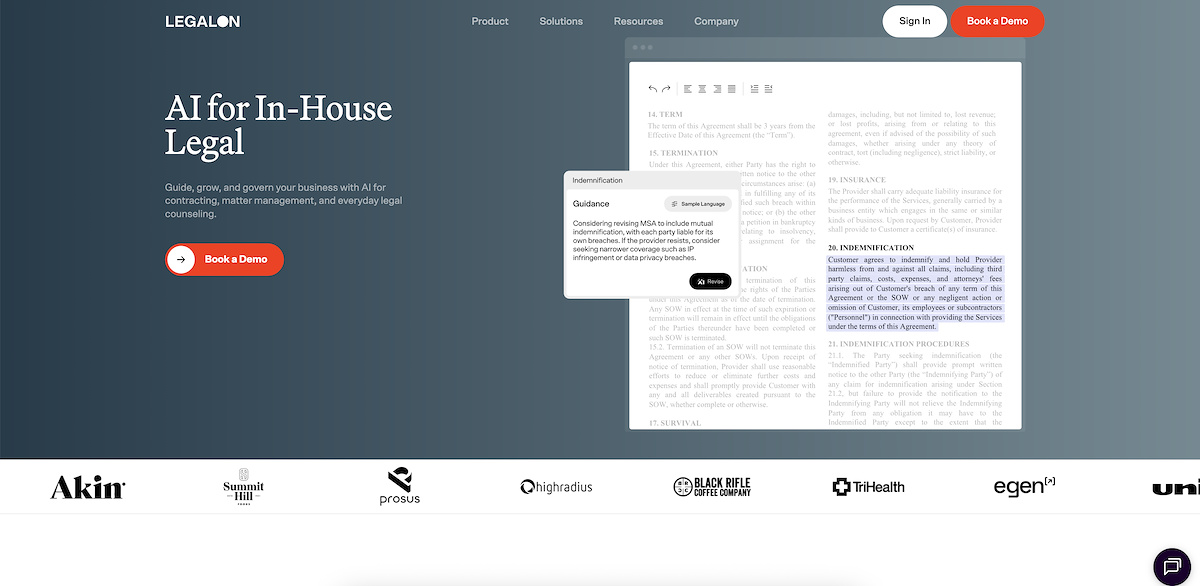
LegalOn Features
Playbook-driven review inside Microsoft Word.
Attorney-authored guidance explaining identified issues.
Prioritized alerts for low, medium, and high-risk contract items.
A web application for intake, matter tracking, and template management.
An AI assistant for ad-hoc drafting, summarization, and queries.
LegalOn Pricing
Pricing is structured on a per-seat, per-module basis.
Individual licenses begin at approximately $3,500 per user annually.
Team pricing is customized; five enterprise seats cost around $40,000 per year.
Final cost depends on the number of users and selected modules.
Key Considerations about LegalOn
LegalOn positions itself as "inch wide, mile deep," focusing almost exclusively on contract review and negotiation. This narrow scope means it is not designed to be an end-to-end legal operations platform. Its core strength is its curated, attorney-authored playbooks, which prioritize consistency but may offer less flexibility than more dynamic AI systems.
While the platform is suitable for regulated industries, organizations should note that its value is highest when used as a specialized tool within a larger tech stack. For teams needing support with protected health information, other tools also offer HIPAA compliance.
2. CoCounsel
CoCounsel is an AI legal assistant from Thomson Reuters that integrates AI workflows with the company’s vast Westlaw and Practical Law content libraries. It is designed for legal teams that need research-backed support for drafting, analysis, and document review.
While LegalOn offers a specialized, playbook-driven system for contract review, CoCounsel's approach is broader. Its core value is tied to its proprietary research content, making it a different kind of tool in the LegalOn vs CoCounsel comparison—one that may be more complex for teams focused purely on contract execution.
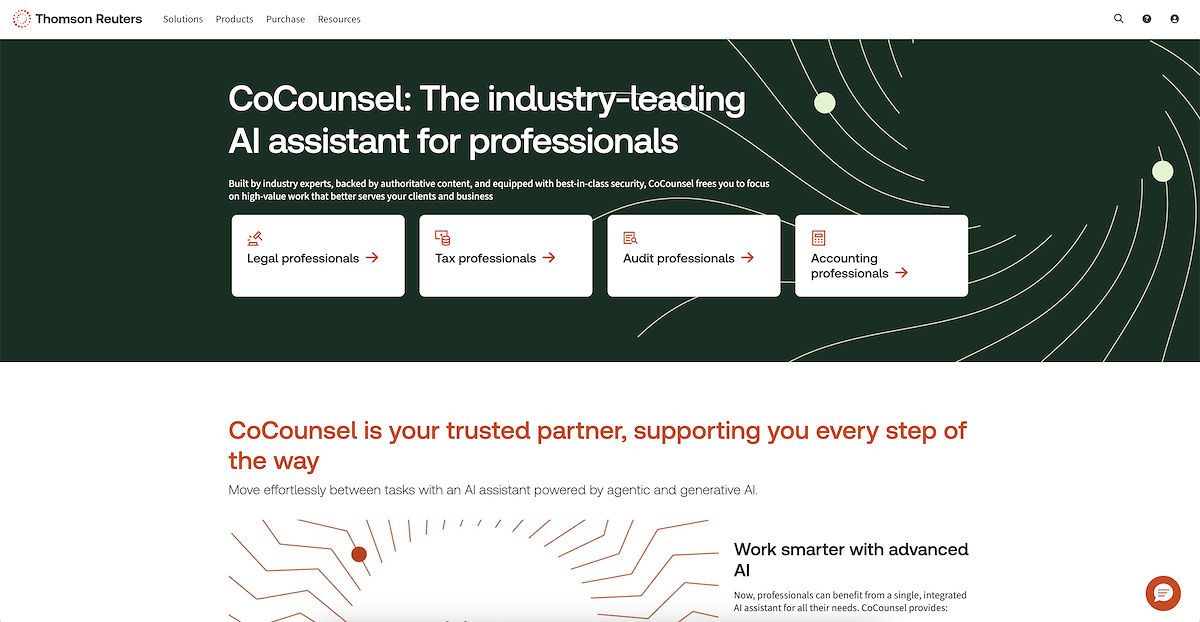
CoCounsel Features
An AI assistant for drafting, summarization, and document analysis.
Direct integration with Westlaw and Practical Law for research-backed answers.
Playbook functionality for applying standardized review criteria.
A Microsoft Word add-in for in-document work and a separate web portal for multi-document analysis.
Knowledge management features for storing and reusing documents.
CoCounsel Pricing
Pricing is at the high end of the market, especially when bundled with research products.
Offered on a per-seat, annual subscription basis.
Custom quotes are provided for enterprise teams based on size and feature requirements.
Key Considerations about CoCounsel
While CoCounsel's connection to Thomson Reuters content is a key feature, potential users should weigh a few practical points. The platform's value is significantly tied to subscriptions for Westlaw and Practical Law, making it a costly option if you only need its base AI features.
The workflow is also divided between a Word add-in and a separate web portal. This split can disrupt efficiency for teams accustomed to working entirely within their document editor.
For teams focused purely on contract execution, CoCounsel's broad, research-oriented design may introduce unnecessary complexity. This is a central point in the LegalOn vs CoCounsel matchup, as teams must decide between a specialized review tool and a research-integrated assistant.
3. Spellbook, The Smarter Alternative
For teams looking for a more integrated option, Spellbook offers a complete AI suite built for contracts and commercial law. It works directly in Microsoft Word, helping over 4,000 legal teams at companies like Dropbox and Fender draft and review contracts 10x faster and with greater precision, eliminating context switching.
Spellbook is also the only contract AI grounded in real-time market data. Its Review feature analyzes agreements against live benchmarks from thousands of similar contracts, giving lawyers data-driven answers to "What's market?" in any negotiation. This provides a practical advantage over static playbooks or general legal research.
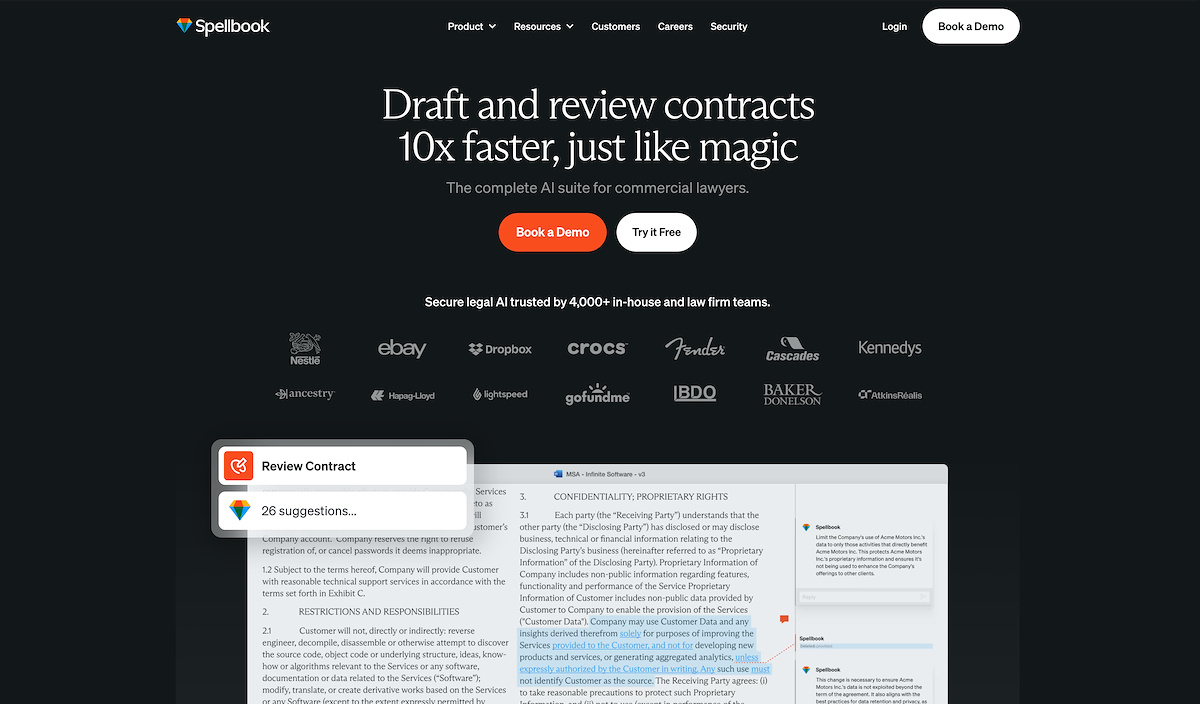
Spellbook Features
Review: Instantly analyzes contracts to identify risks and suggest redlines directly within Microsoft Word. Edits appear as standard track changes, giving lawyers full control over the final document.
Draft: Generates new clauses or entire agreements from simple instructions. It can also search a firm’s past contracts to find and adapt precedent language to the current document’s context and style.
Ask: A contract-specific Q&A tool that lets lawyers ask questions about a document directly in Word. It provides answers with citations to the relevant contract language for quick verification.
Compare to Market: Compares contract terms against real-time data from thousands of similar agreements. This feature gives lawyers data-driven benchmarks to answer “What’s market?” and strengthen their negotiating position.
Associate: An AI agent that executes complex, multi-document projects from a single prompt. It can handle tasks like performing due diligence across a data room or preparing a full document package from a term sheet.
Spellbook Pricing
Spellbook uses a custom per-seat pricing model with annual subscriptions tailored to your team's size and needs. All core features, onboarding, and support are included in the standard plan.
Pricing is provided through a custom quote.
Volume discounts are available for teams of 10 or more users.
You can test all features and workflows with a 7-day free trial.
Why Commercial Lawyers Love Spellbook
Unlike specialized point solutions, Spellbook is built as a complete AI suite that integrates directly into a lawyer's existing workflow. While it operates exclusively within Microsoft Word to keep legal work focused, its key advantage is its data-driven approach.
Instead of relying on static playbooks or general research databases, Spellbook gives lawyers real-time market benchmarks for negotiation. This allows teams to work faster without sacrificing precision, making it a practical choice for commercial lawyers focused on execution.
[cta-1]
CoCounsel vs LegalOn vs Spellbook: Key Differences
The choice in the LegalOn vs CoCounsel matchup often boils down to a trade-off between structured review and broad research. LegalOn offers a rigid, playbook-driven system for consistency, while CoCounsel provides a research-integrated assistant. A third alternative, Spellbook, presents a different approach focused on workflow integration and data-driven negotiation.
1. Core Workflow and Integration
LegalOn: Provides a specialized system for contract review using curated playbooks. Its workflow operates within a Word add-in and a separate web application for tasks like intake and template management.
CoCounsel: Functions as a research-backed AI assistant. Its workflow is split between a Word add-in for in-document work and a web portal for multi-document analysis, which can disrupt efficiency for some teams.
Spellbook: Delivers a complete AI suite that works entirely within Microsoft Word. This fully integrated approach helps legal teams draft and review contracts with greater speed and precision by eliminating context switching.
2. AI Architecture and Intelligence
LegalOn: Relies on static, attorney-authored playbooks. This method prioritizes risk control but can be inflexible and may not reflect current market practices.
CoCounsel: Grounds its intelligence in the vast Thomson Reuters content library. While authoritative, this research content is general and not always tailored to specific, real-time negotiation contexts.
Spellbook: Uses a multi-model approach, selecting the best AI for each task, such as Claude for document analysis. It is the only platform grounded in real-time market data, giving lawyers statistical benchmarks for negotiation on key terms like limitation of liability.
3. Primary Use Case
LegalOn: Best for teams that need to enforce strict, standardized review criteria across a high volume of recurring commercial contracts.
CoCounsel: Suited for teams whose work frequently requires deep legal research and access to a broad library of legal templates and guidance.
Spellbook: Ideal for commercial lawyers focused on execution. It combines a seamless workflow with data-driven negotiation tools and institutional knowledge capture, supported by significant investment in its technology, including a recent Series B funding round.
Which Option Is Right For Your Business?
For Teams Prioritizing Strict Standardization
LegalOn is the logical choice if your main objective is enforcing rigid internal playbooks across high volumes of contracts. Its specialized, playbook-driven system is built for consistency and risk control above all else.
For Teams Needing Deep Research Integration
CoCounsel is best suited for teams whose work is heavily tied to legal research. If your workflows depend on accessing Westlaw and Practical Law for drafting memos or complex analysis, its direct integration is its main advantage.
For Teams Focused on Efficient Contract Execution
Spellbook is the ideal fit for most commercial legal teams focused on getting deals done. It works entirely within Microsoft Word, eliminating workflow disruptions, and its data-driven approach provides a practical edge in negotiations, balancing speed with high precision.
The Bottom Line
While LegalOn offers rigid control and CoCounsel provides research depth, Spellbook is built for the practical realities of modern commercial law. It combines a fully integrated workflow with real-time market data, making it the most direct path to faster, more accurate contract work.
Try Spellbook Free
Rather than choosing between a rigid playbook system and a complex research tool, you can try a more direct path to faster, more accurate contract work. See how thousands of legal teams use Spellbook to improve contract execution by starting a free trial today.
Frequently Asked Questions
How do LegalOn and CoCounsel handle implementation and training?
LegalOn's implementation is centered on configuring its playbook system. This process typically involves working with their team to align the platform's rules and risk thresholds with your firm's internal policies. Training focuses on teaching users to work with the AI's suggestions within the Microsoft Word add-in.
CoCounsel's implementation can be more complex, particularly when integrating its Westlaw and Practical Law content. Training is broader, covering skills from running research queries to using the AI for drafting and summarization across both its web portal and Word add-in.
Are LegalOn and CoCounsel secure for handling confidential client information?
Both platforms are built for the legal sector and provide enterprise-grade security, including data encryption and secure cloud hosting, to protect sensitive information. They are designed to handle the confidential nature of legal work.
However, it is always critical for legal teams to perform their own due diligence on any AI provider's security and data handling policies. Understanding how your data is used is essential, as general questions around whether AI is private have made data security a primary concern for the legal industry.
How does Spellbook compare to LegalOn and CoCounsel for day-to-day contract work?
Spellbook offers a distinct alternative by focusing on workflow integration and data-driven insights. While LegalOn applies static playbooks and CoCounsel connects to general legal research, Spellbook operates entirely within Microsoft Word, helping lawyers work faster and with greater precision by keeping them in a single environment.
In the LegalOn vs CoCounsel debate, Spellbook's key differentiator is its ability to benchmark contract language against thousands of real, recent agreements. This gives lawyers live market data to support negotiations on key clauses like indemnification, providing a practical advantage that goes beyond fixed rules or broad research databases.
[cta-2]
Our Research Methodology
This comparison is based on comprehensive research of publicly available information, including product websites, feature documentation, press releases, customer reviews, legal technology publications, and third-party analyses from sources like LawSites, Artificial Lawyer, and industry analysts.
Where pricing information is not publicly disclosed, we've included estimates based on available industry data and user reports. Information is current as of 2026 and may change as products evolve. We encourage readers to verify details directly with vendors and request demos to evaluate fit for their specific needs.
.png)
%20(1).png)


Thank you for your interest! Our team will reach out to further understand your use case.
Spellbook is the most complete AI suite for commercial legal work, trusted by more than 4,400 in-house teams and law firms worldwide.

SOC 2 Type II

HIPAA

GDPR

EU AI Act

HIPAA Compliant
