
LegalOn vs GC AI: Which Is the Top Pick in 2026?
.jpeg)


Choosing between LegalOn vs GC AI means deciding between two distinct approaches to legal AI. LegalOn is a specialized contract review tool focused on playbook-driven consistency, while GC AI provides a broader workspace that combines contract work with research and team collaboration. To help you decide, this 2026 review breaks down their core features, pricing, and underlying technology, giving you a clear picture of which platform best fits your legal workflows.
Key Takeaways
LegalOn is a specialized contract review tool that uses attorney-authored playbooks to ensure consistency, while GC AI is a broader legal workspace that combines contract review with research and team collaboration features.
The key difference lies in their focus. LegalOn provides deep, structured analysis for individual contracts. GC AI offers a wider platform for managing team knowledge and conducting legal research alongside contract work.
Spellbook is a complete AI suite trusted by over 4,000 legal teams to draft and review contracts with greater speed and precision. It is the only platform that grounds contract negotiations in real-time market data, helping lawyers answer “what’s market?” in a single click.
1. LegalOn
LegalOn is a contract review platform focused narrowly on review, negotiation support, and redlining. It operates on a playbook-driven model, using curated legal standards from its internal legal team to identify risks and deviations in contracts.
This approach makes it a tool primarily for in-house teams managing high volumes of recurring commercial agreements. In the LegalOn vs GC AI comparison, LegalOn represents a point solution for a specific task, unlike GC AI's broader workspace which also includes research and team collaboration features.
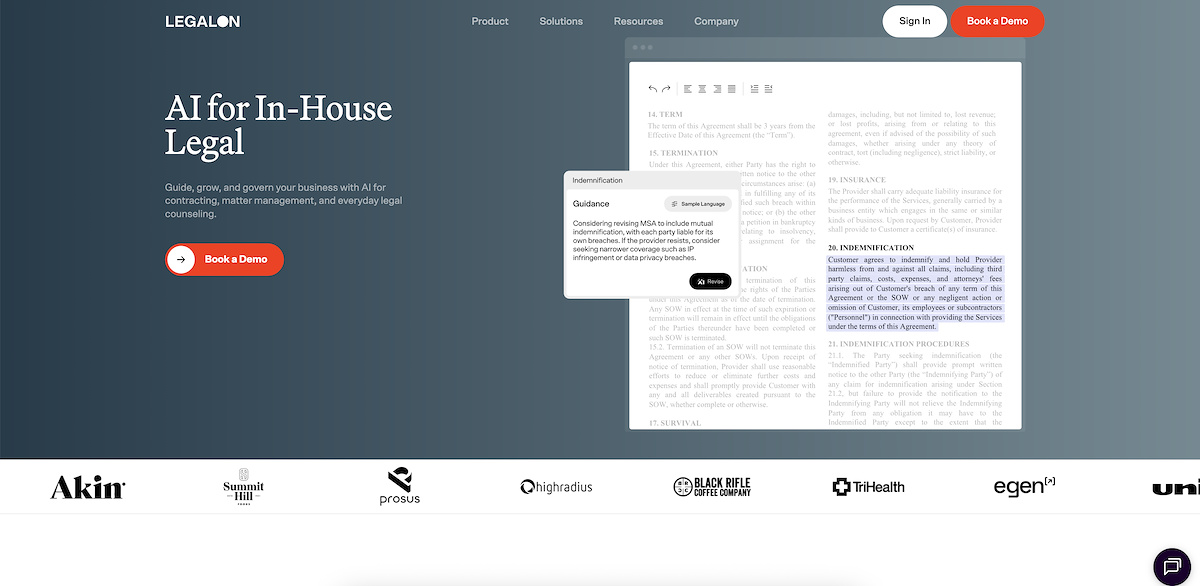
LegalOn Features
LegalOn's product is centered on a structured contract review workflow. Its capabilities are delivered through a Microsoft Word add-in and a supporting web application.
Playbook-driven analysis to check contracts against pre-set legal standards.
Attorney-authored guidance explaining risks and offering sample language.
An AI assistant for ad-hoc drafting, summarization, and Q&A.
A web application for basic intake, matter tracking, and template management.
Conceptual issue detection that identifies risks beyond simple clause matching.
LegalOn Pricing
LegalOn uses a modular pricing model, where costs depend on the number of users and the specific features enabled. Pricing is not bundled into a single package.
Pricing is on a per-seat, per-module basis.
Individual licenses with limited features start around $3,500 per year.
A five-user team with all core modules costs approximately $40,000 annually.
Key Considerations about LegalOn
When evaluating LegalOn vs GC AI, it's important to understand LegalOn's narrow focus. The platform is designed specifically for contract review and does not aim to be an end-to-end legal operations platform.
Its review process is grounded in curated playbooks authored by its internal legal team. While this ensures a degree of consistency, it differs from tools that provide analysis based on real-time market data, which can be more useful for negotiating current terms.
Because of its specialized nature, LegalOn works best as one component within a broader legal tech stack. Teams looking for a single platform to manage the entire contract lifecycle or a wider range of legal work may find its scope limiting.
2. GC AI
GC AI is a legal AI platform positioned as a workspace for in-house teams, combining a web application for research with a Word add-in for contract work. It is designed for counsel who need a single platform for review, research, and team collaboration. In the LegalOn vs GC AI comparison, GC AI’s broad functionality contrasts with LegalOn’s specialized focus on contract review. This wider approach, however, may not provide the same depth as tools dedicated solely to redlining and analysis.
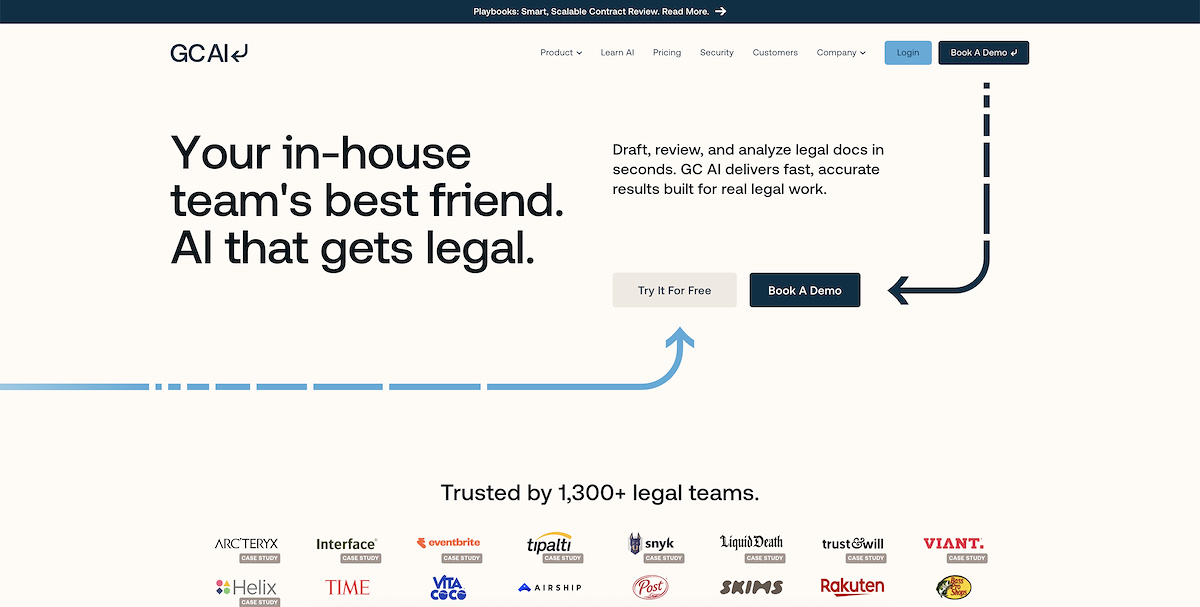
GC AI Features
GC AI's platform is divided between a web application for research and a Microsoft Word add-in for contract work. Its capabilities are designed to support general in-house workflows.
Web application for legal research and team knowledge management.
Word add-in for contract review and redlining.
Playbooks built from a company’s internal precedents.
Shared prompts and knowledge bases to support team collaboration.
Analysis across multiple documents with citations to source material.
GC AI Pricing
GC AI offers two main pricing tiers on an annual basis, with costs increasing for teams needing collaboration features.
A solo license costs $5,000 per user per year.
A team license is $7,000 per user per year and adds SSO and shared features.
Volume discounts are available for teams with 10 or more users.
Key Considerations about GC AI
When considering LegalOn vs GC AI, it is important to note GC AI's broad scope. The platform aims to be a general workspace, combining contract work with legal research. This approach may not offer the same depth of analysis as tools designed specifically for contract drafting and negotiation.
The workflow is split between a web application and a Word add-in. Teams that work almost exclusively in Microsoft Word may find this separation less efficient than a single, fully integrated Word-native tool.
While GC AI provides citations for its research, it does not ground contract analysis in real-time market data. This limits its utility in negotiations where data-driven answers to "what's market?" are needed to validate positions.
3. Spellbook, The Smarter Alternative
While the LegalOn vs GC AI discussion presents two different paths for legal AI, Spellbook stands out as a more complete alternative. It is an AI suite built specifically for contracts and commercial law that integrates directly into Microsoft Word, helping over 4,000 legal teams at companies like Dropbox and Fender draft and review agreements up to 10x faster and with greater precision.
Spellbook is also the only platform grounded in real-time market data. Its Review feature analyzes contracts against live benchmarks from thousands of similar agreements, giving lawyers data-driven answers to "What's market?" in any negotiation. This allows teams to move beyond playbook limitations and negotiate with confidence.
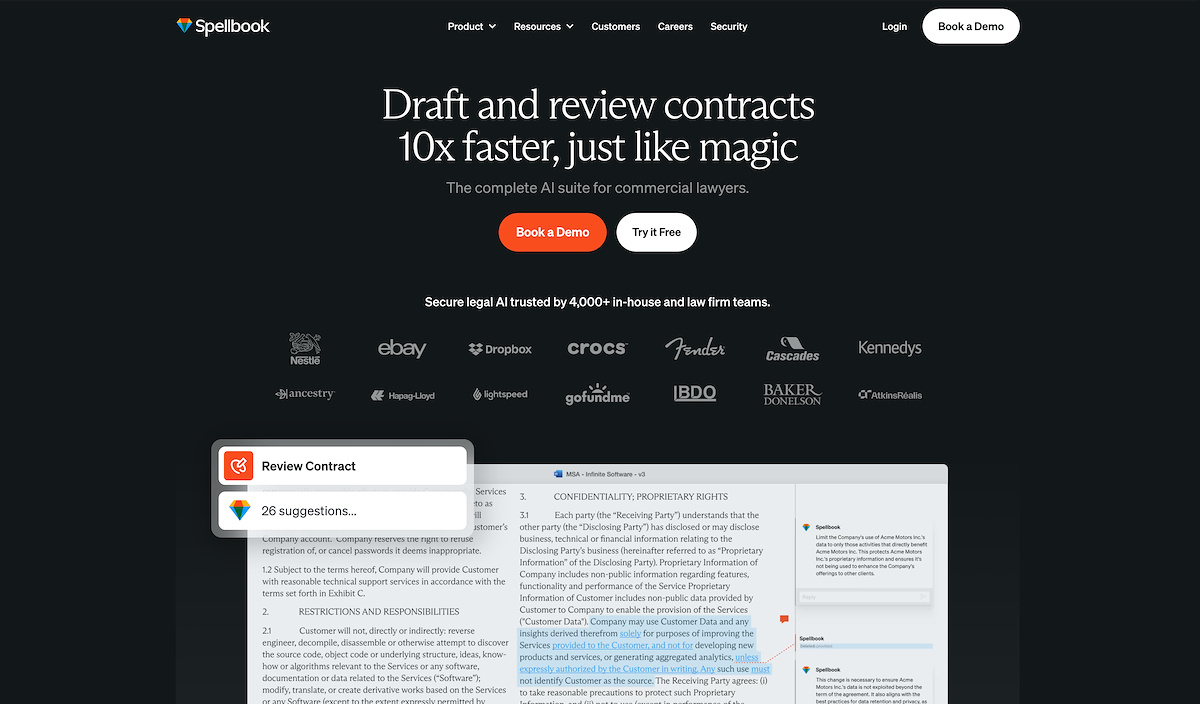
Spellbook Features
Spellbook’s functionality is delivered through a suite of integrated tools, all operating directly within Microsoft Word. This unified approach provides a distinct alternative in the LegalOn vs GC AI comparison, where workflows can be split across platforms or limited in scope.
Review: Instantly analyzes entire contracts to identify risks, suggest redlines, and flag issues. Unlike tools that rely solely on rigid, pre-set standards, Spellbook combines playbook consistency with AI-driven analysis, with all edits appearing as native track changes.
Draft: Generates new clauses or entire agreements from simple instructions. It can also draw from a firm’s own historical contracts, allowing teams to reuse their best precedent language while the AI adapts it to the current document’s context and defined terms.
Ask: Functions as a contract-specific Q&A tool. Lawyers can ask questions about obligations, dates, or specific terms directly in Word and receive answers with citations pointing to the relevant contract language.
Compare to Market: Provides data-driven answers to “what’s market?” by comparing contract terms against real-time data from thousands of similar agreements. This feature allows lawyers to validate negotiating positions with statistical evidence, a capability not offered by LegalOn or GC AI.
Associate: An AI agent that manages multi-document, multi-step projects from a single prompt. It can cross-reference entire data rooms, update terms across multiple files, and prepare full document packages, handling work that would typically require a junior associate.
Spellbook Pricing
Spellbook offers custom pricing on a per-seat, annual basis, tailored to your team’s size and needs. All plans include every feature, plus onboarding, training, and support.
Custom quotes are provided after a demo.
Volume discounts are available for larger teams.
You can explore the full platform with a 7-day free trial.
Why Commercial Lawyers Love Spellbook
Unlike point solutions or fragmented workspaces, Spellbook is built as a complete AI suite for commercial law.
While it operates exclusively within Microsoft Word to keep legal workflows focused, its core advantage is its unified design. It combines AI-driven drafting and review with unique, data-grounded negotiation tools.
This allows lawyers to not only work faster but also to validate their positions with market intelligence, a critical element in modern negotiations that is absent in the LegalOn vs GC AI comparison.
[cta-1]
GC AI vs LegalOn vs Spellbook: Key Differences
The choice in the LegalOn vs GC AI debate is between a specialized review tool and a general legal workspace. LegalOn offers a deep, playbook-driven analysis for individual contracts, while GC AI provides a broader platform combining contract work with research. Spellbook presents a third option, designed as a complete AI suite that integrates drafting, review, and data-driven negotiation directly into Microsoft Word.
1. Core Focus and Workflow
LegalOn: A point solution for contract review. Its workflow is focused on applying pre-set, attorney-authored playbooks for consistency.
GC AI: A general legal workspace. Its workflow is split between a web app for research and a Word add-in for contract work, which can create context switching.
Spellbook: A complete AI suite for commercial law operating entirely within Microsoft Word. It unifies drafting, review, and analysis, allowing lawyers to work with speed and precision without leaving their primary drafting environment.
2. Data and Negotiation Intelligence
LegalOn: Analysis is based on static, curated playbooks from its internal legal team. This ensures consistency but lacks real-time market context.
GC AI: Builds playbooks from a company’s internal precedents, grounding analysis in historical firm data but not the current market.
Spellbook: The only platform that provides analysis grounded in real-time market data. Its Review feature compares terms against thousands of similar agreements, giving lawyers data-driven answers to “what’s market?” in any negotiation.
3. Platform and Integration
LegalOn: A Word add-in for review, with a separate web app for other tasks like intake and template management.
GC AI: A fragmented system requiring users to move between a web application and a Word add-in.
Spellbook: A fully integrated, Word-native platform. All tools, including its AI agent, Associate, are available directly in Word. This unified design, combined with enterprise-grade security like SOC 2 Type II certification and HIPAA compliance, makes it a focused and secure choice for commercial legal teams.
Which Option Is Right For Your Business?
For Teams Needing Strict Playbook Adherence
LegalOn is the logical choice for large legal departments that prioritize consistency above all else. Its playbook-driven model is designed to enforce standardized review across high volumes of routine agreements.
For Teams Wanting a General Legal Workspace
GC AI is best suited for in-house counsel who need a single platform for varied tasks beyond just contract review. If your team splits its time between redlining, legal research, and internal knowledge management, its broader workspace offers a centralized hub.
For Commercial Teams Focused on Drafting and Negotiation
Spellbook is the ideal fit for most commercial lawyers and corporate counsel who work primarily in Microsoft Word. It keeps the entire workflow in one place, combining drafting and review tools with negotiation intelligence backed by market data. This unified approach is central to how modern AI for lawyers should function, supporting both speed and precision without forcing users to switch between applications.
The Bottom Line: Your decision in the LegalOn vs GC AI debate depends on your primary need. LegalOn is for rigid, high-volume review. GC AI is for generalists who need a multi-purpose tool. For most lawyers focused on contract drafting and negotiation, Spellbook offers a more powerful and integrated experience directly where the work happens.
Try Spellbook Free
Unlike tools focused on static playbooks or general research, Spellbook provides data-driven negotiation intelligence directly within Microsoft Word. This unified approach helps you draft and review with greater speed and precision. You can experience the full platform by starting a free 7-day trial today.
Frequently Asked Questions
Which AI models do these platforms use?
Most legal AI platforms, including LegalOn and GC AI, do not publicly disclose the specific large language models (LLMs) they use. They typically build their features on top of foundational models from providers like OpenAI or Anthropic, then fine-tune them with proprietary legal data and workflows.
The key factor is not just the underlying model but how the platform applies it. A platform's effectiveness depends on its fine-tuning for legal reasoning, its security protocols, and the quality of the data it uses for analysis. Concerns about the privacy of general AI tools are valid, which is why legal-specific platforms add critical security and confidentiality layers.
Can these tools be used for complex transactional work?
The suitability of each tool for complex work depends on its core design. LegalOn is built for high-volume, routine agreements where playbook consistency is key. It may be less adaptable for highly negotiated, one-off transactions like M&A deals.
GC AI's combination of research and drafting makes it more flexible, but its effectiveness in complex matters depends on the quality of the precedents in its knowledge base. Spellbook is designed to handle both routine and complex agreements, as its AI can generate novel language and perform sophisticated legal document analysis across multiple files, which is common in larger transactions.
How is Spellbook a different alternative to both LegalOn and GC AI?
Spellbook offers a distinct approach compared to the choices in the LegalOn vs GC AI matchup. It is not a narrow review tool like LegalOn, nor is it a split workspace like GC AI. It functions as a complete AI suite for commercial lawyers, with all its tools fully integrated within Microsoft Word.
Its primary distinction is its use of data. While LegalOn relies on static playbooks and GC AI uses a firm's historical data, Spellbook is the only one that grounds its analysis in real-time market benchmarks. This gives lawyers data to support their negotiation positions, a feature not available in the other two platforms.
[cta-2]
Our Research Methodology
This comparison is based on comprehensive research of publicly available information, including product websites, feature documentation, press releases, customer reviews, legal technology publications, and third-party analyses from sources like LawSites, Artificial Lawyer, and industry analysts.
Where pricing information is not publicly disclosed, we've included estimates based on available industry data and user reports. Information is current as of 2026 and may change as products evolve. We encourage readers to verify details directly with vendors and request demos to evaluate fit for their specific needs.
.png)
%20(1).png)


Thank you for your interest! Our team will reach out to further understand your use case.
Spellbook is the most complete AI suite for commercial legal work, trusted by more than 4,400 in-house teams and law firms worldwide.

SOC 2 Type II

HIPAA

GDPR

EU AI Act

HIPAA Compliant
