
Legora vs CoCounsel: Which Is The Top Pick in 2026?
.jpeg)


Choosing between Legora vs CoCounsel means comparing two distinct approaches to legal AI. Legora is built for large-scale contract analysis and governance, while CoCounsel integrates AI with Thomson Reuters' extensive legal research content. This review breaks down their features, pricing, and core architectures to help you decide which platform is the right fit for your team.
Key Takeaways
- Legora is a legal AI platform built for large-scale contract analysis and governance, while CoCounsel is an AI assistant integrated with Thomson Reuters' proprietary legal research content.
- The main difference in the Legora vs CoCounsel matchup is their focus: Legora excels at portfolio-level analysis and extracting structured data across thousands of documents, while CoCounsel’s strength is its integration with Westlaw and Practical Law for research-backed answers.
- Spellbook offers a different approach, trusted by over 4,000 legal teams to draft and review contracts with greater speed and precision. It operates directly in Microsoft Word and is the only legal AI grounded in real-time market data, giving lawyers data-driven answers to "What's market?" in any negotiation.
1. Legora
Legora is a legal AI platform built for large-scale contract analysis and governance. It is designed for enterprise legal departments and M&A teams that need to review thousands of documents for tasks like due diligence and compliance audits. Unlike CoCounsel, which integrates with legal research databases, Legora’s main function is extracting structured data across large document portfolios. Its focus on scale and process standardization makes it a tool for portfolio-level review rather than individual contract drafting or negotiation support.

Legora Features
Legora’s platform is built around three main components designed for large-scale contract intelligence.
- Tabular Review: Extracts structured data across thousands of documents for portfolio-level analysis.
- AI Assistant: A document-confined Q&A tool designed to reduce hallucination risk by limiting its sources.
- Word Add-in: Applies rule-based playbooks to standardize contract review according to predefined company policies.
- Primary Use Cases: Built for M&A due diligence, compliance audits, and large-scale risk identification.
Legora Pricing
Legora’s pricing is geared toward enterprise teams with significant budgets.
- Starting Price: $3,000 per user, per year.
- Minimum Commitment: Requires a 10-seat minimum for all plans.
- Annual Cost: The minimum annual contract value is $30,000.
Key Considerations about Legora
Legora is built for a specific purpose: analyzing thousands of documents at once. This makes it a powerful tool for large-scale M&A diligence or portfolio-wide compliance checks.
However, its focus on scale means it is less suited for the day-to-day work of drafting, redlining, and negotiating individual agreements. While it can handle multi-document projects, teams looking for an AI agent to assist with more dynamic, multi-step workflows might find other tools more flexible. The platform's high entry point, with a minimum 10-seat commitment, also makes it inaccessible for smaller legal teams.
2. CoCounsel
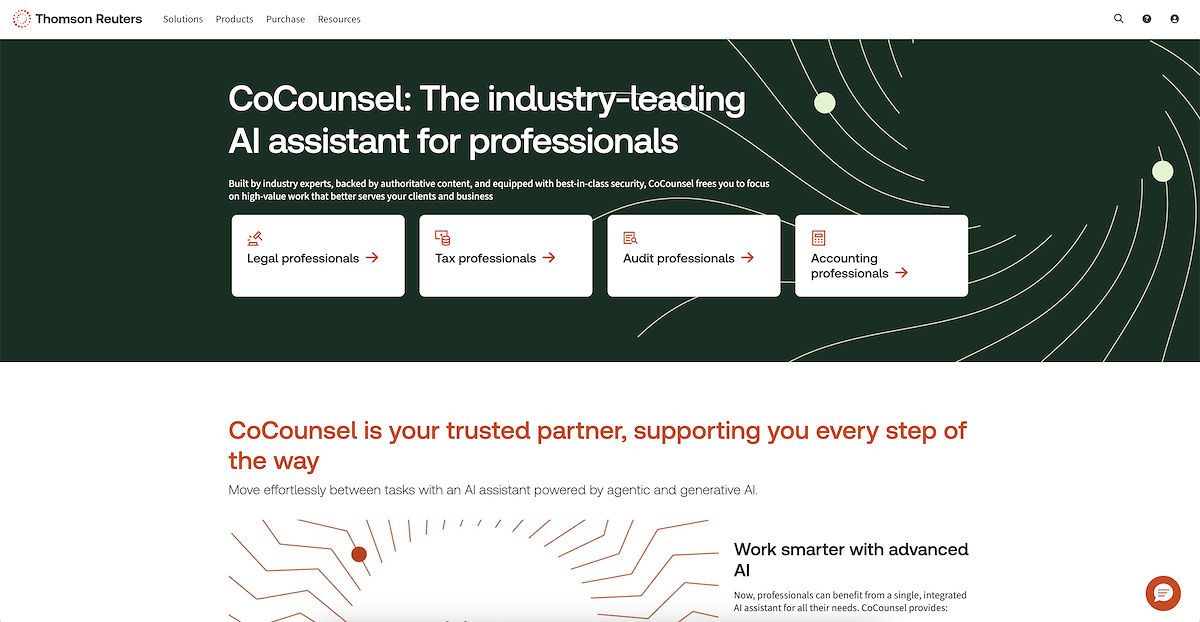
CoCounsel is an AI legal platform from Thomson Reuters that integrates AI tools with its proprietary content from Westlaw and Practical Law. It is built for legal teams that require research-backed answers for drafting, redlining, and analyzing contracts. Unlike Legora’s focus on large-scale portfolio analysis, CoCounsel’s primary value comes from its connection to these databases. This reliance on a specific content ecosystem makes it a considerable investment for teams not already using Thomson Reuters products, and it presents a different approach than tools focused on speed and precision directly within Microsoft Word.
CoCounsel Features
- AI-Assisted Workflows: Tools for summarizing, drafting, and redlining documents.
- Playbook Compliance: Check contracts against internal policies using custom playbooks.
- Multi-Document Analysis: Upload and run queries across large sets of agreements in a web portal.
- Microsoft Word Add-in: For in-document review and playbook application.
- Research Integration: Optional connection to Westlaw and Practical Law for citation-backed answers.
CoCounsel Pricing
- Tiered Model: A per-user, per-year subscription with multiple tiers.
- Starting Price: Core functionality begins at $4,500 per user, per year.
- Add-on Costs: Integrating Westlaw and Practical Law significantly increases the annual price, placing it at the high end of the market.
Key Considerations about CoCounsel
The platform’s primary strength is its integration with Thomson Reuters' proprietary content. Teams not already invested in the Westlaw and Practical Law ecosystem may find the cost difficult to justify, as much of the value is tied to these expensive add-ons.
The workflow is split between a Word add-in and a separate web portal, which can feel less integrated than tools that operate entirely within Word. Research-backed queries can also be slower, which may not suit teams prioritizing speed in their contract reviews.
While CoCounsel aims to ground its outputs, the risk of AI-generated errors remains a concern, making user oversight essential. This makes the Legora vs CoCounsel decision more complex for teams focused on risk management.
3. Spellbook, The Smarter Alternative
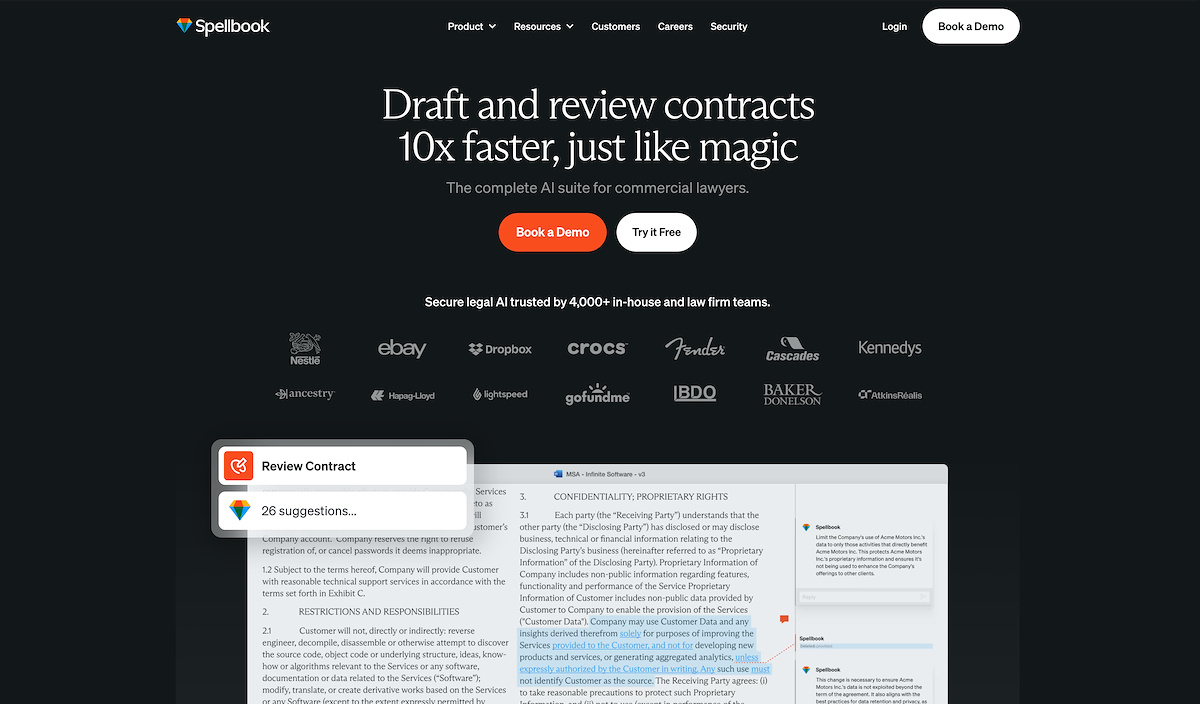
While the Legora vs CoCounsel debate centers on portfolio analysis versus research integration, Spellbook presents a smarter alternative. It is the most complete AI suite for contracts, operating directly within Microsoft Word to help over 4,000 legal teams draft and review agreements with greater speed and precision, eliminating context switching.
Spellbook’s key advantage is its grounding in real-time market data. The Review feature analyzes contracts against live benchmarks from thousands of similar agreements. This gives lawyers at companies like Dropbox, Fender, and Crocs data-driven answers to "What's market?" in any negotiation.
Spellbook Features
- Review: Instantly analyzes an entire document in Microsoft Word, providing AI-generated redlines and identifying risks. All suggestions appear as track changes, keeping the lawyer in full control of the final work product.
- Draft: Generates new clauses or entire agreements from simple instructions. It can also draw from a firm’s own historical contracts, allowing lawyers to reuse successful precedent with language that automatically adapts to the current document’s context.
- Ask: A Q&A tool that answers questions about the specific contract you are working on. Responses are supported by citations that point directly to the relevant language in the document, ensuring all information is verifiable.
- Compare to Market: This feature sets Spellbook apart in the Legora vs CoCounsel comparison. It allows lawyers to check any term against real-time data from thousands of similar, anonymized agreements. This provides a statistical basis for what is "market" in a negotiation, a different approach from CoCounsel’s reliance on static, editor-curated content.
- Associate: An AI agent that can execute multi-step projects across multiple documents from a single instruction. It can handle tasks like preparing a full document package from a term sheet or reviewing a data room for due diligence, functioning more like a delegate than a simple tool.
Spellbook Pricing
Spellbook uses a custom per-seat pricing model tailored to your team's size and needs.
- Subscriptions are structured annually per user.
- Volume discounts are available for larger teams.
- All core features, training, and support are included.
See the difference for yourself. Start your free 7-day trial today.
Why Commercial Lawyers Love Spellbook
Unlike point solutions for either large-scale portfolio analysis or siloed legal research, Spellbook is built for the everyday workflow of commercial lawyers. Its strength is delivering both speed and precision directly within Microsoft Word, giving lawyers data-driven negotiation power without forcing them to switch between applications.
While it operates exclusively in Word to maintain this focused workflow, this integration ensures all AI suggestions appear as track changes, keeping the lawyer in complete control. This practical approach is why it's trusted for drafting and negotiation, not just high-level review, making it a strong contender in any Legora vs CoCounsel evaluation.
[cta-1]
CoCounsel vs Legora vs Spellbook: Key Differences
The choice between Legora, CoCounsel, and Spellbook comes down to their fundamental design and intended use case. Each platform offers a different approach to legal AI, focusing on distinct aspects of a lawyer's work.
1. Legora: The Portfolio-Scale Analyzer
- Core Function:
Legora is designed for large-scale contract analysis and governance across entire document portfolios. It focuses on extracting structured data from large collections of agreements to support compliance reviews, diligence projects, and portfolio oversight. - Workflow:
The platform primarily operates through a web-based tabular interface, allowing users to review and organize extracted information across many documents at once.
2. CoCounsel: The Research-Integrated Assistant
- Core Function:
CoCounsel provides AI-powered legal assistance integrated with proprietary legal research databases, helping lawyers analyze legal questions and documents with research-backed context. - Workflow:
The experience is split between a web portal for research tasks and a Microsoft Word add-in for reviewing documents, creating a workflow that moves between research and drafting environments.
3. Spellbook: The Contract Workflow Specialist
- Core Function:
Spellbook is an AI suite purpose-built for commercial contracts, helping legal teams draft, review, and negotiate agreements with greater speed and precision. - Workflow:
Spellbook operates entirely within Microsoft Word, allowing lawyers to work directly in their primary drafting environment without switching tools. The platform is designed for the day-to-day realities of commercial legal work, assisting with drafting, redlining, and reviewing contracts directly in the document. It also analyzes agreements against live market data from thousands of similar contracts, giving lawyers data-driven insights that help them negotiate terms more confidently and efficiently.
Which Option Is Right For Your Business?
Your choice in the Legora vs CoCounsel matchup depends on your team’s primary function. Here’s a breakdown based on common legal team profiles.
For Large-Scale Due Diligence
Legora is the right choice for enterprise teams focused on high-volume M&A due diligence or portfolio-wide compliance audits. Its architecture is built specifically for analyzing thousands of documents at once and extracting structured data. If your main goal is portfolio-level analysis, Legora’s specialization is a clear advantage.
For Firms Deep in the Thomson Reuters Ecosystem
CoCounsel is best suited for law firms already heavily invested in Thomson Reuters products. Its value is tied to its integration with Westlaw and Practical Law. If your team relies on these databases for daily research and requires citation-backed answers, CoCounsel extends that workflow into your document review process.
For Daily Contract Drafting and Negotiation
Spellbook is the ideal fit for most in-house legal teams and commercial lawyers. It is designed for the day-to-day work of drafting, reviewing, and negotiating contracts with speed and precision. Because it operates entirely within Microsoft Word, it integrates into existing workflows without disruption. Its focus on practical application and data-driven negotiation support makes it a powerful tool for teams that need to move quickly and confidently.
The Bottom Line
Your decision comes down to focus. Choose Legora for massive-scale portfolio review and CoCounsel for deep research integration. For the majority of legal teams focused on the practical, everyday work of commercial contracts, Spellbook offers the most direct path to faster, more accurate work where it happens: in Microsoft Word.
Try Spellbook Free
While Legora focuses on portfolio analysis and CoCounsel on research integration, Spellbook is built for the practical, day-to-day work of commercial law. See how AI-powered drafting and review can bring greater speed and precision to your work, directly within Microsoft Word, by starting a free trial.
Frequently Asked Questions
How do Legora and CoCounsel handle data security and client confidentiality?
Both platforms are built with enterprise security in mind. Legora is SOC 2 compliant and follows a zero data retention policy for AI model training, which means your confidential contract data is not used to train their system.
CoCounsel is part of the Thomson Reuters ecosystem and benefits from its established enterprise-grade security protocols. For any legal team, understanding the specifics of data handling is critical, as general questions around AI privacy and data protection remain a key consideration when adopting new technology.
Can these tools be customized for a firm's specific needs or playbooks?
Yes, both platforms support customization through playbooks. CoCounsel allows firms to upload their own playbooks to check documents for compliance with internal policies and preferred clause language.
Similarly, Legora’s Word add-in applies rule-based playbooks to standardize reviews. Its strength lies in applying these rules consistently across thousands of documents, making it effective for large-scale audits where uniform analysis is required.
What is the risk of AI hallucination with Legora and CoCounsel?
Both platforms have safeguards to reduce the risk of AI "hallucinations" or fabricated information. Legora’s AI Assistant is document-confined, meaning its answers are based only on the source materials you provide, which greatly limits its ability to introduce external, incorrect data.
CoCounsel grounds its outputs in the Westlaw and Practical Law databases, providing a verifiable source for its research-backed answers. However, no AI is perfect, and attorney oversight is always necessary. The responsible use of AI in law requires verifying all outputs, a key point in the discussion of whether lawyers can use AI ethically.
How is Spellbook different from Legora and CoCounsel for day-to-day contract work?
Spellbook is designed specifically for the daily workflow of commercial lawyers, focusing on delivering both speed and precision directly within Microsoft Word. While Legora is built for massive-scale portfolio analysis and CoCounsel for siloed legal research, Spellbook integrates into the drafting and negotiation process without forcing users to switch between applications.
Its primary distinction is its grounding in real-time market data, which gives lawyers data-driven answers on what is "market" for any term during a negotiation. By combining this unique insight with features that generate redlines as track changes or draft new clauses from simple instructions, Spellbook acts as a practical partner for the entire contract lifecycle.
[cta-2]
Our Research Methodology
This comparison is based on comprehensive research of publicly available information, including product websites, feature documentation, press releases, customer reviews, legal technology publications, and third-party analyses from sources like LawSites, Artificial Lawyer, and industry analysts.
Where pricing information is not publicly disclosed, we've included estimates based on available industry data and user reports. Information is current as of 2026 and may change as products evolve. We encourage readers to verify details directly with vendors and request demos to evaluate fit for their specific needs.
.png)
%20(1).png)

Thank you for your interest! Our team will reach out to further understand your use case.
Spellbook is the most complete AI suite for commercial legal work, trusted by more than 4,400 in-house teams and law firms worldwide.

SOC 2 Type II

HIPAA

GDPR

EU AI Act

HIPAA Compliant
