
Legora vs GC AI: Which Is The Top Pick in 2026?
.jpeg)


In the Legora vs GC AI comparison, legal teams are weighing two distinct approaches to contract work. Legora is built for large-scale, auditable review processes, while GC AI provides a collaborative workspace combining contract tools with legal research. This article breaks down their features, pricing, and AI models to help you determine the right fit for your workflow.
Key Takeaways
- Legora is an enterprise AI platform designed for large-scale, auditable contract review, while GC AI offers a collaborative workspace that combines contract tools with legal research for in-house teams.
- The primary difference in the Legora vs GC AI matchup is scale versus integration. Legora is optimized for portfolio-level analysis across thousands of documents, while GC AI integrates contract review with a shared, citation-backed research environment.
- Spellbook presents a third option and is trusted by over 4,000 legal teams to draft and review contracts with greater speed and precision, negotiate with data-driven confidence using its unique Compare to Market feature, and automate complex tasks with its AI agent, Spellbook Associate.
1. Legora
Legora is an enterprise AI platform designed for large-scale, auditable contract review. It is built for legal teams that need to manage high volumes of contracts with a focus on governance and consistency.
The platform is primarily used for M&A diligence and portfolio review, where it analyzes thousands of documents at once. In the Legora vs GC AI comparison, Legora offers a more structured environment for repeatable workflows, positioning it as a legal operations tool rather than a flexible drafting assistant.

Legora Features
Legora’s platform is built around three main components designed for structured, large-scale review.
- An AI Assistant for document-specific Q&A.
- A Microsoft Word add-in driven by rule-based playbooks.
- A Tabular Review environment for extracting data across thousands of documents.
- A federated model approach using GPT-4, Claude, and Gemini models.
- Confidence indicators that flag uncertain AI outputs.
Legora Pricing
The platform is positioned for enterprise-level budgets with a significant upfront commitment.
- List pricing starts at $3,000 per user per year.
- A minimum commitment of 10 seats is required.
- The minimum annual contract value is $30,000.
Key Considerations about Legora
While powerful for its intended purpose, Legora’s focus on portfolio-level analysis makes it less suitable for teams prioritizing day-to-day drafting speed and individual contract workflows. Its design is optimized for M&A diligence and large-scale audits rather than accelerating the redlining and negotiation of a single agreement.
The high entry cost and 10-seat minimum make it inaccessible for smaller legal teams, solo practitioners, or firms that want to pilot AI tools with just a few users. In the Legora vs GC AI comparison, this enterprise-first model is a critical factor.
Finally, the platform is an execution engine for standardized review, not a tool for creative drafting or deep legal reasoning. Teams should also verify its suitability for specific regulatory environments, as features like HIPAA compliance are not explicitly advertised.
2. GC AI
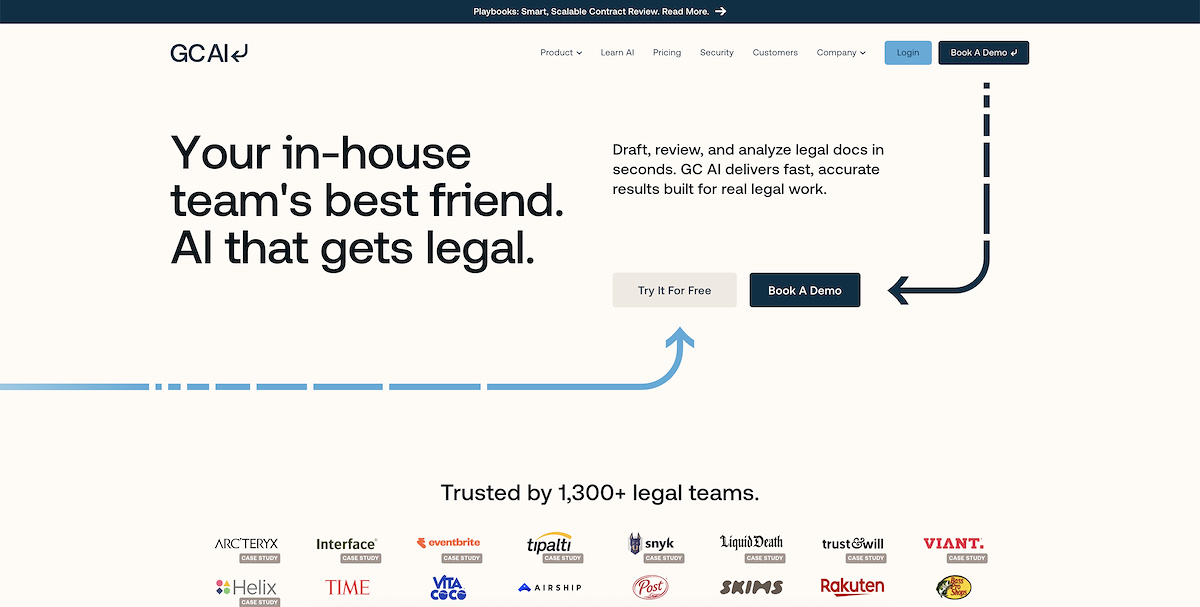
GC AI is a legal AI platform positioned as a collaborative workspace for in-house legal teams. It combines a web application for research and analysis with a separate Microsoft Word add-in for contract review and redlining. The platform is built for teams that need to blend day-to-day contract work with shared legal research and knowledge management. In the Legora vs GC AI matchup, GC AI offers a more integrated, research-focused environment, while Legora is designed for large-scale, auditable portfolio analysis.
GC AI Features
GC AI’s platform is divided between a web application and a Microsoft Word add-in. Its features are designed to support both research and contract work.
- A web app for legal research with citation support.
- A Word add-in for contract review and redlining.
- Playbooks built from internal precedents for standardized review.
- Shared prompts, chats, and knowledge bases for team collaboration.
- Multi-document analysis for risk flagging and provision identification.
GC AI Pricing
Pricing is offered on a per-seat annual basis, with a higher tier for teams requiring collaboration features.
- A solo seat is priced at $5,000 per user per year.
- The team tier costs $7,000 per user per year and includes SSO and shared workspaces.
- Volume discounts are available for teams of 10 or more.
Key Considerations about GC AI
While GC AI offers a blend of research and contract tools, teams should consider its workflow structure. The platform splits its functionality between a web application for research and a separate Word add-in for redlining. This division can interrupt the workflow for lawyers who prefer to remain within a single environment.
The platform's attempt to serve both as a research tool and a contract editor means it may not have the focused depth of specialized tools. In the Legora vs GC AI debate, teams prioritizing high-volume portfolio analysis or rapid, Word-native drafting speed may find this dual focus less efficient for their primary tasks.
3. Spellbook, The Smarter Alternative
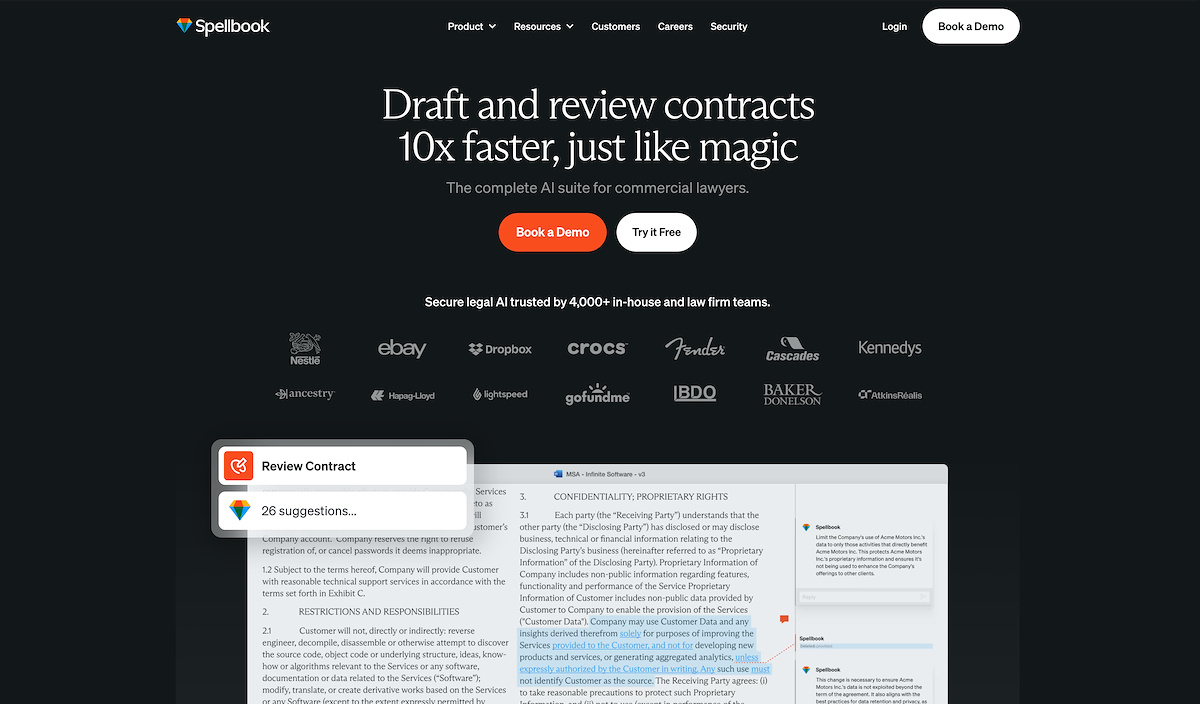
Spellbook is the most complete AI suite built specifically for contracts and commercial law. It integrates directly into Microsoft Word, where lawyers already work, helping legal teams draft and review contracts 10x faster and with greater precision.
Spellbook is also the only contract AI grounded in real-time market data. Its Review feature analyzes contracts against live benchmarks from thousands of similar agreements, giving lawyers data-driven answers to "What's market?" in any negotiation. More than 4,000 legal teams, including those at Dropbox, Fender, and Crocs, trust Spellbook to improve contract workflows and eliminate legal busywork.
Spellbook Features
- Review: The primary analysis engine that provides an instant, document-wide review. It generates redlines as track changes under the lawyer's name and integrates with custom playbooks to enforce firm-specific standards.
- Draft: A tool for generating new clauses or entire agreements from scratch. It also allows users to find and reuse language from their firm’s historical contracts, automatically adapting it to fit the context of the current document.
- Ask: A contract-specific Q&A tool that functions directly within Microsoft Word. Lawyers can ask questions about obligations or terms and receive answers with citations to the relevant contract language.
- Compare to Market: This feature allows lawyers to compare contract terms against real-time market data from thousands of similar agreements. It provides a data-driven basis for negotiations, showing whether a position is standard for a given industry, jurisdiction, or deal type.
- Spellbook Associate: An AI agent that executes multi-document, multi-step projects from a single instruction. It can handle complex tasks like preparing a full document package from a term sheet or reviewing a data room for due diligence.
- Preference Learning and Library: Spellbook learns from the edits a lawyer makes, personalizing future suggestions to match their style and risk tolerance. The Library feature ingests and indexes a firm’s contract history to ground the AI in its own precedents.
- Security and Compliance: Spellbook is SOC 2 Type II certified and supports teams working with sensitive data by offering HIPAA compliance and executing Business Associate Agreements (BAAs).
Spellbook Pricing
Spellbook uses a custom, per-seat pricing model based on your team’s size and requirements. All quotes are provided during the demo process and include the full suite of features.
- Pricing is structured as an annual subscription per user.
- Volume discounts are available for teams of 10 or more.
- A 7-day free trial is available for individuals and small teams.
Get started with a free trial to test the platform.
Why Commercial Lawyers Love Spellbook
Unlike platforms that separate legal research from contract work or focus on large-scale audits, Spellbook is designed for the day-to-day workflow of commercial lawyers. It operates entirely within Microsoft Word, keeping the entire process in one place.
While the platform is built exclusively for Word, this focus provides a deeply integrated experience that accelerates drafting and review without disruptive context switching. Lawyers can move from generating a new indemnification clause to analyzing market data for a negotiation without ever leaving their document. This unified approach is a key consideration in the Legora vs GC AI matchup, offering a more practical tool for everyday contract velocity and precision.
[cta-1]
GC AI vs Legora vs Spellbook: Key Differences
The choice in the Legora vs GC AI vs Spellbook comparison ultimately depends on a legal team’s primary focus: large-scale audits, integrated research, or day-to-day contract velocity.
1. Workflow and Focus
- Legora is built for portfolio-level analysis. Its strength lies in running structured, auditable reviews across thousands of documents at once, making it ideal for M&A diligence and legal operations teams that prioritize governance over individual drafting speed.
- GC AI provides a collaborative workspace that splits its functions. It pairs a web application for legal research with a separate Microsoft Word add-in for redlining. This approach serves teams that need to blend research with contract work, but it requires switching between environments.
- Spellbook is designed for the daily workflow of commercial lawyers. As the most complete AI suite for contracts, it operates entirely within Microsoft Word, allowing lawyers to draft and review with greater speed and precision without context switching.
2. Key Differentiators
In the Legora vs GC AI matchup, the core difference is scale versus collaboration. Legora is about massive, repeatable reviews, while GC AI is about a shared research and redlining space.
Spellbook introduces a different value proposition. It is the only contract AI grounded in real-time market data. Its Compare to Market feature analyzes terms against thousands of similar agreements, giving lawyers a data-driven edge in negotiations. Furthermore, its AI agent, Spellbook Associate, can execute complex, multi-document tasks from a single instruction, offering a level of automation the other two do not. This focus on practical, in-document tools and data makes Spellbook a distinct choice in the Legora vs GC AI landscape.
Which Option Is Right For Your Business?
For M&A and Portfolio Review Teams
If your primary need is conducting large-scale, auditable reviews for events like M&A diligence, Legora is the most suitable choice. Its platform is purpose-built for analyzing thousands of documents at once and managing repeatable, high-volume workflows.
For In-House Teams Needing a Unified Workspace
In-house teams that handle both contract work and legal research should consider Spellbook. While GC AI offers tools for both, its split between a web app and a Word add-in can fragment the workflow. Spellbook operates entirely within Microsoft Word, keeping the entire review and drafting process in one place for greater efficiency.
For Transactional Lawyers Focused on Contract Velocity
For lawyers whose daily work involves drafting, redlining, and negotiating agreements, Spellbook is the practical option. Its design is centered on accelerating the contract lifecycle where it happens: inside the document. This focus provides a more direct path to faster, more accurate contract execution.
The Bottom Line
Your decision in the Legora vs GC AI debate comes down to your main priority. Legora is built for massive, standardized audits. GC AI offers a separate workspace for research and redlining. For the majority of commercial lawyers who need to improve the speed and precision of their daily contract work, Spellbook provides the most direct and integrated path forward.
Try Spellbook Free
In the Legora vs GC AI comparison, Spellbook stands out by focusing on the daily workflow of commercial lawyers, operating entirely within Microsoft Word to improve both speed and precision. You can see how its data-driven review and drafting tools work for your team by starting a free trial today.
Frequently Asked Questions
How do Legora and GC AI handle data security and client confidentiality?
Data security is a primary concern when adopting any legal AI tool. Legora, as an enterprise platform, is built for auditable and governed processes, which suggests a strong focus on security protocols. GC AI also serves enterprise teams and likely has security measures in place for its web and Word applications.
However, legal teams should always conduct their own diligence. It is essential to understand how any AI tool processes data, as general-purpose models can present privacy risks. For example, it's important to know if ChatGPT is private before using it with sensitive information. Always request and review a vendor’s security certifications, data processing agreements, and privacy policies.
Can I customize the review process in Legora and GC AI with my firm’s own standards?
Yes, both platforms support customization using playbooks. Legora’s Microsoft Word add-in is driven by rule-based playbooks, which fits its purpose for structured, repeatable reviews across many documents. This is effective for enforcing specific standards during large-scale audits.
GC AI also allows teams to build playbooks from their internal precedents to guide contract review. The main difference lies in the application. Legora’s playbooks are geared toward portfolio-level governance, while GC AI’s are designed for collaborative, day-to-day redlining within its workspace.
How does Spellbook compare to Legora and GC AI for daily contract work?
Spellbook is designed specifically for the transactional lawyer's daily workflow. While Legora is for portfolio-level audits and GC AI separates its functions between research and redlining, Spellbook operates entirely within Microsoft Word. This integrated approach keeps the entire process in one place, allowing lawyers to draft, review, and negotiate without switching applications.
Its features are built to increase contract velocity with high precision. For instance, Spellbook not only flags risks but also suggests revisions as track changes and provides data-driven negotiation points with its Compare to Market feature. This makes it a more practical tool for lawyers focused on executing deals efficiently and accurately, directly within their primary document editor.
[cta-2]
Our Research Methodology
This comparison is based on comprehensive research of publicly available information, including product websites, feature documentation, press releases, customer reviews, legal technology publications, and third-party analyses from sources like LawSites, Artificial Lawyer, and industry analysts.
Where pricing information is not publicly disclosed, we've included estimates based on available industry data and user reports. Information is current as of 2026 and may change as products evolve. We encourage readers to verify details directly with vendors and request demos to evaluate fit for their specific needs.
.png)
%20(1).png)

Thank you for your interest! Our team will reach out to further understand your use case.
Spellbook is the most complete AI suite for commercial legal work, trusted by more than 4,400 in-house teams and law firms worldwide.

SOC 2 Type II

HIPAA

GDPR
EU AI Act

HIPAA Compliant
