
Legora vs Harvey: Which Is The Top Pick in 2026?
.jpeg)

Choosing the right legal AI platform in the Legora vs Harvey debate means understanding two distinct approaches to contract analysis. Legora is built for large-scale, structured contract review, while Harvey focuses on collaborative legal analysis and complex diligence workflows. To help you decide, we will compare their product features, AI architecture, and pricing models.
Key Takeaways
- Legora is a legal AI platform built for large-scale, structured contract review and data extraction, while Harvey is designed for collaborative legal analysis and complex diligence workflows.
- The core difference in the Legora vs Harvey comparison is their primary function: Legora excels at processing high volumes of documents for structured data, whereas Harvey focuses on team-based analysis and configurable legal processes.
- Spellbook offers a powerful alternative, trusted by over 4,000 legal teams to draft and review contracts with more speed and precision. It works directly within Microsoft Word, provides real-time market data for negotiations, and learns from user preferences to become a personalized drafting assistant.
1. Legora
Legora is a legal AI platform designed for enterprise teams managing high volumes of contracts through standardized and auditable review processes. It excels at turning contract analysis into a structured, repeatable workflow, making it suitable for M&A diligence and large-scale portfolio reviews. Where Legora differs from a platform like Harvey is its focus on execution and scale over legal reasoning. This positions it more as a tool for legal operations and data extraction, rather than a platform for nuanced legal analysis or drafting assistance.

Legora Features
- AI Assistant: A generative AI tool confined to specific documents to reduce errors and maintain context.
- Microsoft Word Add-in: Applies rule-based playbooks for standardized contract review directly in Word.
- Tabular Review: Extracts structured data from thousands of documents into a spreadsheet-like view for portfolio analysis.
- Primary Use Cases: M&A diligence, compliance audits, and large-scale portfolio review.
Legora Pricing
Legora is positioned as an enterprise solution with a significant upfront investment.
- Starts at $3,000 per user, per year.
- Requires a minimum 10-seat commitment.
- Minimum annual contract value is $30,000.
Key Considerations about Legora
In the Legora vs Harvey debate, Legora’s focus on scale is a key differentiator. It is built for a specific purpose: processing high volumes of documents for structured data. This makes it more of a legal operations tool than a drafting assistant, and less suitable for teams that need support with nuanced legal analysis or the day-to-day work of redlining individual contracts.
The platform’s focus on portfolio-level extraction means it lacks the agility for rapid, single-document workflows. Its high minimum seat count and cost also make it inaccessible for many smaller firms or in-house teams.
2. Harvey
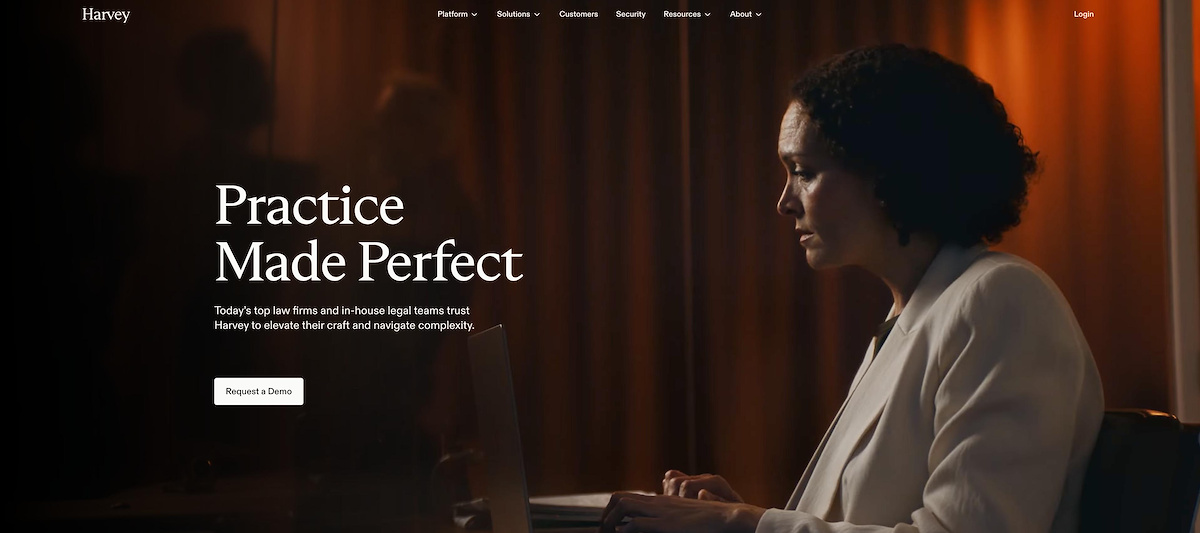
Harvey is a legal AI platform designed for collaborative analysis and complex diligence workflows, primarily serving large law firms and enterprise in-house teams. It functions as a legal operations platform with three main parts: an AI assistant, a multi-document repository called Vault, and configurable Workflows. Unlike Legora, which focuses on high-volume data extraction, Harvey emphasizes team-based legal reasoning and process management. This makes it more of a system for coordinating diligence rather than a direct tool for individual contract drafting and redlining.
Harvey Features
- AI Assistant: A prompt-based interface for legal questions and analysis.
- Vault: A repository for analyzing up to 100,000 documents in a collaborative, spreadsheet-like view.
- Workflows: Configurable, multi-step processes to standardize legal tasks like diligence and drafting.
- Microsoft Word Add-in: Supports in-document editing and drafting as part of the broader platform.
- Primary Use Cases: Collaborative diligence, legal process management, and large-scale document analysis.
Harvey Pricing
Harvey is sold on an enterprise subscription basis with custom pricing.
- Indicative pricing is around $40,000 annually for 10 users.
- Pricing is negotiated based on team size and contract terms.
- Evaluation typically involves a structured, two-week pilot.
Key Considerations about Harvey
When evaluating Legora vs Harvey, it is important to note Harvey’s emphasis on legal operations and team collaboration. The platform is built as a system for coordinating complex diligence projects rather than as a tool for accelerating individual contract redlining.
Its strengths lie in managing large-scale analysis across entire document sets. This focus means it may be less suited for teams whose primary need is rapid, day-to-day drafting and review within Microsoft Word.
While its configurable workflows aim to standardize processes and reduce reliance on individual prompting skills, they can also introduce additional setup and management overhead compared to more focused solutions.
3. Spellbook, The Smarter Alternative
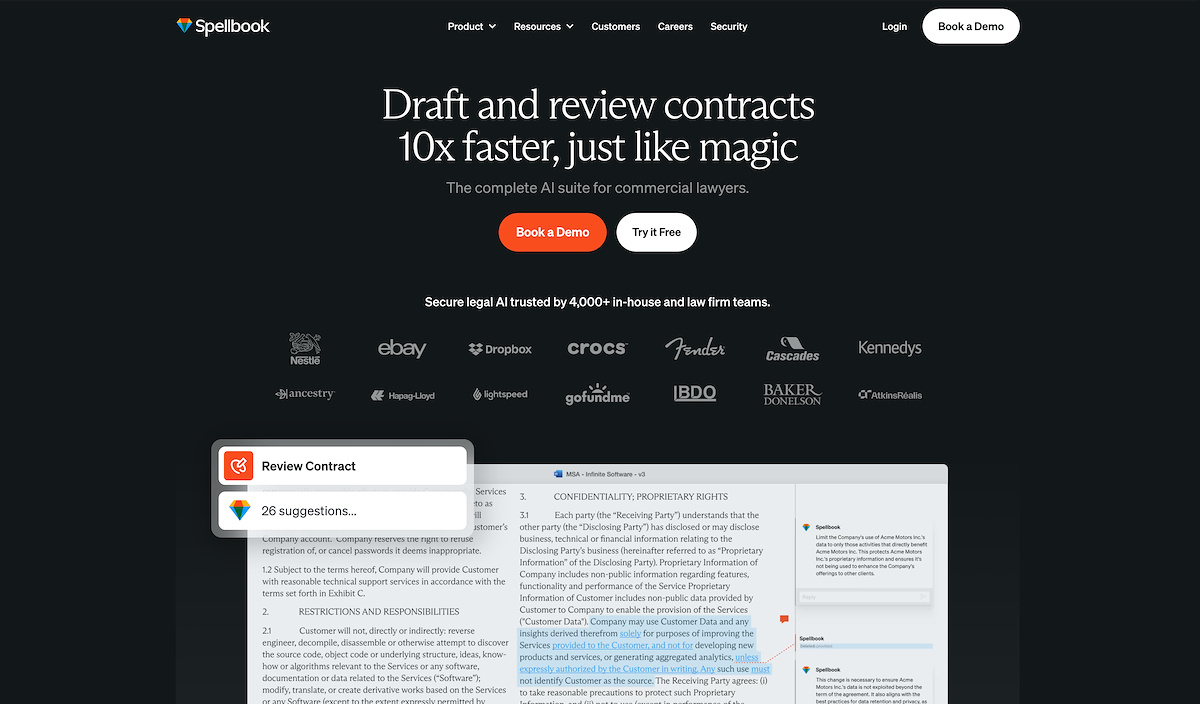
While the Legora vs Harvey debate centers on platform-based workflows, Spellbook offers a smarter alternative built specifically for contracts and commercial law. It integrates directly into Microsoft Word, where lawyers already work, helping more than 4,000 legal teams at companies like Dropbox, Fender, and Crocs draft and review agreements up to 10x faster and with greater precision.
Spellbook is also the only contract AI grounded in real-time market data. Its Review feature analyzes contracts against live benchmarks from thousands of similar agreements, giving lawyers data-driven answers to the question of "What's market?" in every negotiation.
Spellbook Features
- Review: Analyzes entire contracts instantly within Microsoft Word, suggesting redlines and flagging risks with high precision. Unlike platform-based tools, all edits appear as native track changes, keeping the lawyer in full control of the final work product.
- Draft: Generates new clauses or entire agreements from simple instructions. It can also find and adapt language from a firm’s past contracts or its built-in library of standard provisions, such as for indemnification, ensuring contextually appropriate and consistent language.
- Ask: Functions as a Q&A tool directly within the document. Lawyers can ask specific questions about the contract, and Spellbook provides answers with citations to the relevant text, supporting quick verification.
- Compare to Market: A feature unique to Spellbook that benchmarks contract terms against real-time data from thousands of similar agreements. This gives lawyers a data-driven basis to negotiate, answering the "What's market?" question with statistical evidence—a capability not focused on in the Legora vs Harvey comparison.
- Associate: An AI agent that handles multi-document, multi-step projects from a single instruction. It can plan and execute complex tasks like preparing a full document package from a term sheet or reviewing a data room, functioning more like a delegate than a simple tool.
Spellbook Pricing
Spellbook uses a custom per-seat pricing model tailored to your team's size and needs.
- Annual subscriptions include all features, with volume discounts available for larger teams.
- Onboarding, training, and support are included with every plan.
Unlike the lengthy evaluation periods for other platforms, you can experience Spellbook's full capabilities immediately. Get started with a free 7-day trial.
Why Commercial Lawyers Love Spellbook
Unlike legal operations platforms that require users to work in a separate environment, Spellbook integrates directly into Microsoft Word. This focus makes it exceptionally fast for the day-to-day tasks of drafting, redlining, and reviewing individual agreements with high precision.
While its deep integration is exclusive to the Word environment, this allows Spellbook to assist lawyers where they already spend their time. Its ability to provide real-time market data for negotiations gives lawyers a distinct advantage. This makes it a practical tool for lawyers who need to accelerate daily contract work, rather than manage large-scale diligence projects.
[cta-1]
Harvey vs Legora vs Spellbook: Key Differences
The choice in the Legora vs Harvey debate comes down to two different approaches to legal operations. Legora is built for large-scale, structured data extraction, while Harvey is designed for collaborative, multi-step legal projects. Spellbook offers a third approach, focusing on accelerating the day-to-day work of drafting and reviewing contracts with high precision.
1. Legora: The Data Extractor
- Core Function: A legal operations tool for processing high volumes of documents to extract structured data into a spreadsheet-like view.
- Best For: M&A diligence and portfolio reviews where the main goal is to pull specific data points from thousands of agreements.
- Key Consideration: Its focus on portfolio-level extraction makes it less suited for nuanced legal analysis or the daily work of redlining individual contracts.
2. Harvey: The Project Coordinator
- Core Function: A platform for managing collaborative legal analysis and complex diligence workflows across teams.
- Best For: Coordinating large-scale analysis across entire document sets where multiple team members need to contribute and track progress.
- Key Consideration: It functions as a separate system for managing legal processes, which may add overhead for lawyers who primarily need to speed up drafting and review within Microsoft Word.
3. Spellbook: The Drafting Assistant
- Core Function: An AI suite built for commercial law that integrates directly into Microsoft Word to help legal teams draft and review contracts faster and with greater precision.
- Best For: Commercial lawyers who need to accelerate daily contract work, redline agreements, and negotiate from a data-driven position.
- Key Consideration: Spellbook is the only contract AI grounded in real-time market data, giving lawyers statistical answers to "What's market?" during negotiations. Its AI agent, Associate, can also handle multi-document projects, offering a practical alternative for teams that value speed and accuracy in their existing workflows.
Which Option Is Right For Your Business?
For Large-Scale Diligence Teams
Your primary need is managing complex, multi-document projects like M&A diligence. Harvey is designed for this, functioning as a project coordination platform for large teams.
It excels at organizing analysis across thousands of documents but is less focused on accelerating individual drafting tasks.
For In-House Commercial Teams
If your team spends most of its time drafting and negotiating agreements with clauses like limitation of liability, Spellbook is the most practical choice. It works within your existing Word-based workflow, increasing both speed and precision without requiring you to adopt a new platform.
Its per-seat pricing model is also more accessible for teams of varying sizes.
For Boutique and Mid-Sized Law Firms
Your focus is on delivering high-quality work efficiently. Spellbook supports this by directly improving the core tasks of contract drafting and review.
It helps you negotiate more effectively with market data and can handle complex tasks without the overhead of an enterprise system. This allows you to provide more value to clients with faster turnarounds.
The Bottom Line
Your decision in the Legora vs Harvey discussion—or whether to choose a different path—depends on your primary workflow. If you need a system to manage large-scale projects, Harvey or Legora are built for that.
If your goal is to make daily contract work faster and more accurate for every lawyer on your team, Spellbook is the smarter, more direct solution.
Try Spellbook Free
While the Legora vs Harvey debate centers on separate platforms, Spellbook improves your existing workflow directly in Microsoft Word. It provides real-time market data and high-precision suggestions to make daily contract work faster and more accurate. Start your free 7-day trial to experience the difference today.
Frequently Asked Questions
What is the difference in the AI architecture between Harvey AI vs Legora?
The core architectural difference lies in their intended function. Harvey is built on large language models, similar to technologies like GPT-4, which allows it to perform a wide range of legal reasoning, analysis, and summarization tasks across complex documents.
In contrast, Legora's AI is more focused on structured data extraction. It uses a combination of AI and rule-based systems to identify and pull specific data points from high volumes of contracts, making it more of a specialized data processing tool than a general legal reasoning engine.
How do Legora and Harvey handle data security and client confidentiality?
Both Legora and Harvey are enterprise-grade platforms designed for large law firms and corporations, so they treat data security as a top priority. They typically offer features like SOC 2 compliance, data encryption, and access controls to protect sensitive client information.
However, it is always important for legal teams to confirm the specific security protocols of any AI provider. Understanding topics like whether AI is private and where data is stored is a critical part of the due diligence process when adopting new legal technology.
How does Spellbook fit in when you compare Legora vs. Harvey AI?
Spellbook serves a different primary purpose than the platforms in the Harvey vs Legora debate. While Harvey and Legora are legal operations platforms for managing large-scale projects, Spellbook is an AI suite built to accelerate the daily work of drafting, reviewing, and negotiating contracts directly within Microsoft Word.
Instead of requiring users to work in a separate environment, Spellbook enhances the tools lawyers already use. It focuses on improving speed and precision for individual tasks, offering unique features like real-time market data for negotiations. This makes it a more practical tool for commercial lawyers who need to improve their day-to-day contract workflow rather than manage a large-scale diligence project.
[cta-2]
Our Research Methodology
This comparison is based on comprehensive research of publicly available information, including product websites, feature documentation, press releases, customer reviews, legal technology publications, and third-party analyses from sources like LawSites, Artificial Lawyer, and industry analysts.
Where pricing information is not publicly disclosed, we've included estimates based on available industry data and user reports. Information is current as of 2026 and may change as products evolve. We encourage readers to verify details directly with vendors and request demos to evaluate fit for their specific needs.
.png)
%20(1).png)

Thank you for your interest! Our team will reach out to further understand your use case.
Spellbook is the most complete AI suite for commercial legal work, trusted by more than 4,400 in-house teams and law firms worldwide.

SOC 2 Type II

HIPAA

GDPR
EU AI Act

HIPAA Compliant
