
Spellbook vs CoCounsel: Which Is The Top Pick in 2026?
.jpeg)


Deciding between Spellbook vs CoCounsel is a pivotal choice for legal teams looking to adopt AI. Spellbook is an AI suite that works directly in Microsoft Word to help you draft and review contracts faster and with greater precision. To help you make an informed decision, this review breaks down how each platform compares on key metrics, including product features, pricing, and their underlying AI architecture.
Key Takeaways
- Spellbook and CoCounsel are AI platforms designed to help legal teams with contract drafting, review, and analysis. Both tools integrate into legal workflows to improve efficiency and accuracy.
- The primary distinction is their approach to grounding information. CoCounsel leverages the extensive Thomson Reuters ecosystem, providing answers backed by Westlaw and Practical Law. Spellbook focuses on workflow integration within Microsoft Word, using a firm’s own documents and real-time market data to inform its suggestions.
- Spellbook is trusted by over 4,000 in-house and law firm teams to draft, review, and negotiate contracts with more speed and precision. Its ability to benchmark agreements against real-time market data and adapt to a user’s drafting style makes it a powerful tool for data-driven negotiation directly within Microsoft Word.
1. CoCounsel
CoCounsel by Thomson Reuters is an AI-assisted legal platform designed for tasks like document summarization, drafting, and analysis. It primarily serves legal teams that require outputs grounded in established legal research, leveraging the extensive Westlaw and Practical Law content libraries. While both platforms in the Spellbook vs CoCounsel debate aim to improve legal workflows, CoCounsel’s core value is its deep integration with the Thomson Reuters ecosystem, contrasting with tools that prioritize workflow speed and data-driven negotiation directly within Microsoft Word.
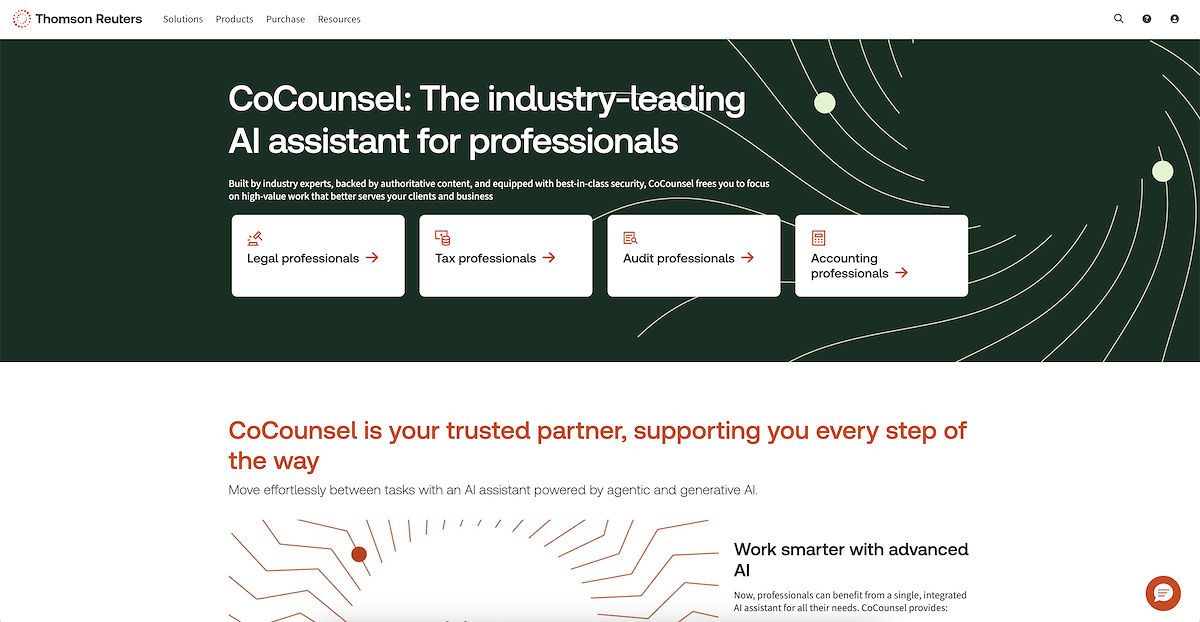
CoCounsel Features
CoCounsel's platform is built around several key capabilities designed to assist with legal work.
- AI-powered document analysis for summarization, drafting, and review.
- A playbook function to check contracts against internal standards.
- A web portal for storing documents and analyzing multiple files at once.
- A Microsoft Word add-in for in-document redlining and review.
- Optional integration with Westlaw and Practical Law for legal research.
CoCounsel Pricing
CoCounsel’s pricing is structured in tiers and is positioned at the higher end of the market.
- Annual, per-user subscriptions with multiple tiers.
- Core features are priced separately from the premium research integrations.
- Costs increase significantly when adding Westlaw or Practical Law.
- A 30-day free trial is offered to new users.
Key Considerations about CoCounsel
When evaluating Spellbook vs CoCounsel, it's important to note that CoCounsel's primary value is its deep integration with the Thomson Reuters ecosystem. Teams not subscribed to Westlaw or Practical Law may find its utility limited, as it relies on user-provided standards in its "closed" mode.
The workflow is also split between a web portal and a Word add-in, which can be less efficient than a tool that operates entirely within Microsoft Word.
Finally, its grounding is based on curated legal databases, which contrasts with platforms that provide negotiation insights from real-time market data. This makes it more of a research-backed tool than a data-driven negotiation assistant.
2. Spellbook, The Smarter Alternative
Spellbook is the most complete AI suite built for contracts and commercial law. It integrates directly into Microsoft Word, where lawyers already work, helping over 4,000 legal teams draft and review agreements up to 10x faster and with greater precision. This eliminates the need to switch between different applications, keeping the workflow focused and efficient.
Unlike tools that rely on static legal databases, Spellbook is the only contract AI grounded in real-time market data. Its Review feature analyzes agreements against thousands of similar contracts, giving lawyers data-driven answers to "What's market?" during negotiations. This makes it a powerful alternative for teams that prioritize data-driven negotiation over research-backed drafting.
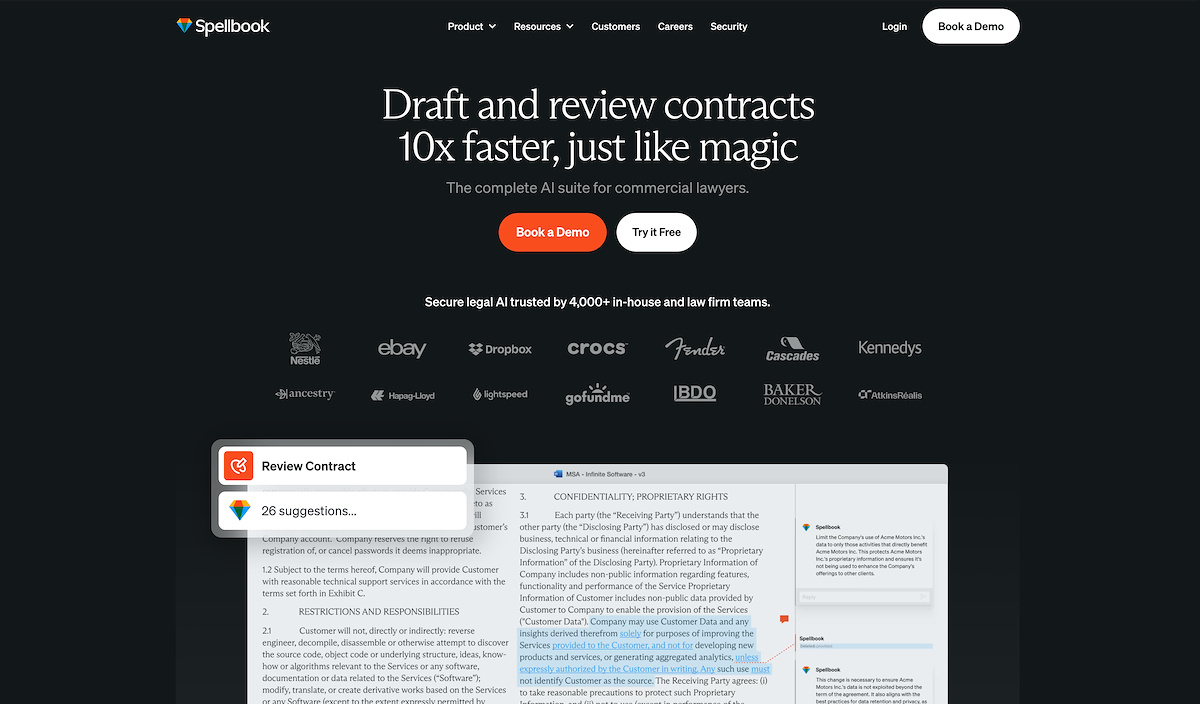
Spellbook Features
Spellbook’s features are designed to work together within Microsoft Word, providing a focused environment for contract work. This contrasts with platforms that split workflows between a web portal and a Word add-in. The tools are built to support lawyers through every stage of the contract process, from initial drafting to data-driven negotiation.
- Review analyzes an entire document to suggest redlines and flag potential risks. All edits appear as track changes under the lawyer’s name, which preserves authorship and keeps the user in full control of the final work product.
- Draft generates new clauses or entire agreements based on simple instructions. It can also draw from a firm’s own historical contracts to find and adapt precedent language, automatically matching the style and defined terms of the current document.
- Ask is a Q&A tool that lets lawyers ask questions about a contract directly within Word. It provides answers with citations to the relevant language in the document, saving time on manual review.
- Compare to Market is a key differentiator in the Spellbook vs CoCounsel comparison. It allows lawyers to benchmark contract terms against real-time data from thousands of similar agreements. This provides data-driven answers to "What's market?" and helps lawyers identify where to focus their negotiation efforts.
- Associate is an AI agent that can execute multi-document projects from a single prompt. It can handle complex tasks like preparing a full document package from a term sheet or reviewing a data room for due diligence, functioning much like a junior associate.
Together, these features create an AI suite that supports the entire contract workflow with speed and precision. The platform is also built with enterprise-grade security, including SOC 2 Type II certification and HIPAA compliance, ensuring that sensitive client data is always protected.
Spellbook Pricing
Spellbook offers custom per-seat pricing determined by team size and feature requirements. This model provides flexibility for legal teams of all sizes.
- Subscriptions are on an annual, per-user basis.
- All core features, training, and support are included.
- Volume discounts are available for larger teams.
When considering Spellbook vs CoCounsel, you can experience the difference firsthand. Get started with a free trial to see how Spellbook works for your team.
Why Commercial Lawyers Love Spellbook
Unlike legal AI tools grounded in static research databases, Spellbook is built for the practical realities of commercial law. Its value comes from providing data-driven negotiation leverage directly within a lawyer's existing workflow.
While its functionality is centered exclusively within Microsoft Word, this focus creates an efficient environment for contract work. It allows the AI to learn a user's drafting style and draw from their firm’s own precedent, a key consideration for lawyers using AI.
This results in suggestions that are not just fast but also highly relevant and precise. Lawyers retain full control and can negotiate with confidence, knowing their positions are backed by real-time market data.
[cta-1]
Spellbook vs CoCounsel: Key Differences
When comparing Spellbook vs CoCounsel, the primary differences emerge in their core philosophies on workflow, data grounding, and overall purpose. While both platforms aim to assist legal teams, they cater to different needs and priorities. Understanding these distinctions is key to choosing the right tool for your practice.
1. Workflow and Integration
- Spellbook operates entirely within Microsoft Word. This unified environment allows lawyers to draft, review, and negotiate without switching applications, creating a focused and efficient workflow that keeps them where they already work.
- CoCounsel splits its functionality between a web portal for multi-document analysis and a separate Word add-in for redlining. This can interrupt the flow of work for users who prefer to remain within a single application.
2. Data Grounding and Intelligence
- Spellbook is the only contract AI grounded in real-time market data. It benchmarks agreements against thousands of similar, recent contracts to provide data-driven answers on market standards, which is a significant advantage in negotiations.
- CoCounsel grounds its outputs in the static, curated content of the Thomson Reuters ecosystem, such as Westlaw and Practical Law. This makes it more of a research-backed tool than a dynamic negotiation assistant powered by live market activity.
3. AI Architecture and Focus
- Spellbook is a complete AI suite built for the practical realities of commercial law. Its architecture is designed to learn a user's drafting style and can execute complex, multi-document tasks with its AI agent, Associate. It is also SOC 2 Type II certified and supports HIPAA compliance.
- CoCounsel’s primary value is its deep integration with proprietary research databases. For teams not subscribed to Westlaw or Practical Law, its utility may be limited, as it relies on user-provided standards in its "closed" mode.
Which Option Is Right For Your Business?
The right choice in the Spellbook vs CoCounsel debate depends on your team’s specific needs. Consider which of these profiles best describes your practice.
For the fast-paced in-house team
Spellbook is the better fit. Its entire workflow lives within Microsoft Word, eliminating the need to switch between applications. This focus on efficiency and data-driven negotiation support is ideal for commercial teams that need to move quickly and with precision.
For the research-intensive law firm
CoCounsel may be the more suitable option. Teams that are deeply integrated with the Thomson Reuters ecosystem and prioritize outputs grounded in Westlaw or Practical Law will find its research capabilities valuable. It is built for practices where extensive legal research is central to the drafting process.
For the data-driven negotiator
Spellbook is the clear winner. It is designed for lawyers who want to back their negotiation positions with real-time market data, not static legal databases. Its ability to provide insights on market standards gives commercial lawyers a distinct advantage, a key consideration for AI-powered legal work.
The Bottom Line
Your decision comes down to workflow and grounding. If your practice depends on a deep research ecosystem, CoCounsel is a logical extension. However, for most commercial lawyers who need speed, precision, and data-driven negotiation insights directly in Microsoft Word, Spellbook is the smarter, more practical choice.
Try Spellbook Free
While CoCounsel is built around its research ecosystem, Spellbook is designed for the practical workflow of commercial lawyers, offering data-driven negotiation insights directly in Microsoft Word. See how this focused approach improves both speed and precision for your team.
Frequently Asked Questions
How do Spellbook and CoCounsel handle data security and client confidentiality?
Both platforms prioritize security, but their approach reflects their architecture. Spellbook is built with enterprise-grade security, holding a SOC 2 Type II certification and supporting HIPAA compliance. All data is encrypted in transit and at rest, and is never used to train public AI models, addressing key questions around AI data privacy.
CoCounsel operates within the extensive Thomson Reuters security framework. Its security measures are robust, but the platform’s integration with external research databases means data handling protocols may differ depending on whether you are using its "closed" or "open" features.
What AI technology powers each platform?
Spellbook uses a combination of leading large language models, including GPT-4 and Anthropic's Claude, alongside its own proprietary AI. This multi-model approach allows it to select the best technology for a specific task, such as the nuanced work involved in legal document analysis, to deliver more accurate and contextually relevant results.
CoCounsel is built on the technology from Casetext, which was acquired by Thomson Reuters. Its AI is deeply integrated with and optimized for the Westlaw and Practical Law content libraries, making its core strength research-backed drafting rather than dynamic, multi-model task execution.
How does Spellbook ensure the lawyer remains in control of the final work product?
Spellbook is designed to function as a co-pilot, not an autopilot. All suggestions from its tools, including redlines from the Review feature or new language from Draft, are inserted as tracked changes directly within Microsoft Word. These edits are attributed to the user, preserving authorship and ensuring the lawyer has the final say on every change.
This approach keeps the lawyer in full command of the document, mitigating the risks of unverified AI outputs. It provides the speed of AI with the precision and control required in legal practice, preventing issues like the ones faced by a lawyer fined for using AI that produced inaccurate information.
[cta-2]
Our Research Methodology
This comparison is based on comprehensive research of publicly available information, including product websites, feature documentation, press releases, customer reviews, legal technology publications, and third-party analyses from sources like LawSites, Artificial Lawyer, and industry analysts.
Where pricing information is not publicly disclosed, we've included estimates based on available industry data and user reports. Information is current as of 2026 and may change as products evolve. We encourage readers to verify details directly with vendors and request demos to evaluate fit for their specific needs.
Lawyer-built prompts to help you draft, review, and negotiate contracts faster—with any LLM.
Get the latest news, trends, and tactics in legal Al—straight to your inbox.


Thank you for your interest! Our team will reach out to further understand your use case.
Spellbook is the most complete AI suite for commercial legal work, trusted by more than 4,000 in-house teams and law firms worldwide.

SOC 2 Type II

HIPAA

GDPR

EU AI Act

HIPAA Compliant
