
Spellbook vs Iqidis: Which Is The Top Pick in 2026?
.jpeg)


Choosing the right legal AI tool is a critical decision, and the Spellbook vs Iqidis debate highlights two distinct approaches to contract work.
Spellbook offers a complete AI suite built for speed and precision directly within Microsoft Word, while Iqidis (now rebranded as Irys) is framed as a centralized legal operating system. This review breaks down their core features, pricing, and technology to help you determine the best fit for your team.
Key Takeaways
- Spellbook is an AI suite that operates within Microsoft Word to help legal teams draft and review contracts with greater speed and precision. Iqidis is a centralized legal operating system for managing legal projects and workflows in a separate web application.
- Their fundamental difference is their approach to workflow. Spellbook enhances a lawyer's existing process inside Word, while Iqidis requires adopting a new, all-in-one platform to manage legal work.
- Trusted by over 4,000 in-house and law firm teams, Spellbook helps lawyers draft and review contracts 10x faster. It is also the only platform that provides real-time market data, giving legal teams a data-driven edge in negotiations.
1. Iqidis
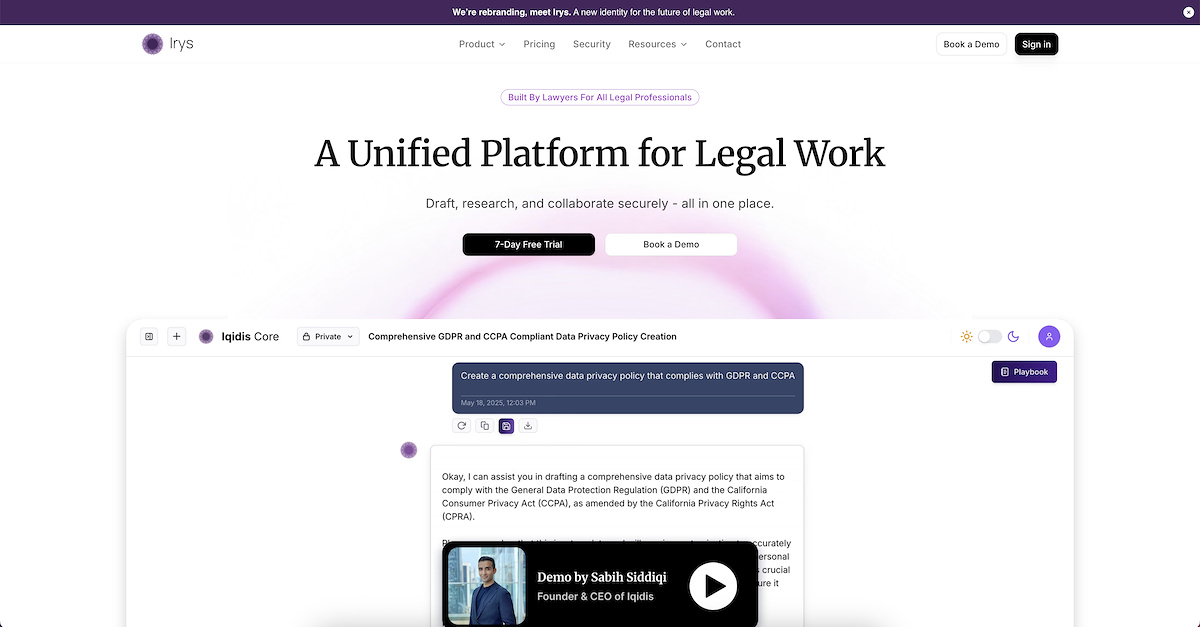
Iqidis (now rebranded as Irys) is positioned as a centralized “legal operating system.” It operates as a separate web application designed to manage legal projects and workflows from a single hub, organizing work into matter-specific folders. The platform is built for multi-document analysis and team collaboration, primarily serving large law firms and in-house teams. This approach requires users to adopt a new, all-in-one system, which is a fundamental difference in the Spellbook vs Iqidis comparison, as Spellbook works directly within Microsoft Word.
Iqidis Features
Iqidis is built as a central hub for legal work, with features organized around matter-specific folders. Its capabilities include:
- A centralized web application for managing projects.
- Multi-document analysis and Q&A across entire folders.
- An AI assistant for summarizing, drafting, and redlining, with exports to Word.
- Collaboration tools for internal teams and external stakeholders.
- A roadmap that includes a future Word add-in and precedent search functions.
Iqidis Pricing
Iqidis uses an enterprise seat-based model. Pricing is provided on a per-user basis and requires a longer-term commitment.
- Ranges from $329 to $399 per user, per month.
- Billed on a semi-annual or annual contract basis.
Key Considerations about Iqidis
The primary factor in the Spellbook vs Iqidis decision is workflow. Iqidis requires teams to adopt a new, separate web application, which can disrupt existing processes centered in Microsoft Word. Key features, including its own Word add-in, are still on the product roadmap and not yet available.
Furthermore, while the company website mentions security, specific certifications like SOC 2 Type II were not highlighted in product materials. This is an important consideration for legal teams that require platforms to be HIPAA compliant or meet other stringent data protection standards.
2. Spellbook, The Smarter Alternative
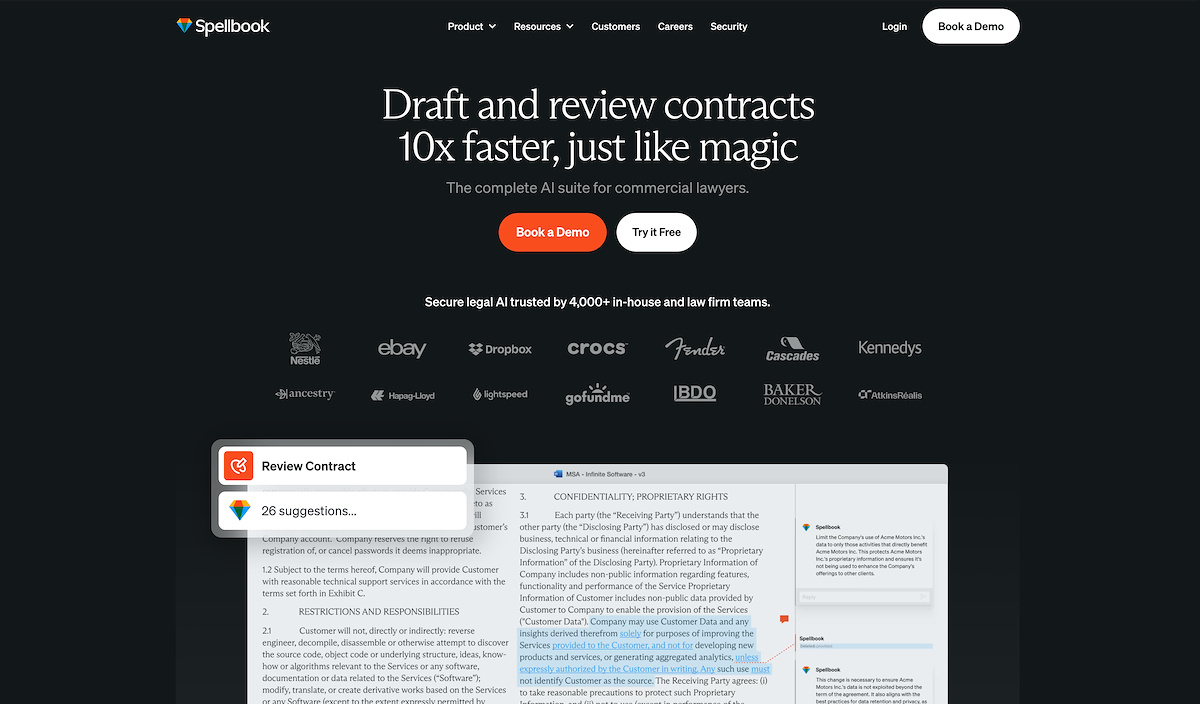
Spellbook is the most complete AI suite built for contracts and commercial law. It integrates directly into Microsoft Word, helping legal teams draft and review agreements 10x faster and with greater precision, all without context switching. This makes it a practical tool for in-house teams and law firms that handle commercial contracting, M&A, and other transactional work.
Unlike platforms that require adopting a new operating system, Spellbook works where lawyers already are. It is also the only contract AI grounded in real-time market data. Its Review feature analyzes agreements against thousands of similar contracts, giving lawyers data-driven answers to "What's market?" in any negotiation.
Spellbook Features
Spellbook's features are designed to fit directly into a lawyer's existing workflow, operating within Microsoft Word to increase both speed and accuracy. This approach contrasts with platforms that require moving work to a separate application.
- Review: Instantly analyzes entire documents to flag risks and suggest redlines. All edits appear as standard track changes under the lawyer's name, maintaining full control and a professional presentation.
- Draft: Generates new language, from individual clauses to entire agreements. It can also access a firm’s past contracts to find and adapt precedent, automatically matching the style and defined terms of the current document, including for complex terms like an indemnification clause.
- Ask: A contract-specific Q&A tool that lets you ask questions about an open document directly in Word. Answers include citations to the relevant contract language for quick verification.
- Compare to Market: Provides data-driven answers to "What's market?" by analyzing contract terms against thousands of similar, anonymized agreements. This feature helps lawyers verify negotiation positions with real-time data, a key differentiator in the Spellbook vs Iqidis comparison.
- Associate: An AI agent that handles multi-document projects from a single instruction. It can perform tasks like cross-referencing files, updating terms across a set of documents, or preparing a full document package from a term sheet.
- Playbooks and Learning: Spellbook also supports custom Playbooks to standardize review processes. Its Library feature indexes a firm's historical contracts for intelligent drafting, while Preference Learning adapts to a user's editing style over time, making suggestions more personalized.
Spellbook Pricing
Spellbook offers custom per-seat pricing based on team size and requirements.
- Subscriptions are provided on an annual, per-user basis.
- All features, training, and ongoing support are included in the standard plan.
Get started today and see how Spellbook works for your team with a free 7-day trial.
Why Commercial Lawyers Love Spellbook
Unlike centralized legal operating systems, Spellbook integrates directly into Microsoft Word. This allows lawyers to use powerful AI tools without leaving their primary drafting environment, avoiding the disruption of switching to a separate application.
While Spellbook is focused on delivering a deep integration within Word and does not currently offer a separate browser extension, this approach ensures a stable and familiar user experience. It gives lawyers full control over their work, backed by data-driven negotiation insights and a strong commitment to security. For teams concerned about data handling, understanding how AI privacy works is crucial, and Spellbook's architecture is built to meet these stringent legal standards.
[cta-1]
Spellbook vs Iqidis: Key Differences
The Spellbook vs Iqidis comparison reveals fundamental differences in workflow, data intelligence, and platform maturity. While both aim to support legal teams, they take distinct paths, making the choice between them critical for your practice.
1. Workflow: Integrated vs. Centralized
Spellbook is the most complete AI suite for contracts, integrating directly into Microsoft Word where lawyers already work. This approach eliminates context switching, helping legal teams draft and review contracts 10x faster with greater precision.
Iqidis (Irys), on the other hand, is a separate, centralized "legal operating system." It requires teams to adopt a new web application to manage work in matter-specific folders. A Word add-in for Iqidis is on its product roadmap but is not yet available.
2. Data Intelligence: Market Benchmarks vs. Internal Organization
A key differentiator in the Spellbook vs Iqidis debate is data. Spellbook is the only contract AI grounded in real-time market data. Its Review feature analyzes agreements against thousands of similar contracts, giving lawyers data-driven answers to "What's market?" during negotiations.
Iqidis focuses on organizing a firm’s internal documents within its platform, with precedent discovery planned for the future.
3. Security and Maturity
Trusted by over 4,000 legal teams, Spellbook provides clear, enterprise-grade security, including SOC 2 Type II certification. This is vital for teams that require platforms to be HIPAA compliant.
In contrast, specific security certifications for Iqidis were not highlighted in product materials, an important consideration for legal teams handling sensitive data.
Which Option Is Right For Your Business?
For the Fast-Paced In-House Team
Spellbook is the clear choice. Its direct integration into Microsoft Word means no workflow disruption. Your team can increase its contract review speed and accuracy immediately, without needing to learn a new platform.
For the Large Firm Seeking a Centralized Hub
Iqidis (Irys) may be a better fit if your primary goal is to centralize all legal work into a single, separate operating system. Its structure is built for managing multiple matters and team collaboration in one web-based location.
For the Transactional Lawyer Needing a Data Edge
Spellbook is the superior option. It operates within your existing drafting environment and provides market data to support your negotiation positions. Its strong security posture is also critical for handling sensitive client information, especially given the questions around how lawyers can use AI.
The Bottom Line
The final decision in the Spellbook vs Iqidis debate comes down to workflow. If your team works primarily in Microsoft Word and values speed, precision, and data-driven insights, Spellbook is the smarter choice. If you are looking to adopt a new, centralized project management tool, Iqidis presents an alternative.
Try Spellbook Free
While other tools require adopting a new system, Spellbook integrates directly into Microsoft Word to increase your team's speed and precision. Experience the advantage of data-driven contract review and start a free trial to see the difference for yourself.
Frequently Asked Questions
What AI models power Spellbook and Iqidis?
Spellbook uses a combination of leading large language models, including models from OpenAI and Anthropic, to deliver high-quality results for each legal task. This multi-model approach ensures flexibility and precision.
The specific models behind Iqidis (Irys) are not detailed in its public materials, but it also relies on large language model technology. For any legal AI tool, understanding how AI handles data privacy is a critical consideration for law firms and in-house teams.
How much training is required to use Spellbook compared to Iqidis?
Spellbook is designed for rapid adoption because it operates directly within Microsoft Word. Most lawyers find the tool intuitive and can begin using it effectively with minimal training, as it complements their existing workflow.
Iqidis, as a separate legal operating system, generally requires more extensive training. Teams must learn a new platform, its folder structures, and its project management features, which can involve a steeper learning curve.
Which platform is better for multi-document analysis?
Both platforms offer capabilities for working with multiple documents. Iqidis is structured around matter-specific folders, allowing users to ask questions across all documents within a folder in its web application.
Spellbook handles this with its Associate feature, an AI agent that can perform tasks like cross-referencing files or updating terms across a set of documents from a single instruction. This allows lawyers to manage complex projects using effective AI prompts without leaving their familiar work environment.
How does Spellbook's "Compare to Market" feature work and why is it important?
Spellbook's "Compare to Market" feature analyzes language in your contract and compares it against a live, anonymized database of thousands of similar, recently negotiated agreements. This provides real-time benchmarks on specific clauses, such as a limitation of liability clause.
This data-driven insight is a key differentiator in the Spellbook vs Iqidis discussion. It allows lawyers to answer "What's market?" with confidence, strengthening their negotiation position and moving contract review from being purely subjective to being backed by current market standards.
[cta-2]
Our Research Methodology
This comparison is based on comprehensive research of publicly available information, including product websites, feature documentation, press releases, customer reviews, legal technology publications, and third-party analyses from sources like LawSites, Artificial Lawyer, and industry analysts.
Where pricing information is not publicly disclosed, we've included estimates based on available industry data and user reports. Information is current as of 2026 and may change as products evolve. We encourage readers to verify details directly with vendors and request demos to evaluate fit for their specific needs.
Lawyer-built prompts to help you draft, review, and negotiate contracts faster—with any LLM.
Get the latest news, trends, and tactics in legal Al—straight to your inbox.

Thank you for your interest! Our team will reach out to further understand your use case.
Spellbook is the most complete AI suite for commercial legal work, trusted by more than 4,000 in-house teams and law firms worldwide.

SOC 2 Type II

HIPAA

GDPR

EU AI Act

HIPAA Compliant
