
Clio vs Harvey: Which Is the Right Choice in 2026?
.jpeg)


The Clio vs Harvey debate pits a comprehensive practice management suite against a specialized legal analysis platform. Clio aims to be the all-in-one operating system for your firm, while Harvey focuses on deep, collaborative analysis for complex legal work. To help you choose, we will break down their core features, pricing models, and underlying AI architecture.
Key Takeaways
- Clio is a practice management platform designed to help run a law firm’s operations, while Harvey is a legal AI platform built for complex analysis and research.
- Their primary difference is scope. Clio provides a wide range of tools for firm operations, including billing and client intake. Harvey concentrates on collaborative analysis and diligence across large sets of documents.
- For teams focused specifically on contract work, Spellbook offers a more specialized alternative. It is a legal AI suite trusted by over 4,000 in-house and law firm teams to draft and review contracts with greater speed and precision, directly within Microsoft Word.
1. Clio
Clio is a widely used legal practice management platform designed to handle a law firm's operational needs, including matter management, billing, and client intake.
It primarily serves small to mid-sized law firms, though recent acquisitions have added AI-powered legal research and document analysis capabilities.
Unlike Harvey, which is built for complex legal analysis, Clio's scope is much broader. It covers the business of law rather than focusing on specific transactional workflows, making it more of an operational system than a specialized analytical tool.
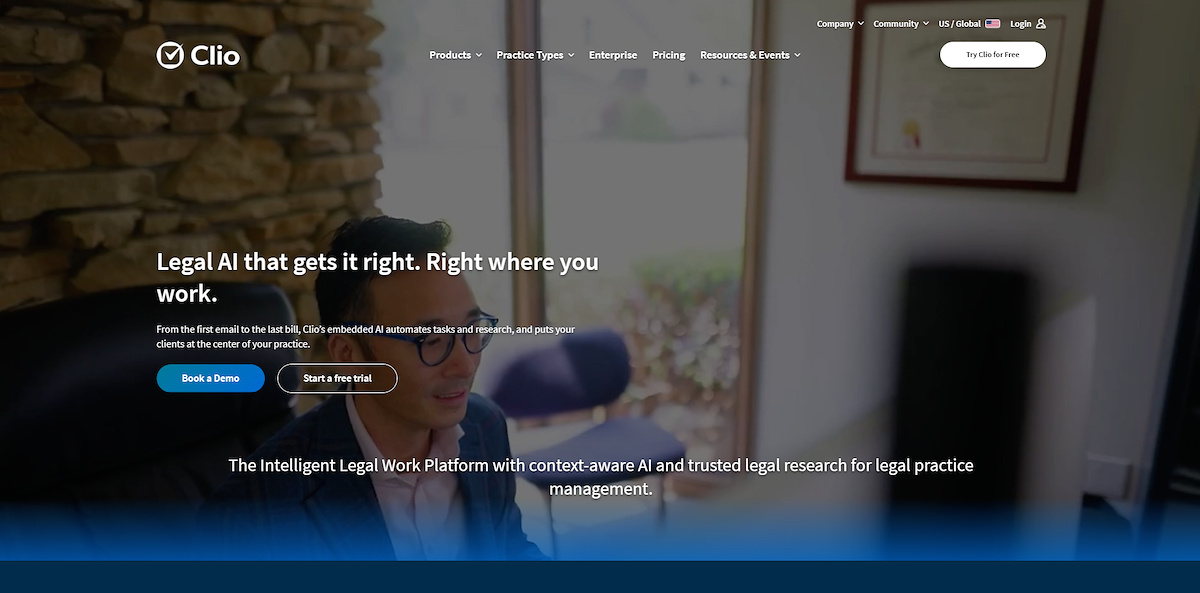
Clio Features
- Clio Manage: Core tools for matter management, time tracking, and billing.
- Clio Grow: A client relationship management (CRM) and intake system.
- Clio Draft: Document automation using templates and matter data.
- Clio Work: Legal research and intelligence, powered by the vLex database.
- Manage AI: An AI assistant for drafting communications, summarizing documents, and checking invoices.
Clio Pricing
- Base plans range from $49 to $149 per user, per month when billed annually.
- AI features, including Manage AI, are priced as separate add-ons.
- The Clio Work module for legal research starts at an additional $399 per user, per month.
- Enterprise-level plans require a custom quote.
Key Considerations about Clio
Clio is built as a broad practice management platform, not a specialized tool for contract work. Its primary strengths are in firm operations like billing and client management.
While it has acquired AI capabilities, its contract review features are not as focused as dedicated tools. The workflow is not optimized for deep, playbook-driven redlining directly within Microsoft Word. Teams evaluating AI for legal work should note this distinction.
Furthermore, many of its key AI and research functions are expensive add-ons, which can significantly increase the total cost. This makes the Clio vs Harvey decision more complex for teams focused on transactional efficiency.
2. Harvey
Harvey is a legal AI platform built for sophisticated analytical work, such as M&A diligence and large-scale document review. It is primarily aimed at enterprise legal teams and large law firms that need to manage complex transactional workflows. While Clio offers a broad set of tools for running a law firm, Harvey is more of a specialized system for legal operations and diligence. This focus may introduce more setup and management overhead for teams that need a straightforward tool for contract drafting and review.
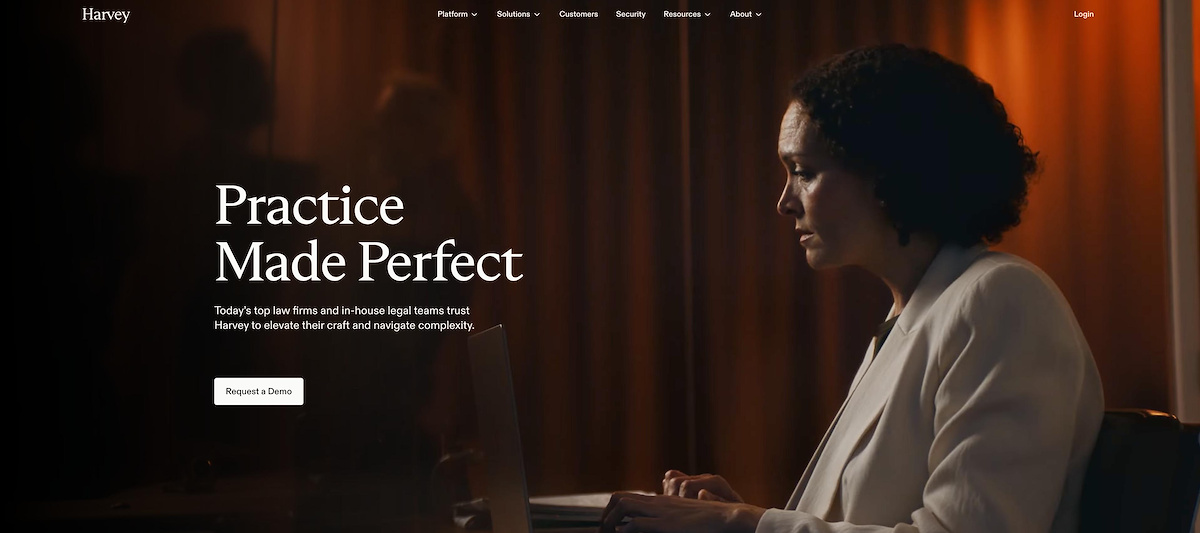
Harvey Features
- Assistant: A prompt-based interface for legal questions and analysis.
- Vault: A repository for analyzing up to 100,000 documents at once.
- Workflows: Configurable, multi-step processes for standardized tasks.
- Collaboration: Shared workspaces with permission controls for team-based review.
- Word Add-in: Supports in-document editing and drafting.
Harvey Pricing
- Pricing is negotiated on an enterprise subscription basis.
- Indicative pricing starts around $300-$333 per user, per month.
- A 10-user team costs approximately $40,000 annually.
- A two-week pilot is part of the standard evaluation process.
Key Considerations about Harvey
Harvey is designed as a system for legal operations, not just a drafting assistant. Its focus on collaboration, governance, and large-scale analysis introduces setup and management overhead that may be unnecessary for teams needing a straightforward tool.
The platform is less specialized for rapid, Word-native redlining. For teams evaluating the Clio vs Harvey matchup based on contract drafting efficiency, Harvey’s architecture is not optimized for individual contract execution speed. Its flexibility requires more configuration compared to tools with more direct AI prompts for lawyers built for specific drafting tasks.
3. Spellbook, The Smarter Alternative
For teams focused on transactional work, Spellbook offers a smarter alternative. It is the most complete AI suite for contracts, integrating directly into Microsoft Word to help legal teams draft and review agreements 10x faster and with greater precision, eliminating context switching.
Spellbook is also the only contract AI grounded in real-time market data. Its Review feature analyzes agreements against live benchmarks, giving lawyers data-driven answers to "What's market?" in negotiations. Over 4,000 legal teams, including those at Dropbox, Fender, and Crocs, trust Spellbook to streamline contract workflows and eliminate legal busywork.
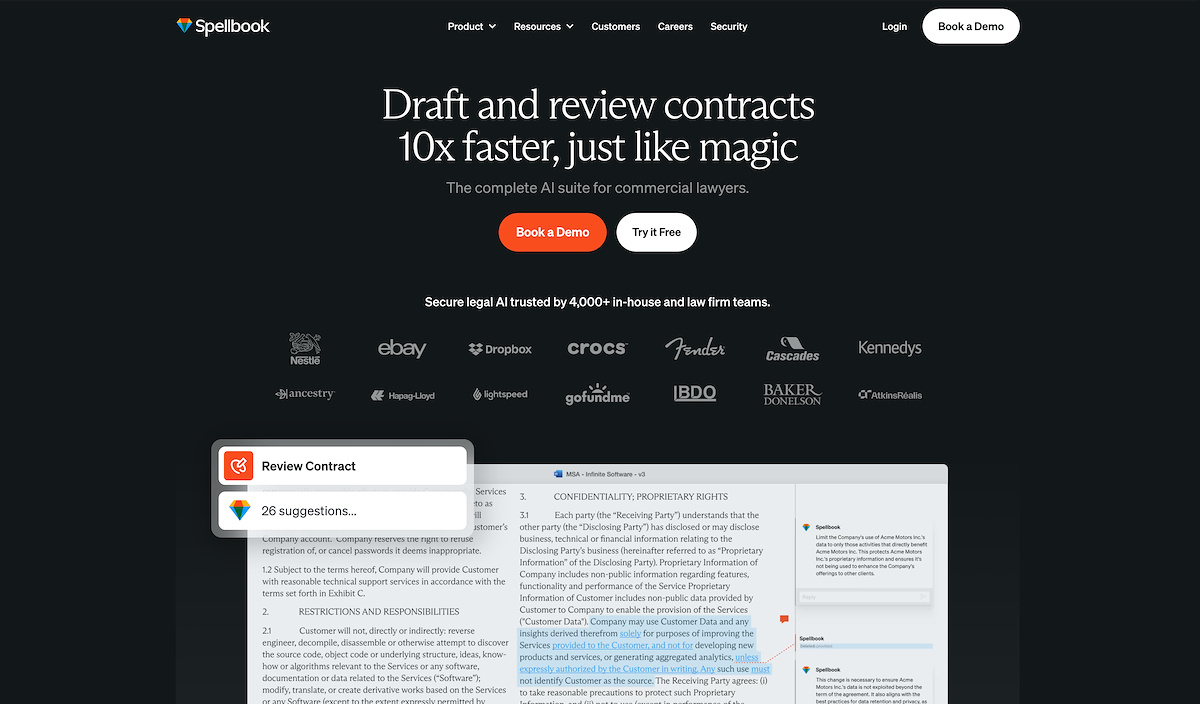
Spellbook Features
- Review: Instantly analyzes an entire document, providing AI-generated redlines that appear as standard track changes in Microsoft Word. This allows lawyers to accept, reject, or modify suggestions without leaving their document, maintaining a natural workflow.
- Draft: Generates new clauses or entire agreements from simple instructions. It can pull from a built-in library of standard provisions or from a firm’s own historical contracts, helping draft difficult clauses like indemnification with language that matches the context of the agreement.
- Ask: A contract-specific Q&A tool that functions directly within Word. Lawyers can ask questions about the document, and the AI provides answers with citations to the relevant contract language for quick verification.
- Compare to Market: Benchmarks contract terms against real-time data from thousands of similar agreements. This feature gives lawyers data-driven answers to "What's market?" during negotiations, with breakdowns by industry and jurisdiction.
- Associate: An AI agent that executes multi-document, multi-step projects from a single prompt. It can cross-reference documents, update terms across multiple files, and prepare entire document packages, handling complex tasks that go beyond simple drafting.
Spellbook Pricing
Spellbook offers custom per-seat pricing based on your team’s size and needs. All plans are provided on an annual basis and include all core features, onboarding, and support.
- Pricing is determined through a custom quote.
- Volume discounts are available for larger teams.
You can test all features and workflows with a free 7-day trial.
Why Commercial Lawyers Love Spellbook
Unlike broad practice management systems or complex analytical platforms, Spellbook is built specifically for the contract workflow. It operates directly within Microsoft Word, eliminating the need to switch between applications.
While its functionality is centered in Word, this design keeps lawyers in their primary drafting environment, improving focus and efficiency.
This approach allows commercial teams to gain immediate value on transactional tasks with greater speed and precision, avoiding the setup overhead of more generalized systems.
[cta-1]
Harvey vs Clio vs Spellbook: Key Differences
The Clio vs Harvey discussion highlights a fundamental difference in scope. Clio is a broad practice management platform for running a law firm, while Harvey is an enterprise system for complex legal analysis. Spellbook offers a third, more focused path for teams centered on transactional work.
1. Scope and Primary Use Case
- Clio: An operational toolkit for your firm. Its strengths are in matter management, billing, and client intake. Its AI for legal work functions as an add-on to this core, not the central focus.
- Harvey: A powerful analytical engine for large-scale projects like M&A diligence. It excels at reviewing massive document sets collaboratively but involves more setup and management.
- Spellbook: The most complete AI suite for contracts. It integrates directly into Microsoft Word, where lawyers already work, helping teams draft and review agreements with greater speed and precision.
2. Workflow and Integration
While Clio and Harvey require users to work within their platforms, Spellbook operates entirely inside Word, eliminating context switching. This design is purpose-built for the contract execution workflow, a key consideration when evaluating Clio vs Harvey for transactional efficiency.
3. Key Differentiator: Data
Spellbook is the only contract AI grounded in real-time market data. Its Review feature analyzes agreements against live benchmarks from thousands of similar deals, giving lawyers data-driven answers to "What's market?" during negotiations. Neither Clio nor Harvey offers this type of real-time, statistical benchmarking for contract terms, making Spellbook a distinct choice for data-driven legal teams.
Which Option Is Right For Your Business?
For Firms Prioritizing Operations
If your main goal is to manage your firm’s business functions, Clio is the logical choice. It is built to be an operational hub for small to mid-sized firms.
Choose Clio if you need a single system for client intake, billing, and general matter management. Its strength is in centralizing the business of law.
For Teams Focused on Contract Work
For legal teams whose work revolves around drafting, reviewing, and negotiating agreements, Spellbook is the most direct fit. It is designed specifically for transactional workflows.
Choose Spellbook for its tight integration with Microsoft Word and its specialization. This focus allows teams to improve contract speed and precision without the overhead of a broader platform.
For Enterprise Teams on Large-Scale Projects
If your work involves complex diligence for M&A or analyzing thousands of documents for litigation, Harvey is the appropriate tool. It is an analytical platform built for scale.
Choose Harvey for its capacity to handle massive document sets and its features for team collaboration on complex legal analysis.
The Bottom Line
Your choice in the Clio vs Harvey debate depends entirely on your primary need. Clio runs your firm, Harvey analyzes huge projects, and Spellbook perfects your contracts.
For the many legal teams focused on improving their day-to-day transactional efficiency, Spellbook offers the most targeted and immediate value.
Try Spellbook Free
While other tools focus on firm operations or large-scale analysis, Spellbook is designed specifically for the contract workflow, operating directly in Microsoft Word for greater speed and precision. You can test its full capabilities on your own agreements by starting a free 7-day trial today.
Frequently Asked Questions
What kind of AI models do Clio and Harvey use?
Harvey was an early partner with OpenAI and is built on their large language models (LLMs), giving it strong analytical capabilities for unstructured text.
Clio’s AI features are more recent, stemming from acquisitions and integrations. Its AI is presented as a feature set for specific tasks, which is a key point for teams considering if it is legal to use ChatGPT or similar AI in their practice.
How much training and setup is required?
Clio is generally designed for quicker adoption, especially for its core practice management features. Its interface is built for day-to-day operational tasks.
Harvey, as an enterprise system for complex analysis, typically requires a more involved implementation. This often includes a pilot period and configuring workflows, which means more initial setup and team training.
How do Clio and Harvey handle data security and privacy?
Both platforms treat security as a priority, but their approach reflects their primary function. Clio secures a wide range of firm and client data as part of its practice management system.
Harvey focuses on securing large volumes of sensitive documents for diligence and analysis, often with enterprise-grade controls. Legal teams should always review the specific security protocols of any AI tool, as understanding if ChatGPT is private provides important context on how different services handle data.
How does Spellbook compare for contract-focused teams?
Spellbook is built specifically for transactional work, unlike Clio's broad operational focus or Harvey's complex analytical design. It operates directly within Microsoft Word, which allows lawyers to work in their familiar drafting environment, improving both speed and precision.
While Clio manages the business of law and Harvey analyzes large projects, Spellbook is focused on improving the contracting process itself. It also offers unique features like real-time market data for negotiations, which neither Clio nor Harvey provides for contract terms.
[cta-2]
Our Research Methodology
This comparison is based on comprehensive research of publicly available information, including product websites, feature documentation, press releases, customer reviews, legal technology publications, and third-party analyses from sources like LawSites, Artificial Lawyer, and industry analysts.
Where pricing information is not publicly disclosed, we've included estimates based on available industry data and user reports. Information is current as of 2026 and may change as products evolve. We encourage readers to verify details directly with vendors and request demos to evaluate fit for their specific needs.
.png)
%20(1).png)


Thank you for your interest! Our team will reach out to further understand your use case.
Spellbook is the most complete AI suite for commercial legal work, trusted by more than 4,400 in-house teams and law firms worldwide.

SOC 2 Type II

HIPAA

GDPR

EU AI Act

HIPAA Compliant
