
The 5 Best Gavel Alternatives in 2026
.jpeg)


If you're searching for Gavel alternatives, you're likely familiar with its strengths in document automation but may need a tool better suited for complex contract negotiations. This guide provides a practical breakdown of the top options, comparing their product features, pricing, and AI architecture to help you make an informed decision.
Key Takeaways
- While Gavel excels at document automation, it often falls short for legal teams who need more advanced tools for complex contract review and negotiation.
- This guide analyzes top Gavel alternatives—including CoCounsel, LexisNexis, Ivo, Callidus, and Spellbook—by comparing their product features, pricing, and AI architecture.
- Spellbook stands out as the leading alternative, trusted by over 4,000 in-house and law firm teams to draft, review, and negotiate contracts faster using AI grounded in real-time market data.
[cta-1]
1. Spellbook: Top Gavel Alternative
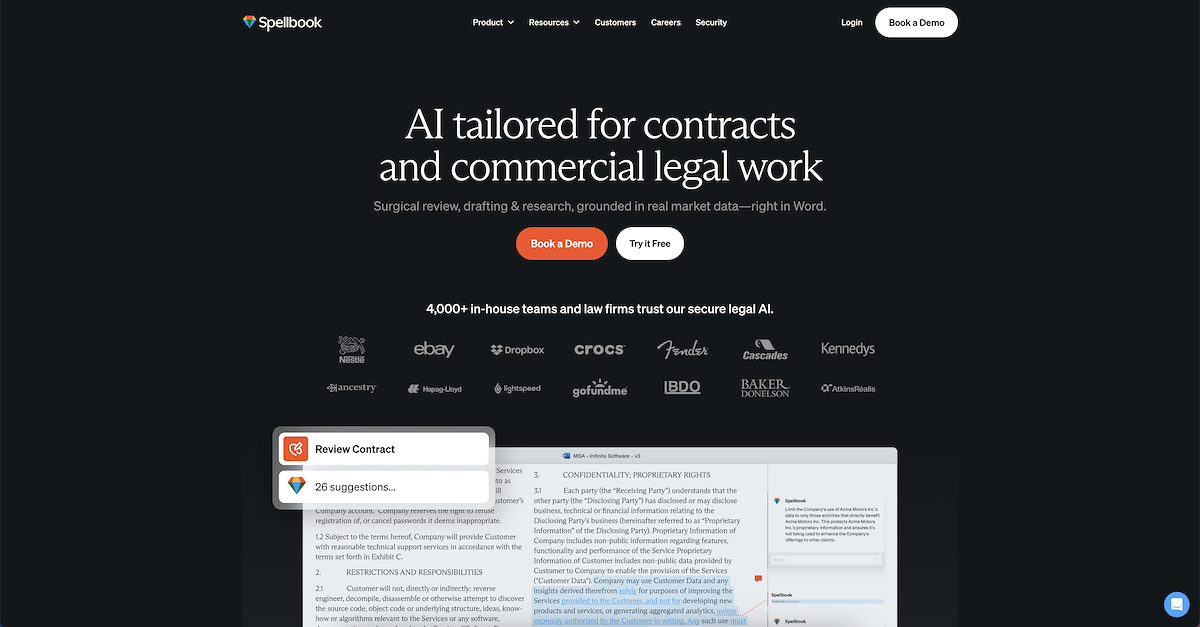
Trusted by over 4,000 legal teams, Spellbook helps lawyers draft and review contracts 10x faster directly within Microsoft Word. It is built specfically for commercial lawyers handling high-volume transactional work, from sales agreements to M&A.
Unlike document automation tools, Spellbook is a complete AI suite tailored for contracts and commercial law. It is also the only contract review tool grounded in real-time market data, giving lawyers data-driven answers to the "What's market?" question in any negotiation.
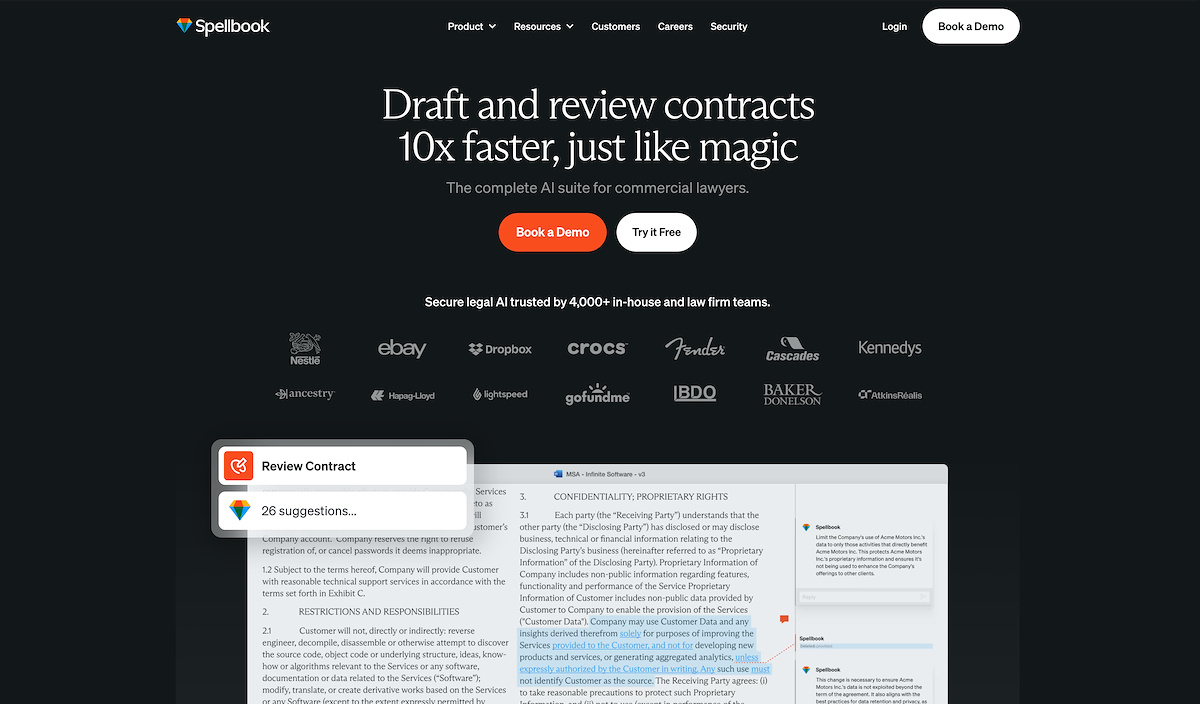
Spellbook Features
While Gavel is built for document automation using templates and questionnaires, Spellbook is designed for the dynamic work of reviewing and negotiating contracts. This makes it one of the strongest Gavel alternatives for legal teams that handle a high volume of third-party paper.
Here are some of the core features that set Spellbook apart:
- Review: Instantly analyzes entire agreements to detect risks, flag unusual terms, and suggest missing clauses. All edits are delivered as standard Microsoft Word track changes, keeping the lawyer in full control.
- Draft: Generates new clauses or entire agreements from a simple instruction. The AI can also draw from a firm’s own precedent library, automatically adapting language to match the style and defined terms of the current document.
- Ask: Functions like a contract-specific search engine directly within Word. Lawyers can ask questions about obligations, dates, or specific terms and get instant answers with citations to the relevant contract language.
- Compare to Market: Provides data-driven answers to "What's market?" for any negotiation. This feature allows users to benchmark clauses against thousands of similar, anonymized agreements, filtered by jurisdiction and deal type. This is a key differentiator for teams looking for an alternative to Gavel that supports evidence-based negotiation.
- Associate: An AI agent that can manage multi-document, multi-step projects from a single prompt. It can handle tasks like conducting due diligence across a data room or preparing a full document package from a term sheet, functioning much like a junior associate.
- Playbooks and Personalization: Spellbook learns from a user's edits over time to adapt its suggestions to their specific style and risk tolerance. Teams can also create playbooks to ensure consistent review standards are applied to every contract.
- Security and Compliance: The platform is SOC 2 Type II certified and supports teams working with sensitive data, offering features like zero data retention and HIPAA compliance.
Spellbook's AI Models & Architecture
Spellbook uses a multi-model approach, selecting from top OpenAI and Anthropic models for optimal performance depending on the task.
It uses retrieval-augmented generation (RAG) to ground outputs in your team's precedents, definitions, and playbooks and enriches them with real-time market data.
This "Market Grounding" approach ensures suggestions are relevant and defensible.
The system also improves over time through Preference Learning, adapting to your team's specific contract review style and making it a strong Gavel alternative.
Spellbook's Security and Compliance
Spellbook is built with enterprise security needs in mind, making it a reliable choice for teams handling sensitive information. The platform's security framework includes several key protections:
- Certifications: SOC 2 Type II certified and compliant with GDPR, CCPA, and PIPEDA.
- Data Handling: Operates with a zero data retention policy, meaning customer documents are never stored or used for model training. It also supports HIPAA compliance.
- Encryption: All data is encrypted both in transit and at rest.
- Enterprise Controls: Offers features like SSO, role-based access controls, and audit logs for administrative oversight.
[cta-1]
Spellbook Pricing
Spellbook offers custom per-seat pricing based on team size and feature requirements, with quotes provided through a demo process.
- Subscriptions are on an annual, per-user basis, with volume discounts available for larger teams.
- All core features, onboarding, training, and ongoing support are included in the standard plan.
You can test the full platform to see if it’s the right alternative to Gavel for your team. Start your 7-day free trial.
Other Alternatives to Gavel
If your team's needs extend beyond Gavel's core functions, it is worth examining other tools in the market. Here is a breakdown of several other companies like Gavel, each with a different focus.
2. CoCounsel
CoCounsel by Thomson Reuters is an AI legal platform that combines contract review tools with its proprietary legal research databases. It's designed for teams who need both drafting assistance and citation-backed answers from Westlaw. Unlike Gavel's focus on document automation, CoCounsel is a broader, more complex ecosystem, often requiring integration with other Thomson Reuters products for full functionality.
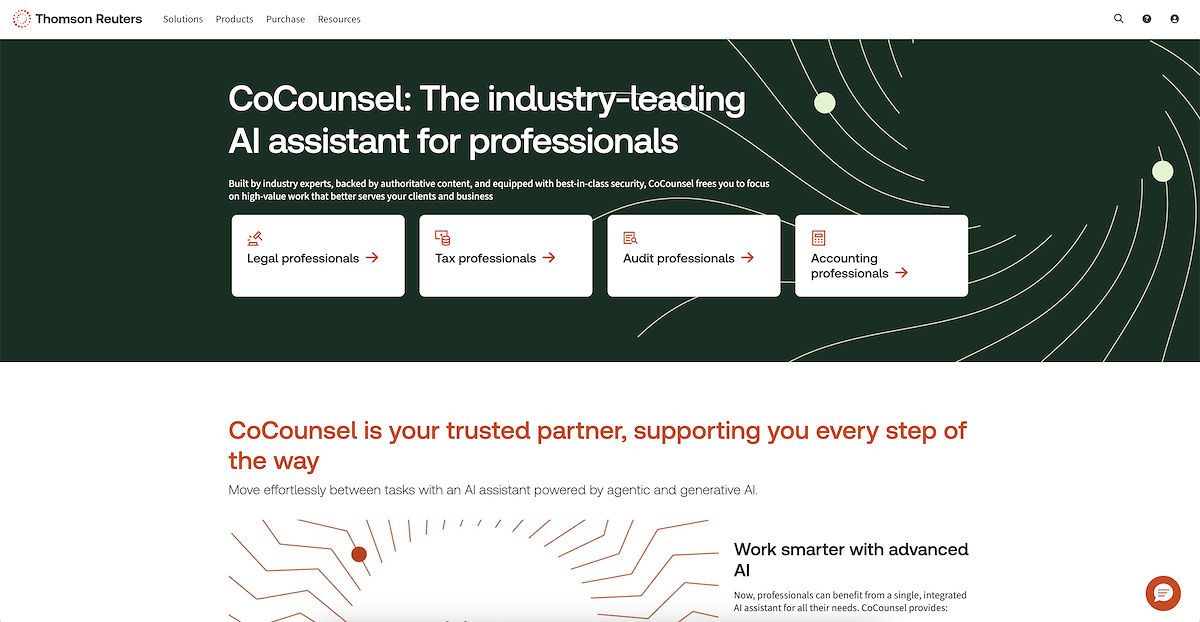
CoCounsel Features
- AI-assisted drafting, summarization, and redlining tools.
- Playbook creation and enforcement for standardized contract review.
- A standalone portal for analyzing large sets of documents.
- Centralized document storage with team sharing permissions.
- Optional integration with Westlaw and Practical Law for legal research.
CoCounsel Pricing
- Pricing is structured as a per-user, annual subscription.
- Tiers are based on user count and whether Westlaw and Practical Law integration is included.
- A 30-day trial is available for evaluation.
3. LexisNexis
LexisNexis embeds its AI assistant within its broader legal research ecosystem, offering drafting and summarization grounded in its proprietary content. It is best for teams that need citation-backed answers from Lexis’s databases. Unlike Gavel’s focus on document automation, LexisNexis is a closed environment, and its contract redlining features rely on a separate Word plug-in, making it less integrated for pure contract negotiation workflows.
LexisNexis Features
- Legal Q&A grounded in proprietary content with citations.
- AI-powered drafting, summarization, and document analysis.
- Comparison of up to three documents at once.
- M&A benchmarking against SEC filings and Practical Guidance.
- A separate Word plug-in for clause-level redlining.
LexisNexis Pricing
- Pricing is seat-based, with costs decreasing as user count increases.
- Promotional pricing is available for multi-year contracts.
- The Create+ Word plug-in for redlining is priced as an add-on.
- Training and support are included with the subscription.
4. Ivo
Ivo is a contract review tool for transactional teams that want to consistently apply their negotiation standards. It operates within Microsoft Word, using structured playbooks to redline agreements. While Gavel focuses on document generation, Ivo is built for enforcing existing company policies, which can be restrictive for teams needing more dynamic AI assistance.
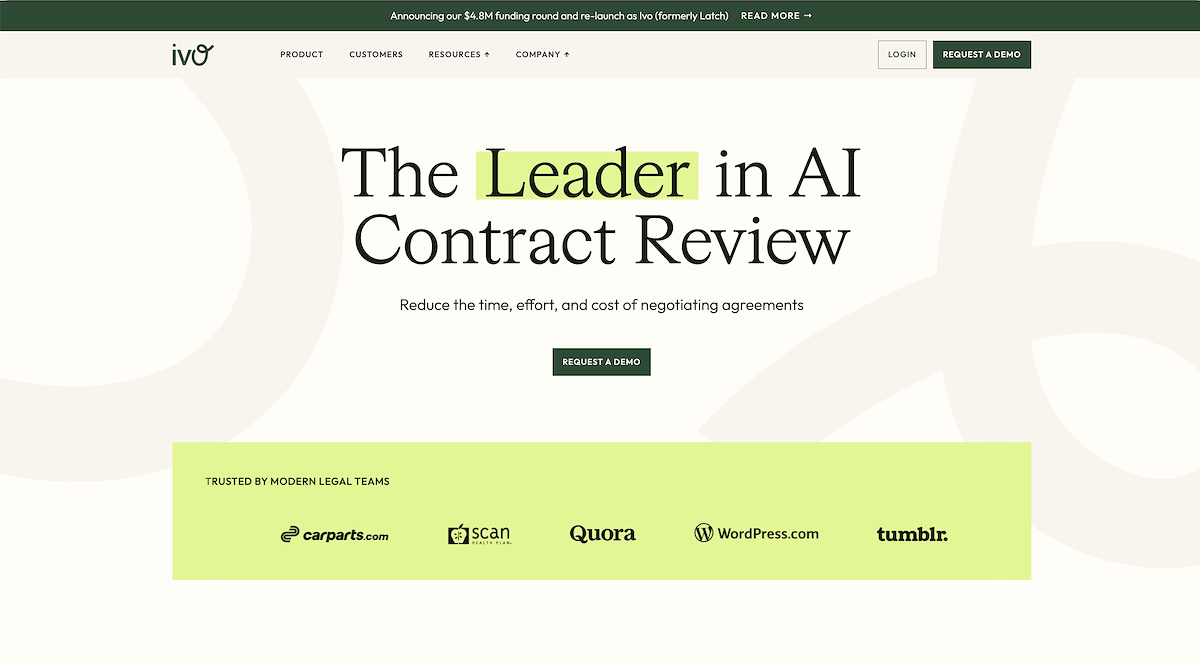
Ivo Features
- Playbook-Driven Review: Analyzes contracts against custom playbooks to enforce negotiation standards.
- Microsoft Word Integration: Operates as an add-in for clause-by-clause review, redlining, and commenting.
- Structured Outputs: Generates issue lists and summary reports to communicate findings.
Ivo Pricing
- Ivo is priced at $6,000 per user, per year.
- The subscription includes playbook creation, onboarding, and ongoing support.
- Discounts are offered for teams with 10 or more seats.
5. Callidus
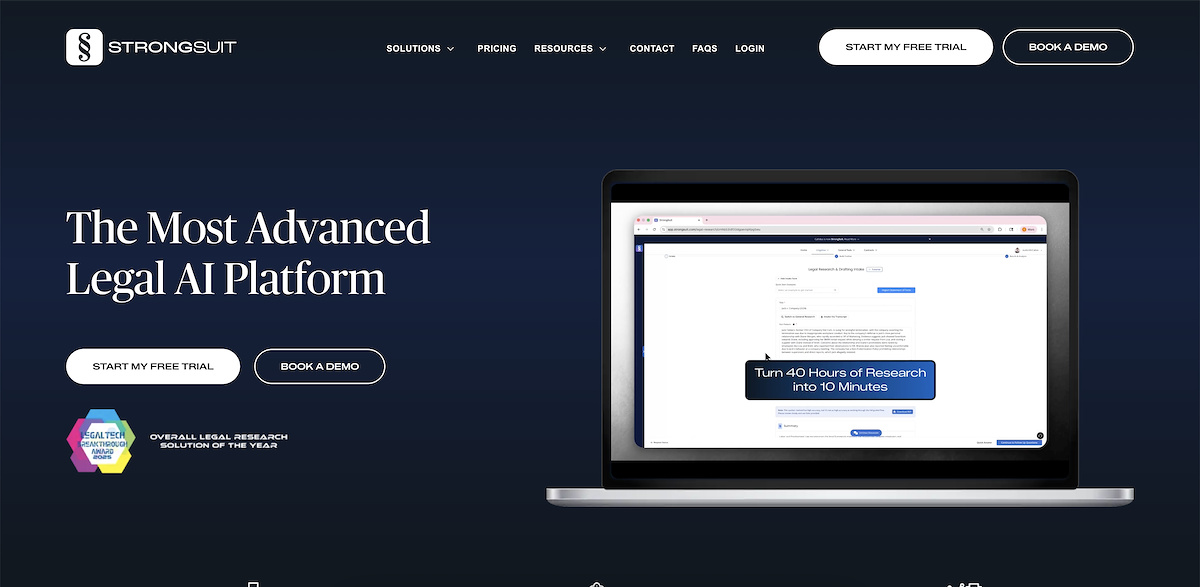
Callidus (StrongSuit) is a legal AI co-pilot that operates within Microsoft Word to assist with contract review and drafting. As an alternative to Gavel, it shifts the focus from structured document automation to more general redlining and analysis tools. While it offers broad functionality, its playbook capabilities are less developed than other platforms, and it has yet to establish strong brand recognition in the legal AI space.
Callidus Features
- Analyzes and redlines contracts against user-defined playbooks.
- Drafts new clauses directly within Microsoft Word.
- Provides a chat assistant for legal Q&A and summarization.
- Includes a proofreading tool for grammar and style.
- Compares third-party documents against internal templates.
- Explains complex legal terms in plain English.
Callidus Pricing
Callidus offers a flat-rate pricing model with no hidden fees.
- $3,000 per user, per year.
- Unlimited usage, onboarding, and support are included.
- Discounts are available for larger teams and multi-year deals.
How To Choose The Best Gavel Alternative
Choosing the right tool requires looking beyond document automation to a platform that supports the dynamic nature of contract work. When evaluating Gavel alternatives, consider these factors to ensure the software aligns with your team's core needs.
1. Focus on Contract Review and Negotiation
While document automation is useful, most legal work involves reviewing and negotiating third-party paper. A tool designed specifically for this purpose will have a greater impact on your team's efficiency and precision than one built for generating documents from templates.
2. Integration with Existing Workflows
The best legal tech fits into how you already work, not the other way around. Look for a tool that integrates directly into Microsoft Word to avoid the friction of switching between applications and disrupting your flow during drafting or review.
3. Access to Data-Driven Insights
Modern contract negotiation relies on data to make defensible arguments. A platform that provides real-time market data for key clauses, such as limitation of liability, gives you a significant advantage and helps you answer "What's market?" with confidence.
Try Spellbook Free
Spellbook stands out by focusing on the dynamic work of contract review and negotiation, rather than just document automation.
It provides data-driven market insights directly within Word to strengthen your position in any negotiation.
See if it's the right fit for your team by starting a free 7-day trial today.
Frequently Asked Questions
Do these Gavel alternatives integrate with platforms other than Microsoft Word?
Most tools designed for contract review and negotiation, like Spellbook, prioritize a deep integration with Microsoft Word because it remains the standard for legal drafting. While some platforms may offer web-based portals, the core redlining and analysis features are typically delivered through a Word add-in to fit into existing workflows.
This focus ensures that lawyers can work within a familiar environment without needing to upload, download, or switch between different applications. For teams that primarily use other platforms like Google Docs, it's important to verify the extent of integration, as functionality may be limited compared to the Word experience.
What are the risks of using AI for contract review, and how do these tools mitigate them?
A primary concern for lawyers is the risk of AI "hallucinations," where the model generates inaccurate or fabricated information. This has led to serious consequences, such as lawyers being fined for submitting briefs with fake citations.
Reputable legal AI tools address this risk through retrieval-augmented generation (RAG). This technology grounds the AI's outputs in specific, reliable data sources—such as your firm's precedents, playbooks, or a curated database of market examples. This ensures suggestions are contextually relevant and factually based, keeping the lawyer in control.
How does Spellbook's approach to drafting compare to Gavel's document automation?
Gavel excels at document automation, which involves generating documents from pre-approved templates and questionnaires. This is effective for creating standardized, high-volume documents where the variables are known in advance.
Spellbook, in contrast, is designed for dynamic drafting and negotiation. Instead of relying on rigid templates, it generates new language from simple instructions, adapts clauses from your precedent library to fit the current agreement, and can even draft entire contracts from a term sheet. This makes it a more flexible tool for handling unique situations and third-party paper, where a templated approach is not practical.
[cta-2]
Our Research Methodology
This comparison is based on comprehensive research of publicly available information, including product websites, feature documentation, press releases, customer reviews, legal technology publications, and third-party analyses from sources like LawSites, Artificial Lawyer, and industry analysts.
Where pricing information is not publicly disclosed, we've included estimates based on available industry data and user reports. Information is current as of 2026 and may change as products evolve. We encourage readers to verify details directly with vendors and request demos to evaluate fit for their specific needs.
Lawyer-built prompts to help you draft, review, and negotiate contracts faster—with any LLM.
Get the latest news, trends, and tactics in legal Al—straight to your inbox.


Thank you for your interest! Our team will reach out to further understand your use case.
Spellbook is the most complete AI suite for commercial legal work, trusted by more than 4,000 in-house teams and law firms worldwide.

SOC 2 Type II

HIPAA

GDPR

EU AI Act

HIPAA Compliant
